Matthew 11:20–30
The NET BibleOther versions
English
- NET The NET Bible
- DARBY 1890 Darby Bible
- ASV American Standard Version
- AV 1873 The Cambridge Paragraph Bible of the Authorized English Version
- CSB Christian Standard Bible
- D-R Douay-Rheims Bible
- ESV English Standard Version
- GW GOD’S WORD Translation
- GNB Good News Translation
- HCSB The Holman Christian Standard Bible
- KJV 1900 King James Version
- LSB Legacy Standard Bible
- LEB The Lexham English Bible
- MSG The Message: The Bible in Contemporary Language
- NASB95 New American Standard Bible (1995)
- NCV New Century Version
- NIrV New International Reader’s Version (1998)
- NIV New International Version (2011)
- NKJV The New King James Version
- NLT New Living Translation
- NRSVue New Revised Standard Version: Updated Edition
- RSV The Revised Standard Version
- RSVCE The Revised Standard Version, Catholic Edition
- YLT Young’s Literal Translation
Arabic
Czech
French
German
Greek
Hungarian
Italian
Korean
Latin
Portuguese
Russian
Simplified Chinese
Spanish
Traditional Chinese
Woes on Unrepentant Cities
11:20Then Jesus began to criticize openly the cities34 in which he had done many of his miracles, because they did not repent. 11:21“Woe to you, Chorazin!35 Woe to you, Bethsaida! If36 the miracles37 done in you had been done in Tyre38 and Sidon,39 they would have repented long ago in sackcloth and ashes. 11:22But I tell you, it will be more bearable for Tyre and Sidon on the day of judgment than for you! 11:23And you, Capernaum,40 will you be exalted to heaven?41 No, you will be thrown down to Hades!42 For if the miracles done among you had been done in Sodom, it would have continued to this day. 11:24But I tell you, it will be more bearable for the region of Sodom43 on the day of judgment than for you!”
Jesus’ Invitation
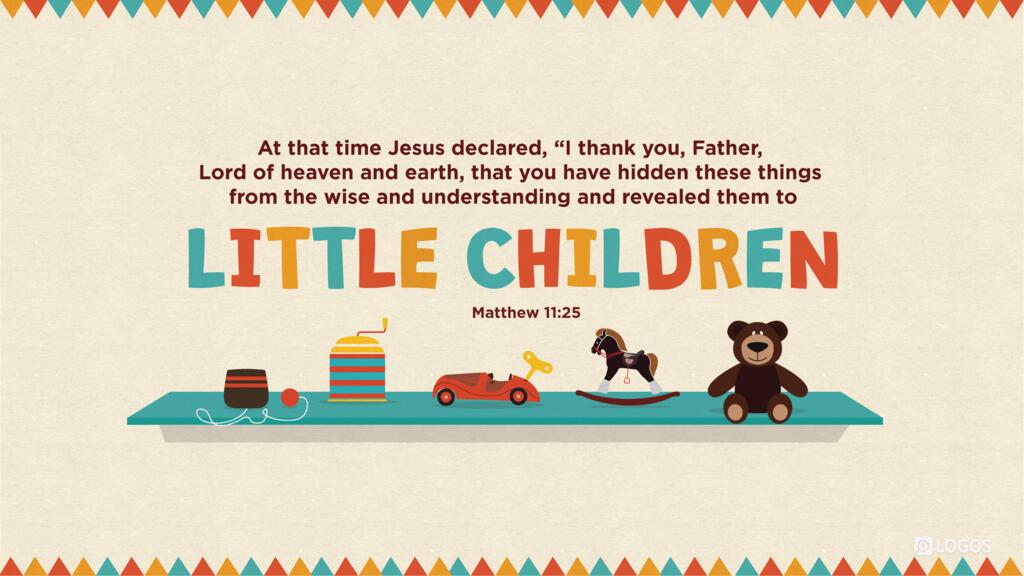
11:25At that time Jesus said,44 “I praise45 you, Father, Lord46 of heaven and earth, because47 you have hidden these things from the wise48 and intelligent, and revealed them to little children. 11:26Yes, Father, for this was your gracious will.4911:27All things have been handed over to me by my Father.50 No one knows the Son except the Father, and no one knows the Father except the Son and anyone to whom the Son decides51 to reveal him. 11:28Come to me, all you who are weary and burdened, and I will give you rest. 11:29Take my yoke52 on you and learn from me, because I am gentle and humble in heart, and you will find rest for your souls. 11:30For my yoke is easy to bear, and my load is not hard to carry.”
Footnotes
- 34 The Greek word here is πόλις (polis) which can be translated “city” or “town.” “Cities” was chosen here to emphasize the size of the places Jesus’ mentions in the following verses.
- 35 Chorazin was a town of Galilee that was probably fairly small in contrast to Bethsaida and is otherwise unattested. Bethsaida was declared a polis by the tetrarch Herod Philip, sometime after a.d. 30.
- 36 This introduces a second class (contrary to fact) condition in the Greek text.
- 37 Or “powerful deeds.”
- 38 For location see ; ; ; ; .
- 39 Tyre and Sidon are two other notorious OT cities (Isa 23; Jer 25:22; 47:4). The remark is a severe rebuke, in effect: “Even the sinners of the old era would have responded to the proclamation of the kingdom, unlike you!” For location see ; ; .
- 40 Capernaum was a town on the northwest shore of the Sea of Galilee, 680 ft (204 m) below sea level. It was a major trade and economic center in the North Galilean region. For location see ; ; .
- 41 The interrogative particle introducing this question expects a negative reply.
- 42 In the OT, Hades was known as Sheol. It is the place where the unrighteous will reside (Luke 10:15; 16:23; Rev 20:13–14).
- 43 The allusion to Sodom, the most wicked of OT cities from Gen 19:1–29, shows that to reject the current message is even more serious, and will result in more severe punishment, than the worst sins of the old era. The phrase region of Sodom is in emphatic position in the Greek text.
- 44 Grk “At that time, answering, Jesus said.” This construction is somewhat redundant in English and has been simplified in the translation.
- 45 Or “thank.”
- 46 The title Lord is an important name for God, showing his sovereignty, but it is interesting that it comes next to a reference to the Father, a term indicative of God’s care. The two concepts are often related in the NT; see Eph 1:3–6.
- 47 Or “that.”
- 49 Grk “for (to do) thus was well-pleasing before you,” ἔμπροσθεν 1.b.δ; speaking of something taking place “before” God is a reverential way of avoiding direct connection of the action to him.
- 50 This verse has been noted for its conceptual similarity to teaching in John’s Gospel (10:15; 17:2). The authority of the Son and the Father are totally intertwined.
- 51 Or “wishes”; or “intends”; or “plans” (cf. βούλομαι 2.b). Here it is the Son who has sovereignty.
- 52 A yoke is a wooden bar or frame that joins two animals like oxen or horses so that they can pull a wagon, plow, etc. together. Here it is used figuratively of the restrictions that a teacher or rabbi would place on his followers.
Cross references
- 48 See 1 Cor 1:26–31.
The NET Bible First Edition, Copyright 1996-2005 by Biblical Studies Press