Mark 10:17–22
The NET BibleOther versions
English
- NET The NET Bible
- DARBY 1890 Darby Bible
- ASV American Standard Version
- AV 1873 The Cambridge Paragraph Bible of the Authorized English Version
- CSB Christian Standard Bible
- D-R Douay-Rheims Bible
- ESV English Standard Version
- GW GOD’S WORD Translation
- GNB Good News Translation
- HCSB The Holman Christian Standard Bible
- KJV 1900 King James Version
- LSB Legacy Standard Bible
- LEB The Lexham English Bible
- MSG The Message: The Bible in Contemporary Language
- NASB95 New American Standard Bible (1995)
- NCV New Century Version
- NIrV New International Reader’s Version (1998)
- NIV New International Version (2011)
- NKJV The New King James Version
- NLT New Living Translation
- NRSVue New Revised Standard Version: Updated Edition
- RSV The Revised Standard Version
- RSVCE The Revised Standard Version, Catholic Edition
- TNIV Today’s New International Version
- YLT Young’s Literal Translation
Arabic
Czech
French
German
Greek
Hungarian
Italian
Korean
Latin
Portuguese
Russian
Simplified Chinese
Spanish
Traditional Chinese
The Rich Man
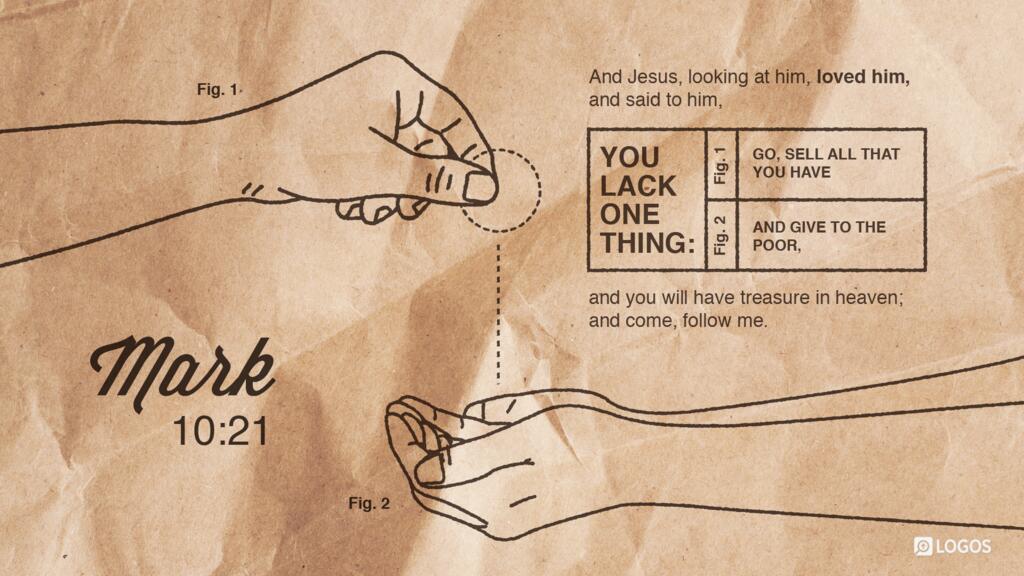
10:17Now26 as Jesus27 was starting out on his way, someone ran up to him, fell on his knees, and said, “Good teacher, what must I do to inherit eternal life?”2810:18Jesus said to him, “Why do you call me good?29 No one is good except God alone. 10:19You know the commandments: ‘Do not murder, do not commit adultery, do not steal, do not give false testimony, do not defraud, honor your father and mother.’ ”3010:20The man31 said to him, “Teacher, I have wholeheartedly obeyed32 all these laws33 since my youth.”3410:21As Jesus looked at him, he felt love for him and said, “You lack one thing. Go, sell whatever you have and give the money35 to the poor, and you will have treasure36 in heaven. Then come, follow me.” 10:22But at this statement, the man37 looked sad and went away sorrowful, for he was very rich.38
Footnotes
- 26 Here καί (kai) has been translated as “now” to indicate the transition to a new topic.
- 27 Grk “he”; the referent (Jesus) has been specified in the translation for clarity. Mark 10:17–31. The following unit, Mark 10:17–31, can be divided up into three related sections: (1) the rich man’s question (vv. 17–22); (2) Jesus’ teaching on riches and the kingdom of God (vv. 23–27); and (3) Peter’s statement and Jesus’ answer (vv. 28–31). They are all tied together around the larger theme of the relationship of wealth to the kingdom Jesus had been preaching. The point is that it is impossible to attain to the kingdom by means of riches. The passage as a whole is found in the section 8:27–10:52 in which Mark has been focusing on Jesus’ suffering and true discipleship. In vv. 28–31 Jesus does not deny great rewards to those who follow him, both in the present age and in the age to come, but it must be thoroughly understood that suffering will be integral to the mission of the disciples and the church, for in the very next section (10:32–34) Jesus reaffirmed the truth about his coming rejection, suffering, death, and resurrection.
- 28 The rich man wanted to know what he must do to inherit eternal life, but Jesus had just finished teaching that eternal life was not earned but simply received (10:15).
- 29 Jesus’ response, Why do you call me good?, was designed to cause the young man to stop and think for a moment about who Jesus really was. The following statement No one is good except God alone seems to point the man in the direction of Jesus’ essential nature and the demands which logically follow on the man for having said it.
- 30 A quotation from Exod 20:12–16; Deut 5:16–20, except for do not defraud, which is an allusion to Deut 24:14.
- 31 Grk “He”; the referent (the man who asked the question in v. 17) has been specified in the translation for clarity.
- 32 Grk “kept.” The implication of this verb is that the man has obeyed the commandments without fail throughout his life, so the adverb “wholeheartedly” has been added to the translation to bring out this nuance.
- 33 Grk “these things.” The referent of the pronoun (the laws mentioned by Jesus) has been specified in the translation for clarity. While the rich man was probably being sincere when he insisted I have wholeheartedly obeyed all these laws, he had confined his righteousness to external obedience. The rich man’s response to Jesus’ command to give away all he had revealed that internally he loved money more than God.
- 34 Since my youth. Judaism regarded the age of thirteen as the age when a man would have become responsible to live by God’s commands.
- 35 The words “the money” are not in the Greek text, but are implied. Direct objects were often omitted in Greek when clear from the context.
- 36 The call for sacrifice comes with a promise of eternal reward: You will have treasure in heaven. Jesus’ call is a test to see how responsive the man is to God’s direction through him. Will he walk the path God’s agent calls him to walk? For a rich person who got it right, see Zacchaeus in Luke 19:1–10.
- 37 Grk “he”; the referent (the man who asked the question in v. 17) has been specified in the translation for clarity.
- 38 Grk “he had many possessions.” This term (κτῆμα, ktēma) is often used for land as a possession.
The NET Bible First Edition, Copyright 1996-2005 by Biblical Studies Press
In other versions
ESVEnglish Standard Version
And as he was setting out on his journey, a man ran up and knelt before him and asked him, “Good Teacher, what must I do to inherit eternal life?” And Jesus said to him, “Why do you call me good? No one is good except God alone. You know the commandments: ‘Do not murder, Do not commit adultery, Do not steal, Do not bear false witness, Do not defraud, Honor your father and mother.’ ” And he said to him, “Teacher, all these I have kept from my youth.” And Jesus, looking at him, loved him, and said to him, “You lack one thing: go, sell all that you have and give to the poor, and you will have treasure in heaven; and come, follow me.” Disheartened by the saying, he went away sorrowful, for he had great possessions.
Copyright 2001 Crossway Bibles
NIVNew International Version (2011)
As Jesus started on his way, a man ran up to him and fell on his knees before him. “Good teacher,” he asked, “what must I do to inherit eternal life?”
“Why do you call me good?” Jesus answered. “No one is good—except God alone. You know the commandments: ‘You shall not murder, you shall not commit adultery, you shall not steal, you shall not give false testimony, you shall not defraud, honor your father and mother.’”
“Teacher,” he declared, “all these I have kept since I was a boy.”
Jesus looked at him and loved him. “One thing you lack,” he said. “Go, sell everything you have and give to the poor, and you will have treasure in heaven. Then come, follow me.”
At this the man’s face fell. He went away sad, because he had great wealth.
Copyright 1973, 1978, 1984, 2011 Biblica, Inc.
CSBChristian Standard Bible
As he was setting out on a journey, a man ran up, knelt down before him, and asked him, “Good teacher, what must I do to inherit eternal life?”
“Why do you call me good?” Jesus asked him. “No one is good except God alone. You know the commandments: Do not murder; do not commit adultery; do not steal; do not bear false witness; do not defraud; honor your father and mother.”
He said to him, “Teacher, I have kept all these from my youth.”
Looking at him, Jesus loved him and said to him, “You lack one thing: Go, sell all you have and give to the poor, and you will have treasure in heaven. Then come, follow me.” But he was dismayed by this demand, and he went away grieving, because he had many possessions.
Copyright 2017 Holman Bible Publishers
NLTNew Living Translation
As Jesus was starting out on his way to Jerusalem, a man came running up to him, knelt down, and asked, “Good Teacher, what must I do to inherit eternal life?”
“Why do you call me good?” Jesus asked. “Only God is truly good. But to answer your question, you know the commandments: ‘You must not murder. You must not commit adultery. You must not steal. You must not testify falsely. You must not cheat anyone. Honor your father and mother.’”
“Teacher,” the man replied, “I’ve obeyed all these commandments since I was young.”
Looking at the man, Jesus felt genuine love for him. “There is still one thing you haven’t done,” he told him. “Go and sell all your possessions and give the money to the poor, and you will have treasure in heaven. Then come, follow me.”
At this the man’s face fell, and he went away sad, for he had many possessions.
Holy Bible, New Living Translation, copyright © 1996, 2004, 2015 by Tyndale House Foundation. Used by permission of Tyndale House Publishers. All rights reserved.
LEBThe Lexham English Bible
And as he was setting out on his way, one individual ran up and knelt down before him and asked him, “Good Teacher, what must I do so that I will inherit eternal life?” So Jesus said to him, “Why do you call me good? No one is good except God alone. You know the commandments: ‘Do not murder, do not commit adultery, do not steal, do not give false testimony, do not defraud, honor your father and mother.’ ” And he said to him, “Teacher, all these I have observed from my youth.” And Jesus, looking at him, loved him, and said to him, “You lack one thing: Go, sell all that you have, and give the proceeds to the poor—and you will have treasure in heaven—and come, follow me.” But he looked gloomy at the statement and went away sorrowful, because he had many possessions.
Copyright 2012 Lexham Press
KJV 1900King James Version
And when he was gone forth into the way, there came one running, and kneeled to him, and asked him, Good Master, what shall I do that I may inherit eternal life? And Jesus said unto him, Why callest thou me good? there is none good but one, that is, God. Thou knowest the commandments, Do not commit adultery, Do not kill, Do not steal, Do not bear false witness, Defraud not, Honour thy father and mother. And he answered and said unto him, Master, all these have I observed from my youth. Then Jesus beholding him loved him, and said unto him, One thing thou lackest: go thy way, sell whatsoever thou hast, and give to the poor, and thou shalt have treasure in heaven: and come, take up the cross, and follow me. And he was sad at that saying, and went away grieved: for he had great possessions.
Public Domain