Luke 3:7–14
The NET BibleOther versions
English
- NET The NET Bible
- DARBY 1890 Darby Bible
- ASV American Standard Version
- AV 1873 The Cambridge Paragraph Bible of the Authorized English Version
- CSB Christian Standard Bible
- D-R Douay-Rheims Bible
- ESV English Standard Version
- GW GOD’S WORD Translation
- GNB Good News Translation
- HCSB The Holman Christian Standard Bible
- KJV 1900 King James Version
- LSB Legacy Standard Bible
- LEB The Lexham English Bible
- MSG The Message: The Bible in Contemporary Language
- NASB95 New American Standard Bible (1995)
- NCV New Century Version
- NIrV New International Reader’s Version (1998)
- NIV New International Version (2011)
- NKJV The New King James Version
- NLT New Living Translation
- NRSVue New Revised Standard Version: Updated Edition
- RSV The Revised Standard Version
- RSVCE The Revised Standard Version, Catholic Edition
- YLT Young’s Literal Translation
Arabic
Czech
French
German
Greek
Hungarian
Italian
Korean
Latin
Portuguese
Russian
Simplified Chinese
Spanish
Traditional Chinese
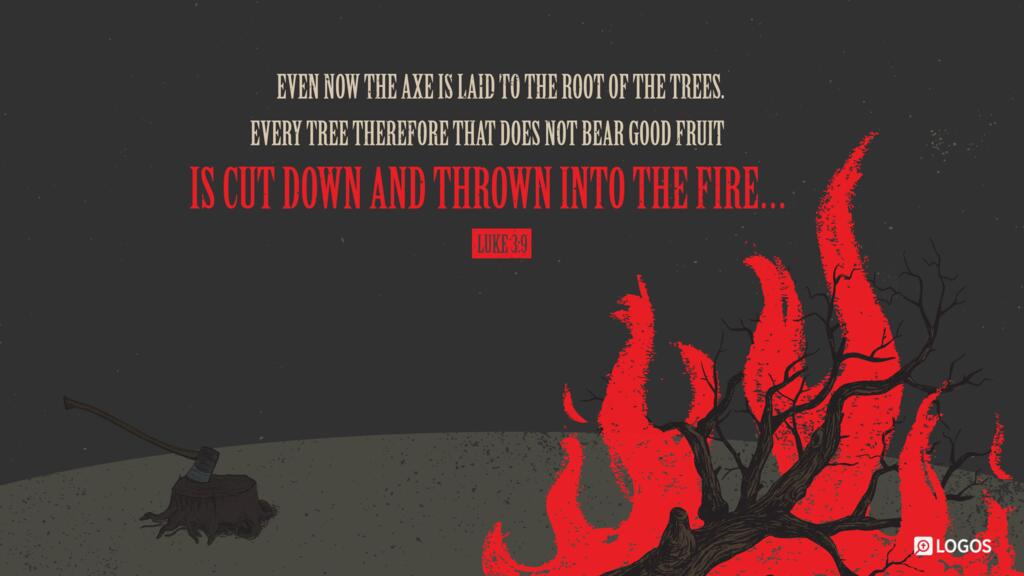
3:7So John19 said to the crowds20 that came out to be baptized by him, “You offspring of vipers!21 Who warned you to flee22 from the coming wrath? 3:8Therefore produce23 fruit24 that proves your repentance, and don’t begin to say25 to yourselves, ‘We have Abraham as our father.’26 For I tell you that God can raise up children for Abraham from these stones!273:9Even now the ax is laid at the root of the trees,28 and every tree that does not produce good fruit will be29 cut down and thrown into the fire.”
3:10So30 the crowds were asking31 him, “What then should we do?” 3:11John32 answered them,33 “The person who has two tunics34 must share with the person who has none, and the person who has food must do likewise.” 3:12Tax collectors35 also came to be baptized, and they said to him, “Teacher, what should we do?” 3:13He told them, “Collect no more36 than you are required to.”373:14Then some soldiers38 also asked him, “And as for us—what should we do?”39 He told them, “Take money from no one by violence40 or by false accusation,41 and be content with your pay.”
Footnotes
- 19 Grk “he”; the referent (John) has been specified in the translation for clarity.
- 20 The crowds. It is interesting to trace references to “the crowd” in Luke. It is sometimes noted favorably, other times less so. The singular appears 25 times in Luke while the plural occurs 16 times. Matt 3:7 singles out the Sadducees and Pharisees here.
- 21 Or “snakes.”
- 22 The rebuke “Who warned you to flee …?” compares the crowd to snakes who flee their desert holes when the heat of a fire drives them out.
- 23 The verb here is ποιέω (poieō; see v. 4).
- 24 Grk “fruits.” The plural Greek term καρπούς has been translated with the collective singular “fruit” (so ; cf. Matt 3:8 where the singular καρπός is found). Some other translations render the plural καρπούς as “fruits” (e.g., , , , ).
- 25 In other words, “do not even begin to think this.”
- 26 We have Abraham as our father. John’s warning to the crowds really assumes two things: (1) A number of John’s listeners apparently believed that simply by their physical descent from Abraham, they were certain heirs of the promises made to the patriarch, and (2) God would never judge his covenant people lest he inadvertently place the fulfillment of his promises in jeopardy. In light of this, John tells these people two things: (1) they need to repent and produce fruit in keeping with repentance, for only that saves from the coming wrath, and (2) God will raise up “children for Abraham from these stones” if he wants to. Their disobedience will not threaten the realization of God’s sovereign purposes.
- 27 The point of the statement God is able from these stones to raise up children to Abraham is that ancestry or association with a tradition tied to the great founder of the Jewish nation is not an automatic source of salvation.
- 28 Even now the ax is laid at the root of the trees. The imagery of an “ax already laid at the root of the trees” is vivid, connoting sudden and catastrophic judgment for the unrepentant and unfruitful. The image of “fire” serves to further heighten the intensity of the judgment referred to. It is John’s way of summoning all people to return to God with all their heart and avoid his unquenchable wrath soon to be poured out. John’s language and imagery is probably ultimately drawn from the OT where Israel is referred to as a fruitless vine (Hos 10:1–2; Jer 2:21–22) and the image of an “ax” is used to indicate God’s judgment (Ps 74:5–6; Jer 46:22).
- 29 Grk “is”; the present tense (ἐκκόπτεται, ekkoptetai) has futuristic force here.
- 30 Here καί (kai) has been translated as “so” to indicate the consequential nature of the people’s response.
- 31 Though this verb is imperfect, in this context it does not mean repeated, ongoing questions, but simply a presentation in vivid style as the following verbs in the other examples are aorist.
- 32 Grk “he”; the referent (John) has been specified in the translation for clarity.
- 33 Grk “Answering, he said to them.” This construction with passive participle and finite verb is pleonastic (redundant) and has been simplified in the translation to “answered them.”
- 34 Or “shirt” (a long garment worn under the cloak next to the skin). The name for this garment (χιτών, chitōn) presents some difficulty in translation. Most modern readers would not understand what a ‘tunic’ was any more than they would be familiar with a ‘chiton.’ On the other hand, attempts to find a modern equivalent are also a problem: “Shirt” conveys the idea of a much shorter garment that covers only the upper body, and “undergarment” (given the styles of modern underwear) is more misleading still. “Tunic” was therefore employed, but with a note to explain its nature.
- 35 The tax collectors would bid to collect taxes for the Roman government and then add a surcharge, which they kept. Since tax collectors worked for Rome, they were viewed as traitors to their own people and were not well liked. Yet even they were moved by John’s call.
- 36 In the Greek text μηδὲν πλέον (mēden pleon, “no more”) is in an emphatic position. By telling the tax collectors to collect no more than … required John was calling for honesty and integrity in a business that was known for greed and dishonesty.
- 37 Or “than you are ordered to.”
- 38 Grk “And soldiers.”
- 39 Grk “And what should we ourselves do?”
- 40 Or “Rob no one.” The term διασείσητε (diaseisēte) here refers to “shaking someone.” In this context it refers to taking financial advantage of someone through violence, so it refers essentially to robbery. Soldiers are to perform their tasks faithfully. A changed person is to carry out his tasks in life faithfully and without grumbling.
- 41 The term translated “accusation” (συκοφαντήσητε, sukophantēsēte) refers to a procedure by which someone could bring charges against an individual and be paid a part of the fine imposed by the court. Soldiers could do this to supplement their pay, and would thus be tempted to make false accusations.
The NET Bible First Edition, Copyright 1996-2005 by Biblical Studies Press
In other versions
ESVEnglish Standard Version
He said therefore to the crowds that came out to be baptized by him, “You brood of vipers! Who warned you to flee from the wrath to come? Bear fruits in keeping with repentance. And do not begin to say to yourselves, ‘We have Abraham as our father.’ For I tell you, God is able from these stones to raise up children for Abraham. Even now the axe is laid to the root of the trees. Every tree therefore that does not bear good fruit is cut down and thrown into the fire.”
And the crowds asked him, “What then shall we do?” And he answered them, “Whoever has two tunics is to share with him who has none, and whoever has food is to do likewise.” Tax collectors also came to be baptized and said to him, “Teacher, what shall we do?” And he said to them, “Collect no more than you are authorized to do.” Soldiers also asked him, “And we, what shall we do?” And he said to them, “Do not extort money from anyone by threats or by false accusation, and be content with your wages.”
Copyright 2001 Crossway Bibles
NIVNew International Version (2011)
John said to the crowds coming out to be baptized by him, “You brood of vipers! Who warned you to flee from the coming wrath? Produce fruit in keeping with repentance. And do not begin to say to yourselves, ‘We have Abraham as our father.’ For I tell you that out of these stones God can raise up children for Abraham. The ax is already at the root of the trees, and every tree that does not produce good fruit will be cut down and thrown into the fire.”
“What should we do then?” the crowd asked.
John answered, “Anyone who has two shirts should share with the one who has none, and anyone who has food should do the same.”
Even tax collectors came to be baptized. “Teacher,” they asked, “what should we do?”
“Don’t collect any more than you are required to,” he told them.
Then some soldiers asked him, “And what should we do?”
He replied, “Don’t extort money and don’t accuse people falsely—be content with your pay.”
Copyright 1973, 1978, 1984, 2011 Biblica, Inc.
CSBChristian Standard Bible
He then said to the crowds who came out to be baptized by him, “Brood of vipers! Who warned you to flee from the coming wrath? Therefore produce fruit consistent with repentance. And don’t start saying to yourselves, ‘We have Abraham as our father,’ for I tell you that God is able to raise up children for Abraham from these stones. The ax is already at the root of the trees. Therefore, every tree that doesn’t produce good fruit will be cut down and thrown into the fire.”
“What then should we do?” the crowds were asking him.
He replied to them, “The one who has two shirts must share with someone who has none, and the one who has food must do the same.”
Tax collectors also came to be baptized, and they asked him, “Teacher, what should we do?”
He told them, “Don’t collect any more than what you have been authorized.”
Some soldiers also questioned him, “What should we do?”
He said to them, “Don’t take money from anyone by force or false accusation, and be satisfied with your wages.”
Copyright 2017 Holman Bible Publishers
NLTNew Living Translation
When the crowds came to John for baptism, he said, “You brood of snakes! Who warned you to flee the coming wrath? Prove by the way you live that you have repented of your sins and turned to God. Don’t just say to each other, ‘We’re safe, for we are descendants of Abraham.’ That means nothing, for I tell you, God can create children of Abraham from these very stones. Even now the ax of God’s judgment is poised, ready to sever the roots of the trees. Yes, every tree that does not produce good fruit will be chopped down and thrown into the fire.”
The crowds asked, “What should we do?”
John replied, “If you have two shirts, give one to the poor. If you have food, share it with those who are hungry.”
Even corrupt tax collectors came to be baptized and asked, “Teacher, what should we do?”
He replied, “Collect no more taxes than the government requires.”
“What should we do?” asked some soldiers.
John replied, “Don’t extort money or make false accusations. And be content with your pay.”
Holy Bible, New Living Translation, copyright © 1996, 2004, 2015 by Tyndale House Foundation. Used by permission of Tyndale House Publishers. All rights reserved.
LEBThe Lexham English Bible
Therefore he was saying to the crowds that came out to be baptized by him, “Offspring of vipers! Who warned you to flee from the coming wrath? Therefore produce fruit worthy of repentance! And do not begin to say to yourselves, ‘We have Abraham as father.’ For I say to you that God is able to raise up children for Abraham from these stones! And even now the ax is positioned at the root of the trees; therefore every tree not producing good fruit is cut down and thrown into the fire.”
And the crowds were asking him, saying, “What then should we do?” And he answered and said to them, “The one who has two tunics must share with the one who does not have one, and the one who has food must do likewise.” And tax collectors also came to be baptized, and they said to him, “Teacher, what should we do?” And he said to them, “Collect no more than what you are ordered to.” And those who served in the army were also asking him, saying, “What should we also do?” And he said to them, “Extort from no one, and do not blackmail anyone, and be content with your pay.”
Copyright 2012 Lexham Press
KJV 1900King James Version
Then said he to the multitude that came forth to be baptized of him, O generation of vipers, who hath warned you to flee from the wrath to come? Bring forth therefore fruits worthy of repentance, and begin not to say within yourselves, We have Abraham to our father: for I say unto you, That God is able of these stones to raise up children unto Abraham. And now also the axe is laid unto the root of the trees: every tree therefore which bringeth not forth good fruit is hewn down, and cast into the fire.
And the people asked him, saying, What shall we do then? He answereth and saith unto them, He that hath two coats, let him impart to him that hath none; and he that hath meat, let him do likewise. Then came also publicans to be baptized, and said unto him, Master, what shall we do? And he said unto them, Exact no more than that which is appointed you. And the soldiers likewise demanded of him, saying, And what shall we do? And he said unto them, Do violence to no man, neither accuse any falsely; and be content with your wages.
Public Domain