Jonah 2:8–9
The NET BibleOther versions
English
- NET The NET Bible
- DARBY 1890 Darby Bible
- ASV American Standard Version
- AV 1873 The Cambridge Paragraph Bible of the Authorized English Version
- CSB Christian Standard Bible
- D-R Douay-Rheims Bible
- ESV English Standard Version
- GW GOD’S WORD Translation
- GNB Good News Translation
- HCSB The Holman Christian Standard Bible
- KJV 1900 King James Version
- LSB Legacy Standard Bible
- LEB The Lexham English Bible
- MSG The Message: The Bible in Contemporary Language
- NASB95 New American Standard Bible (1995)
- NCV New Century Version
- NIrV New International Reader’s Version (1998)
- NIV New International Version (2011)
- NKJV The New King James Version
- NLT New Living Translation
- NRSVue New Revised Standard Version: Updated Edition
- RSV The Revised Standard Version
- RSVCE The Revised Standard Version, Catholic Edition
- TNIV Today’s New International Version
- YLT Young’s Literal Translation
Arabic
Czech
French
German
Hebrew
Hungarian
Italian
Korean
Latin
Portuguese
Russian
Simplified Chinese
Spanish
Traditional Chinese
2:8Those who worship35 worthless idols36 forfeit the mercy that could be theirs.37
2:9But as for me, I promise to offer a sacrifice to you with a public declaration38 of praise;39
Footnotes
- 35 Heb “those who pay regard to.” The verbal root שָׁמַר (shamar, “to keep, to watch”) appears in the Piel stem only here in biblical Hebrew, meaning “to pay regard to” ( 1037 שָׁמַר). This is metonymical for the act of worship (e.g., Qal “to observe” = to worship, Ps 31:7).
- 36 Heb “worthlessnesses of nothingness” or “vanities of emptiness.” The genitive construct הַבְלֵי־שָׁוְא (havle-shavé’) forms an attributive adjective expression: “empty worthlessness” or “worthless vanities.” This ironic reference to false gods is doubly insulting (e.g., Ps 31:7). The noun הֶבֶל (hevel, “vapor, breath”) is often used figuratively to describe what is insubstantial, empty, and futile (31 times in Eccl; see also, e.g., Pss 39:4–6, 11; 144:4; Prov 13:11; 21:6; Isa 30:7; 49:4). It often refers to idols—the epitome of emptiness, nothingness, and worthlessness (Deut 32:21; 1 Kgs 16:13, 26; Ps 31:7; Jer 8:19; 10:8, 15; 14:22; 16:19; 51:18). The noun שָׁוְא (“worthlessness, emptiness, nothingness”) describes what is ineffective and lacking reality ( 996 שָׁוְא; e.g., Exod 20:7; Pss 60:11; 127:1; Ezek 22:28). It is also often used to refer to idols (e.g., Ps 31:7; Jer 18:15; Hos 5:11).
- 37 Heb “abandon their mercy/loyalty.” The meaning of חַסְדָּם יַעֲזֹבוּ (khasdam ya’azovu, “forsake their mercy/loyalty”) is greatly debated. There are two exegetical issues that are mutually related. First, does the noun חֶסֶד (khesed) here mean (1) “mercy, kindness” that man receives from God, or (2) “loyalty, faithfulness” that man must give to God (see 338–39 חֶסֶד; חֶסֶד)? Second, the third masculine plural suffix on חַסְדָּם (“their loyalty/mercy”) has been taken as (1) subjective genitive, referring to the loyal allegiance they ought to display to the true God: “they abandon the loyalty they should show.” Examples of subjective genitives are: “This is your kindness (חַסְדֵּךְ, khasdek) which you must do for me: every place to which we come, say of me, ‘He is my brother’ ” (Gen 20:13; also cf. Gen 40:14; 1 Sam 20:14–15). Several English versions take this approach: “forsake their faithfulness” (), “abandon their faithful love” (), “abandon their loyalty” (, ), “forsake their true loyalty” (, ), “turn their backs on all God’s mercies” (), “have abandoned their loyalty to you” (). (2) This has also been taken as objective genitive, referring to the mercy they might have received from God: “they forfeit the mercy that could be theirs.” The ancient versions interpret חַסְדָּם in this sense: “they do not know the source of their welfare” (), “forsake the source of their welfare” (), and “abandon their own mercy” (). Several English versions follow this approach: “forsake their source of mercy” (); “forfeit the grace that could be theirs” (), “forsake their own welfare” (, ), “forsake their own mercy” (, ), “forsake their own Mercy” (), “turn from the God who offers them mercy” (). This is a difficult lexical/syntactical problem. On the one hand, the next line contrasts their failure with Jonah’s boast of loyalty to the true God—demonstrating that he, unlike pagan idolaters, deserves to be delivered. On the other hand, the only other use of חֶסֶד in the book refers to “mercy” God bestows (4:2)—something that Jonah did not believe that the (repentant) pagan idolaters had a right to receive. 339 I חֶסֶד II takes this approach—He is חַסְדָּם their goodness, favour Jonah 2:9”—and cites other examples of חֶסֶד with suffixes referring to God: חַסְדִּי (khasdi) “my kindness” = he shows kindness to me (Ps 144:2); and אֱלֹהֵי חַסְדִּי (’elohe khasdi) “the God of my kindness” = the God who shows kindness to me (Ps 59:18).
- 38 Heb “voice” or “sound.”
- 39 The reads בְּקוֹל תּוֹדָה (béqol todah, “with a voice of thanksgiving”). Some of Jonah read “with the sound of hymns of thanksgiving” here in 2:9—the longer reading probably reflects an editorial gloss, explaining תּוֹדָה (“thanksgiving”) as “hymns of thanksgiving.” Heb “voice/sound of thanksgiving.” The genitive תּוֹדָה (todah, “thanksgiving”) specifies the kind of public statement that will accompany the sacrifice. The construct noun קוֹל (qol, “voice, sound”) functions as a metonymy of cause for effect, referring to the content of what the voice/sound produces: hymns of praise or declarative praise testimony.
- 40 The verbs translated “I will sacrifice” and “I will pay” are Hebrew cohortatives, expressing Jonah’s resolve and firm intention.
- 41 Heb “what I have vowed I will pay.” Jonah promises to offer a sacrifice and publicly announce why he is thankful. For similar pledges, see Pss 22:25–26; 50:14–15; 56:12; 69:29–33; 71:14–16, 22–24; 86:12–13; 116:12–19.
- 42 Or “deliverance” (, ).
- 43 Or “comes from the Lord.” For similar uses of the preposition lamed (לְ, lé) to convey a sort of ownership in which the owner does or may by right do something, see Lev 25:48; Deut 1:17; 1 Sam 17:47; Jer 32:7–8.
The NET Bible First Edition, Copyright 1996-2005 by Biblical Studies Press
In other versions
ESVEnglish Standard Version
Those who pay regard to vain idols
forsake their hope of steadfast love.
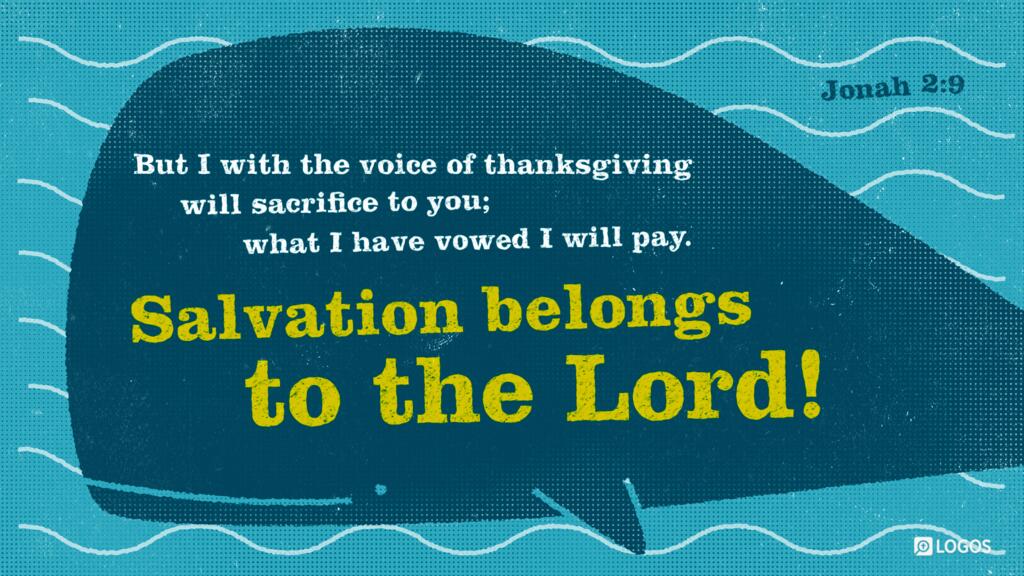
But I with the voice of thanksgiving
will sacrifice to you;
what I have vowed I will pay.
Salvation belongs to the Lord!”
Copyright 2001 Crossway Bibles
NIVNew International Version (2011)
“Those who cling to worthless idols
turn away from God’s love for them.
But I, with shouts of grateful praise,
will sacrifice to you.
What I have vowed I will make good.
I will say, ‘Salvation comes from the Lord.’ ”
Copyright 1973, 1978, 1984, 2011 Biblica, Inc.
CSBChristian Standard Bible
Those who cherish worthless idols
abandon their faithful love,
but as for me, I will sacrifice to you
with a voice of thanksgiving.
I will fulfill what I have vowed.
Salvation belongs to the Lord.
Copyright 2017 Holman Bible Publishers
NLTNew Living Translation
Those who worship false gods
turn their backs on all God’s mercies.
But I will offer sacrifices to you with songs of praise,
and I will fulfill all my vows.
For my salvation comes from the Lord alone.”
Holy Bible, New Living Translation, copyright © 1996, 2004, 2015 by Tyndale House Foundation. Used by permission of Tyndale House Publishers. All rights reserved.
LEBThe Lexham English Bible
Those who worship vain idols
forsake their loyal love.
But I, with a voice of thanksgiving,
will sacrifice to you;
I will fulfill what I have vowed.
Deliverance belongs to Yahweh!”
Copyright 2012 Lexham Press
KJV 1900King James Version
They that observe lying vanities forsake their own mercy.
But I will sacrifice unto thee with the voice of thanksgiving;
I will pay that that I have vowed.
Salvation is of the Lord.
Public Domain