John 19:25–30
The NET BibleOther versions
English
- NET The NET Bible
- DARBY 1890 Darby Bible
- ASV American Standard Version
- AV 1873 The Cambridge Paragraph Bible of the Authorized English Version
- CSB Christian Standard Bible
- D-R Douay-Rheims Bible
- ESV English Standard Version
- GW GOD’S WORD Translation
- GNB Good News Translation
- HCSB The Holman Christian Standard Bible
- KJV 1900 King James Version
- LSB Legacy Standard Bible
- LEB The Lexham English Bible
- MSG The Message: The Bible in Contemporary Language
- NASB95 New American Standard Bible (1995)
- NCV New Century Version
- NIrV New International Reader’s Version (1998)
- NIV New International Version (2011)
- NKJV The New King James Version
- NLT New Living Translation
- NRSVue New Revised Standard Version: Updated Edition
- RSV The Revised Standard Version
- RSVCE The Revised Standard Version, Catholic Edition
- TNIV Today’s New International Version
- YLT Young’s Literal Translation
Arabic
Czech
French
German
Greek
Hungarian
Italian
Korean
Latin
Portuguese
Russian
Simplified Chinese
Spanish
Traditional Chinese
19:25Now standing beside Jesus’ cross were his mother, his mother’s sister, Mary the wife of Clopas, and Mary Magdalene.7819:26So when Jesus saw his mother and the disciple whom he loved standing there, he said to his mother, “Woman,79 look, here is your son!” 19:27He then said to his disciple, “Look, here is your mother!” From that very time80 the disciple took her into his own home.
Jesus’ Death
19:28After this Jesus, realizing that by this time81 everything was completed,82 said (in order to fulfill the scripture),83 “I am thirsty!”8419:29A jar full of sour wine85 was there, so they put a sponge soaked in sour wine on a branch of hyssop86 and lifted it87 to his mouth. 19:30When88 he had received the sour wine, Jesus said, “It is completed!”89 Then he bowed his head and gave up his spirit.90
Footnotes
- 78 Several women are mentioned, but it is not easy to determine how many. It is not clear whether his mother’s sister and Mary the wife of Clopas are to be understood as the same individual (in which case only three women are mentioned: Jesus’ mother, her sister Mary, and Mary Magdalene) or as two different individuals (in which case four women are mentioned: Jesus’ mother, her sister, Mary Clopas’ wife, and Mary Magdalene). It is impossible to be certain, but when John’s account is compared to the synoptics it is easier to reconcile the accounts if four women were present than if there were only three. It also seems that if there were four women present, this would have been seen by the author to be in juxtaposition to the four soldiers present who performed the crucifixion, and this may explain the transition from the one incident in 23–24 to the other in 25–27. Finally, if only three were present, this would mean that both Jesus’ mother and her sister were named Mary, and this is highly improbable in a Jewish family of that time. If there were four women present, the name of the second, the sister of Jesus’ mother, is not mentioned. It is entirely possible that the sister of Jesus’ mother mentioned here is to be identified with the woman named Salome mentioned in Mark 15:40 and also with the woman identified as “the mother of the sons of Zebedee” mentioned in Matt 27:56. If so, and if John the Apostle is to be identified as the beloved disciple, then the reason for the omission of the second woman’s name becomes clear; she would have been John’s own mother, and he consistently omitted direct reference to himself or his brother James or any other members of his family in the Fourth Gospel.
- 79 The term Woman is Jesus’ normal, polite way of addressing women (Matt 15:28, Luke 13:12; John 4:21; 8:10; 19:26; 20:15; see γυνή 1). But it is unusual for a son to address his mother with this term. The custom in both Hebrew (or Aramaic) and Greek would be for a son to use a qualifying adjective or title. Is there significance in Jesus’ use here? Jesus probably used the term here to help establish Mary and the beloved disciple in a new “mother-son” relationship. Someone would soon need to provide for Mary since Jesus, her oldest son, would no longer be alive. By using this term Jesus distanced himself from Mary so the beloved disciple could take his place as her earthly son (cf. John 2:4). See D. A. Carson, John, 617–18, for discussion about symbolic interpretations of this relationship between Mary and the beloved disciple.
- 80 Grk “from that very hour.”
- 81 Or “that already.”
- 82 Or “finished,” “accomplished”; Grk “fulfilled.”
- 83 A reference to Ps 69:21 or Ps 22:15.
- 84 In order to fulfill (τελειωθῇ [teleiōthē], a wordplay on the previous statement that everything was completed [τετέλεσται, tetelestai]) the scripture, he said, “I am thirsty.” The scripture referred to is probably Ps 69:21, “They also gave me gall for my food, and for my thirst they gave me vinegar to drink.” Also suggested, however, is Ps 22:15, “My tongue cleaves to the roof of my mouth, and you [God] lay me in the dust of death.” Ps 22:1 reads “My God, my God, why have you forsaken me?,” a statement Jesus makes from the cross in both Matt 27:46 and Mark 15:34. In light of the connection in the Fourth Gospel between thirst and the living water which Jesus offers, it is highly ironic that here Jesus himself, the source of that living water, expresses his thirst. And since 7:39 associates the living water with the Holy Spirit, Jesus’ statement here in 19:28 amounts to an admission that at this point he has been forsaken by God (cf. Ps 22:1, Matt 27:46, and Mark 15:34).
- 85 The cheap sour wine was called in Latin posca, and referred to a cheap vinegar wine diluted heavily with water. It was the drink of slaves and soldiers, and was probably there for the soldiers who had performed the crucifixion.
- 86 Hyssop was a small aromatic bush; exact identification of the plant is uncertain. The hyssop used to lift the wet sponge may have been a form of reed (κάλαμος, kalamos, “reed,” is used in Matt 27:48 and Mark 15:36); the biblical name can refer to several different species of plant (at least eighteen different plants have been suggested).
- 87 Or “and brought it.”
- 88 Grk “Then when.” Here οὖν (oun) has not been translated for stylistic reasons.
- 89 Or “It is accomplished,” “It is finished,” or “It is ended.” See on .
- 90 Or “he bowed his head and died”; Grk “he bowed his head and gave over the spirit.”
The NET Bible First Edition, Copyright 1996-2005 by Biblical Studies Press
In other versions
ESVEnglish Standard Version
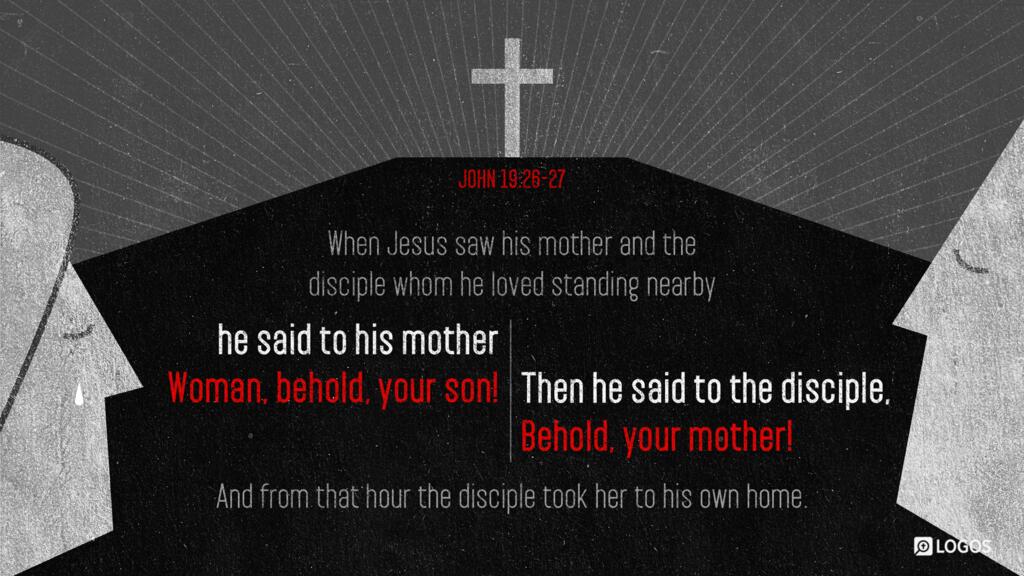
but standing by the cross of Jesus were his mother and his mother’s sister, Mary the wife of Clopas, and Mary Magdalene. When Jesus saw his mother and the disciple whom he loved standing nearby, he said to his mother, “Woman, behold, your son!” Then he said to the disciple, “Behold, your mother!” And from that hour the disciple took her to his own home.
After this, Jesus, knowing that all was now finished, said (to fulfill the Scripture), “I thirst.” A jar full of sour wine stood there, so they put a sponge full of the sour wine on a hyssop branch and held it to his mouth. When Jesus had received the sour wine, he said, “It is finished,” and he bowed his head and gave up his spirit.
Copyright 2001 Crossway Bibles
NIVNew International Version (2011)
Near the cross of Jesus stood his mother, his mother’s sister, Mary the wife of Clopas, and Mary Magdalene. When Jesus saw his mother there, and the disciple whom he loved standing nearby, he said to her, “Woman, here is your son,” and to the disciple, “Here is your mother.” From that time on, this disciple took her into his home.
Later, knowing that everything had now been finished, and so that Scripture would be fulfilled, Jesus said, “I am thirsty.” A jar of wine vinegar was there, so they soaked a sponge in it, put the sponge on a stalk of the hyssop plant, and lifted it to Jesus’ lips. When he had received the drink, Jesus said, “It is finished.” With that, he bowed his head and gave up his spirit.
Copyright 1973, 1978, 1984, 2011 Biblica, Inc.
CSBChristian Standard Bible
Standing by the cross of Jesus were his mother, his mother’s sister, Mary the wife of Clopas, and Mary Magdalene. When Jesus saw his mother and the disciple he loved standing there, he said to his mother, “Woman, here is your son.” Then he said to the disciple, “Here is your mother.” And from that hour the disciple took her into his home.
After this, when Jesus knew that everything was now finished that the Scripture might be fulfilled, he said, “I’m thirsty.” A jar full of sour wine was sitting there; so they fixed a sponge full of sour wine on a hyssop branch and held it up to his mouth.
When Jesus had received the sour wine, he said, “It is finished.” Then bowing his head, he gave up his spirit.
Copyright 2017 Holman Bible Publishers
NLTNew Living Translation
Standing near the cross were Jesus’ mother, and his mother’s sister, Mary (the wife of Clopas), and Mary Magdalene. When Jesus saw his mother standing there beside the disciple he loved, he said to her, “Dear woman, here is your son.” And he said to this disciple, “Here is your mother.” And from then on this disciple took her into his home.
Jesus knew that his mission was now finished, and to fulfill Scripture he said, “I am thirsty.” A jar of sour wine was sitting there, so they soaked a sponge in it, put it on a hyssop branch, and held it up to his lips. When Jesus had tasted it, he said, “It is finished!” Then he bowed his head and gave up his spirit.
Holy Bible, New Living Translation, copyright © 1996, 2004, 2015 by Tyndale House Foundation. Used by permission of Tyndale House Publishers. All rights reserved.
LEBThe Lexham English Bible
Now his mother and the sister of his mother, Mary the wife of Clopas, and Mary Magdalene were standing near the cross of Jesus. So Jesus, seeing his mother and the disciple whom he loved standing there, said to his mother, “Woman, behold your son!” Then he said to the disciple, “Behold your mother!” And from that hour the disciple took her into his own home.
After this, Jesus, knowing that now at last everything was completed, in order that the scripture would be fulfilled, said, “I am thirsty.” A jar full of sour wine was standing there, so they put a sponge full of the sour wine on a branch of hyssop and brought it to his mouth. Then when he had received the sour wine, Jesus said, “It is completed,” and bowing his head, he gave up his spirit.
Copyright 2012 Lexham Press
KJV 1900King James Version
Now there stood by the cross of Jesus his mother, and his mother’s sister, Mary the wife of Cleophas, and Mary Magdalene. When Jesus therefore saw his mother, and the disciple standing by, whom he loved, he saith unto his mother, Woman, behold thy son! Then saith he to the disciple, Behold thy mother! And from that hour that disciple took her unto his own home.
After this, Jesus knowing that all things were now accomplished, that the scripture might be fulfilled, saith, I thirst. Now there was set a vessel full of vinegar: and they filled a spunge with vinegar, and put it upon hyssop, and put it to his mouth. When Jesus therefore had received the vinegar, he said, It is finished: and he bowed his head, and gave up the ghost.
Public Domain