Isaiah 50:4–11
The NET BibleOther versions
English
- NET The NET Bible
- DARBY 1890 Darby Bible
- ASV American Standard Version
- AV 1873 The Cambridge Paragraph Bible of the Authorized English Version
- CSB Christian Standard Bible
- D-R Douay-Rheims Bible
- ESV English Standard Version
- GW GOD’S WORD Translation
- GNB Good News Translation
- HCSB The Holman Christian Standard Bible
- KJV 1900 King James Version
- LSB Legacy Standard Bible
- LEB The Lexham English Bible
- MSG The Message: The Bible in Contemporary Language
- NASB95 New American Standard Bible (1995)
- NCV New Century Version
- NIrV New International Reader’s Version (1998)
- NIV New International Version (2011)
- NKJV The New King James Version
- NLT New Living Translation
- NRSVue New Revised Standard Version: Updated Edition
- RSV The Revised Standard Version
- RSVCE The Revised Standard Version, Catholic Edition
- TNIV Today’s New International Version
- YLT Young’s Literal Translation
Arabic
Czech
French
German
Hebrew
Hungarian
Italian
Korean
Latin
Portuguese
Russian
Simplified Chinese
Spanish
Traditional Chinese
The Servant Perseveres
50:4The sovereign Lord has given me the capacity to be his spokesman,9
so that I know how to help the weary.10
He wakes me up every morning;
he makes me alert so I can listen attentively as disciples do.11
50:5The sovereign Lord has spoken to me clearly;12
I have not rebelled,
I have not turned back.
50:6I offered my back to those who attacked,13
my jaws to those who tore out my beard;
I did not hide my face
from insults and spitting.
50:7But the sovereign Lord helps me,
so I am not humiliated.
For that reason I am steadfastly resolved;14
I know I will not be put to shame.
50:8The one who vindicates me is close by.
Who dares to argue with me? Let us confront each other!15
Who is my accuser?16 Let him challenge me!17
50:9Look, the sovereign Lord helps me.
Who dares to condemn me?
Look, all of them will wear out like clothes;
a moth will eat away at them.
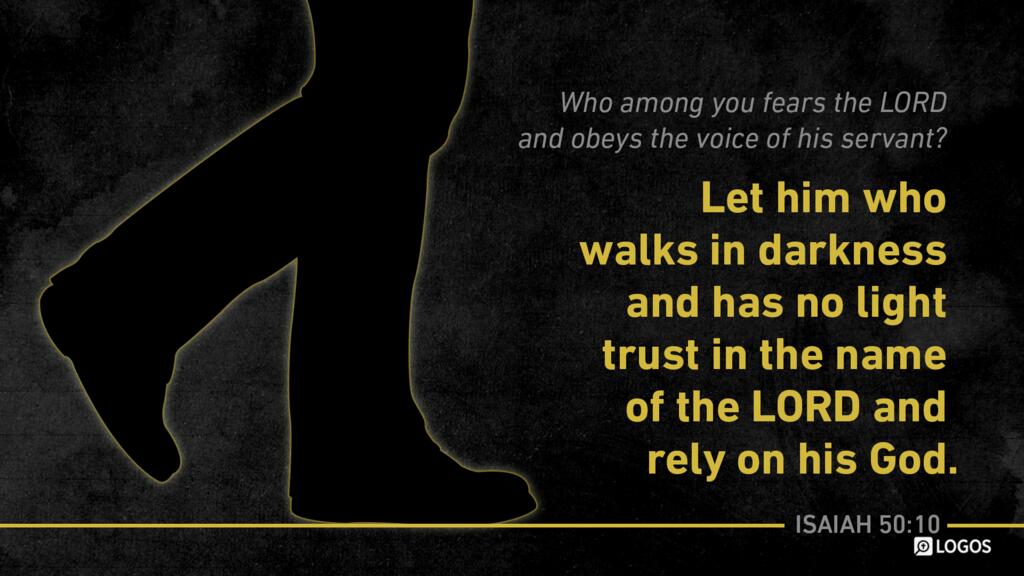
50:10Who among you fears the Lord?
Who obeys18 his servant?
Whoever walks in deep darkness,19
without light,
should trust in the name of the Lord
and rely on his God.
50:11Look, all of you who start a fire
and who equip yourselves with20 flaming arrows,21
walk22 in the light23 of the fire you started
and among the flaming arrows you ignited!24
This is what you will receive from me:25
you will lie down in a place of pain.26
Footnotes
- 9 Heb “has given to me a tongue of disciples.” Verses 4–11 contain the third of the so-called servant songs, which depict the career of the Lord’s special servant, envisioned as an ideal Israel (49:3) who rescues the exiles and fulfills God’s purposes for the world. Here the servant alludes to opposition (something hinted at in 49:4), but also expresses his determination to persevere with the Lord’s help.
- 10 Heb “to know [?] the weary with a word.” Comparing it with Arabic and Aramaic cognates yields the meaning of “help, sustain.” Nevertheless, the meaning of עוּת (’ut) is uncertain. The word occurs only here in the OT (see 736 ). Various scholars have suggested an emendation to עָנוֹת (’anot) from עָנָה (’anah, “answer”): “so that I know how to respond kindly to the weary.” Since the Qumran scroll 1QIsaa and the support the reading, that reading is retained.
- 11 Heb “he arouses for me an ear, to hear like disciples.”
- 12 Or perhaps, “makes me obedient.” The text reads literally, “has opened for me an ear.”
- 13 Or perhaps, “who beat [me].”
- 14 Heb “Therefore I set my face like flint.”
- 15 Heb “Let us stand together!”
- 16 Heb “Who is the master of my judgment?”
- 17 Heb “let him approach me”; , “Let him confront me.”
- 18 Heb “[who] listens to the voice of his servant?” The interrogative is understood by ellipsis (note the preceding line).
- 19 The plural indicates degree. Darkness may refer to exile and/or moral evil.
- 20 Several more recent commentators have proposed an emendation of מְאַזְּרֵי (mé’azzére, “who put on”) to מְאִירִי (mé’iri, “who light”). However, both Qumran scrolls of Isaiah and the support the reading (cf. , ESV).
- 21 On the meaning of זִיקוֹת (ziqot, “flaming arrows”), see זִיקוֹת.
- 22 The imperative is probably rhetorical and has a predictive force.
- 23 Or perhaps, “flame” (so ).
- 24 Perhaps the servant here speaks to his enemies and warns them that they will self-destruct.
- 25 Heb “from my hand” (so , , , ).
- 26 The imagery may be that of a person who becomes ill and is forced to lie down in pain on a sickbed. Some see this as an allusion to a fiery place of damnation because of the imagery employed earlier in the verse.
The NET Bible First Edition, Copyright 1996-2005 by Biblical Studies Press