Hebrews 3:11–4:11
The NET BibleOther versions
English
- NET The NET Bible
- DARBY 1890 Darby Bible
- ASV American Standard Version
- AV 1873 The Cambridge Paragraph Bible of the Authorized English Version
- CSB Christian Standard Bible
- D-R Douay-Rheims Bible
- ESV English Standard Version
- GW GOD’S WORD Translation
- GNB Good News Translation
- HCSB The Holman Christian Standard Bible
- KJV 1900 King James Version
- LSB Legacy Standard Bible
- LEB The Lexham English Bible
- MSG The Message: The Bible in Contemporary Language
- NASB95 New American Standard Bible (1995)
- NCV New Century Version
- NIrV New International Reader’s Version (1998)
- NIV New International Version (2011)
- NKJV The New King James Version
- NLT New Living Translation
- NRSVue New Revised Standard Version: Updated Edition
- RSV The Revised Standard Version
- RSVCE The Revised Standard Version, Catholic Edition
- TNIV Today’s New International Version
- YLT Young’s Literal Translation
Arabic
Czech
French
German
Greek
Hungarian
Italian
Korean
Latin
Portuguese
Russian
Simplified Chinese
Spanish
Traditional Chinese
3:11“As I swore in my anger, ‘They will never enter my rest!’ ”16
3:12See to it,17 brothers and sisters,18 that none of you has19 an evil, unbelieving heart that forsakes20 the living God.213:13But exhort one another each day, as long as it is called “Today,” that none of you may become hardened by sin’s deception. 3:14For we have become partners with Christ, if in fact we hold our initial confidence22 firm until the end. 3:15As it says,23 “Oh, that today you would listen as he speaks!24 Do not harden your hearts as in the rebellion.”253:16For which ones heard and rebelled? Was it not all who came out of Egypt under Moses’ leadership?263:17And against whom was God27 provoked for forty years? Was it not those who sinned, whose dead bodies fell in the wilderness?283:18And to whom did he swear they would never enter into his rest, except those who were disobedient? 3:19So29 we see that they could not enter because of unbelief.
God’s Promised Rest
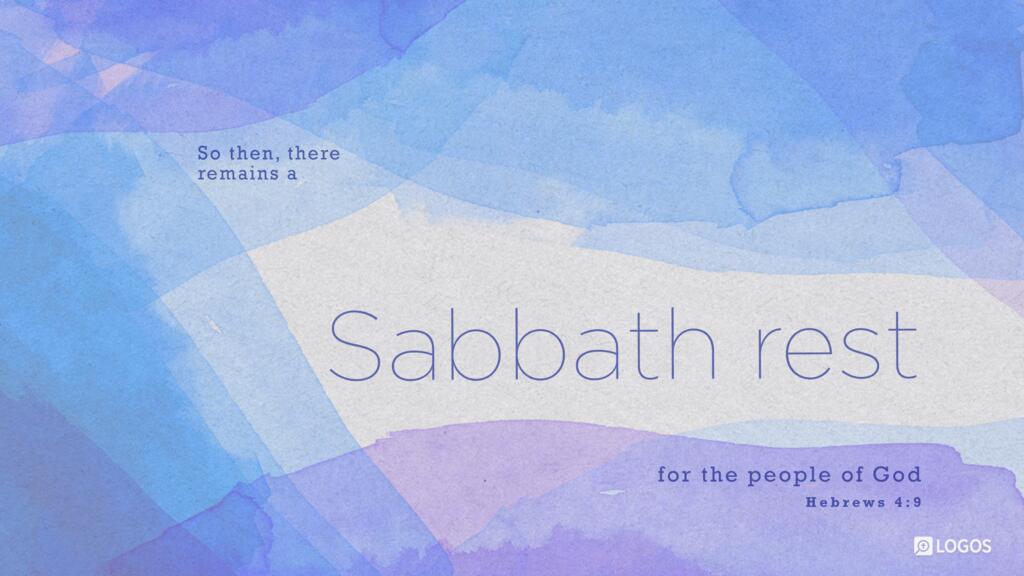
4:1Therefore we must be wary1 that, while the promise of entering his rest remains open, none of you may seem to have come short of it. 4:2For we had good news proclaimed to us just as they did. But the message they heard did them no good, since they did not join in2 with those who heard it in faith.34:3For we who have believed enter that rest, as he has said, “As I swore in my anger, ‘They will never enter my rest!’ ”4 And yet God’s works5 were accomplished from the foundation of the world. 4:4For he has spoken somewhere about the seventh day in this way: “And God rested on the seventh day from all his works,”64:5but to repeat the text cited earlier:7 “They will never enter my rest!” 4:6Therefore it remains for some to enter it, yet those to whom it was previously proclaimed did not enter because of disobedience. 4:7So God8 again ordains a certain day, “Today,” speaking through David9 after so long a time, as in the words quoted before,10 “O, that today you would listen as he speaks!11 Do not harden your hearts.” 4:8For if Joshua had given them rest, God12 would not have spoken afterward about another day. 4:9Consequently a Sabbath rest remains for the people of God. 4:10For the one who enters God’s13 rest has also rested from his works, just as God did from his own works. 4:11Thus we must make every effort to enter that rest, so that no one may fall by following the same pattern of disobedience.
Footnotes
- 16 Grk “if they shall enter my rest,” a Hebrew idiom expressing an oath that something will certainly not happen.
- 17 Or “take care.”
- 18 Grk “brothers.” See note on the phrase “brothers and sisters” in .
- 19 Grk “that there not be in any of you.”
- 20 Or “deserts,” “rebels against.”
- 21 Grk “in forsaking the living God.”
- 22 Grk “the beginning of the confidence.”
- 23 Grk “while it is said.”
- 24 Grk “today if you hear his voice.”
- 25 A quotation from Ps 95:7b–8.
- 26 Grk “through Moses.”
- 27 Grk “he”; in the translation the referent (God) has been specified for clarity.
- 28 An allusion to God’s judgment pronounced in Num 14:29, 32.
- 29 Here καί (kai) has been translated as “So” to indicate a summary or conclusion to the argument of the preceding paragraph.
- 1 Grk “let us fear.”
- 2 Or “they were not united.”
- 3 A few (א and a few versional witnesses) have the nominative singular participle συγκεκερασμένος (sunkekerasmenos, “since it [the message] was not combined with faith by those who heard it”), a reading that refers back to the ὁ λόγος (ho logos, “the message”). There are a few other variants here (e.g., συγκεκεραμμένοι [sunkekerammenoi] in 104, συγκεκεραμένους [sunkekeramenous] in 1881 𝔐), but the accusative plural participle συγκεκερασμένους (sunkekerasmenous), found in 𝔓13vid,46 A B C D* Ψ 0243 0278 33 81 1739 2464 , has by far the best external credentials. This participle agrees with the previous ἐκείνους (ekeinous, “those”), a more difficult construction grammatically than the nominative singular. Thus, both on external and internal grounds, συγκεκερασμένους is preferred.
- 4 A quotation from Ps 95:11.
- 5 Grk “although the works,” continuing the previous reference to God. The referent (God) is specified in the translation for clarity.
- 6 A quotation from Gen 2:2.
- 7 Grk “and in this again.”
- 8 Grk “he”; the referent (God) has been specified in the translation for clarity.
- 9 Ps 95 does not mention David either in the text or the superscription. It is possible that the writer of Hebrews is attributing the entire collection of psalms to David (although some psalms are specifically attributed to other individuals or groups).
- 10 Grk “as it has been said before” (see Heb 3:7).
- 11 Grk “today if you hear his voice.”
- 12 Grk “he”; the referent (God) has been specified in the translation for clarity.
- 13 Grk “his”; the referent (God) has been specified in the translation for clarity.
The NET Bible First Edition, Copyright 1996-2005 by Biblical Studies Press