Genesis 29:1–20
The NET BibleOther versions
English
- NET The NET Bible
- DARBY 1890 Darby Bible
- ASV American Standard Version
- AV 1873 The Cambridge Paragraph Bible of the Authorized English Version
- CSB Christian Standard Bible
- D-R Douay-Rheims Bible
- ESV English Standard Version
- GW GOD’S WORD Translation
- GNB Good News Translation
- HCSB The Holman Christian Standard Bible
- KJV 1900 King James Version
- LSB Legacy Standard Bible
- LEB The Lexham English Bible
- MSG The Message: The Bible in Contemporary Language
- NASB95 New American Standard Bible (1995)
- NCV New Century Version
- NIrV New International Reader’s Version (1998)
- NIV New International Version (2011)
- NKJV The New King James Version
- NLT New Living Translation
- NRSVue New Revised Standard Version: Updated Edition
- RSV The Revised Standard Version
- RSVCE The Revised Standard Version, Catholic Edition
- TNIV Today’s New International Version
- YLT Young’s Literal Translation
Arabic
Czech
French
German
Hebrew
Hungarian
Italian
Korean
Latin
Portuguese
Russian
Simplified Chinese
Spanish
Traditional Chinese
The Marriages of Jacob
29:1So Jacob moved on1 and came to the land of the eastern people.229:2He saw3 in the field a well with4 three flocks of sheep lying beside it, because the flocks were watered from that well. Now5 a large stone covered the mouth of the well. 29:3When all the flocks were gathered there, the shepherds6 would roll the stone off the mouth of the well and water the sheep. Then they would put the stone back in its place over the well’s mouth.
29:4Jacob asked them, “My brothers, where are you from?” They replied, “We’re from Haran.” 29:5So he said to them, “Do you know Laban, the grandson7 of Nahor?” “We know him,”8 they said. 29:6“Is he well?”9 Jacob asked. They replied, “He is well.10 Now look, here comes his daughter Rachel with the sheep.” 29:7Then Jacob11 said, “Since it is still the middle of the day,12 it is not time for the flocks to be gathered. You should water the sheep and then go and let them graze some more.”1329:8“We can’t,” they said, “until all the flocks are gathered and the stone is rolled off the mouth of the well. Then we water14 the sheep.”
29:9While he was still speaking with them, Rachel arrived with her father’s sheep, for she was tending them.1529:10When Jacob saw Rachel, the daughter of his uncle Laban,16 and the sheep of his uncle Laban, he17 went over18 and rolled the stone off the mouth of the well and watered the sheep of his uncle Laban.1929:11Then Jacob kissed Rachel and began to weep loudly.2029:12When Jacob explained21 to Rachel that he was a relative of her father22 and the son of Rebekah, she ran and told her father. 29:13When Laban heard this news about Jacob, his sister’s son, he rushed out to meet him. He embraced him and kissed him and brought him to his house. Jacob23 told Laban how he was related to him.2429:14Then Laban said to him, “You are indeed my own flesh and blood.”25 So Jacob26 stayed with him for a month.27
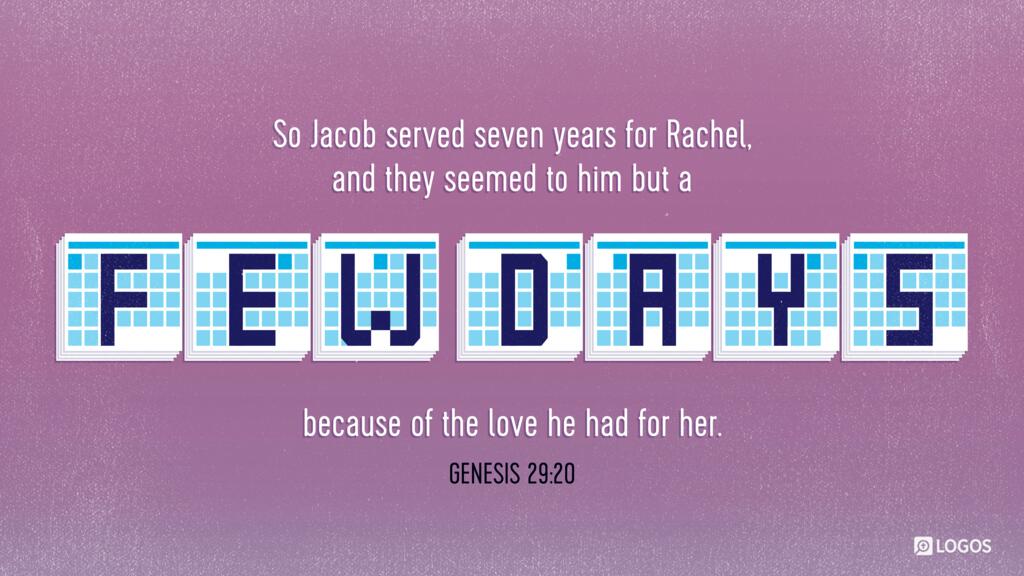
29:15Then Laban said to Jacob, “Should you work28 for me for nothing because you are my relative?29 Tell me what your wages should be.” 29:16(Now Laban had two daughters;30 the older one was named Leah, and the younger one Rachel. 29:17Leah’s eyes were tender,31 but Rachel had a lovely figure and beautiful appearance.)3229:18Since Jacob had fallen in love with33 Rachel, he said, “I’ll serve you seven years in exchange for your younger daughter Rachel.” 29:19Laban replied, “I’d rather give her to you than to another man.34 Stay with me.” 29:20So Jacob worked for seven years to acquire Rachel.35 But they seemed like only a few days to him36 because his love for her was so great.37
Footnotes
- 1 Heb “and Jacob lifted up his feet.” This unusual expression suggests that Jacob had a new lease on life now that God had promised him the blessing he had so desperately tried to gain by his own efforts. The text portrays him as having a new step in his walk.
- 2 Heb “the land of the sons of the east.”
- 3 Heb “and he saw, and look.” As in Gen 28:12–15, the narrator uses the particle הִנֵּה (hinneh, “look”) here and in the next clause to draw the reader into the story.
- 4 Heb “and look, there.”
- 5 The disjunctive clause (introduced by the noun with the prefixed conjunction) provides supplemental information that is important to the story.
- 6 Heb “they”; the referent (the shepherds) has been specified in the translation for clarity.
- 7 Heb “son.”
- 8 Heb “and they said, ‘We know.’ ” The word “him” is not in the Hebrew text, but has been supplied in the translation for stylistic reasons. In the translation several introductory clauses throughout this section have been placed after the direct discourse they introduce for stylistic reasons as well.
- 9 Heb “and he said to them, ‘Is there peace to him?’ ”
- 10 Heb “peace.”
- 11 Heb “and he”; the referent (Jacob) has been specified in the translation for clarity.
- 12 Heb “the day is great.”
- 13 Heb “water the sheep and go and pasture [them].” The verbal forms are imperatives, but Jacob would hardly be giving direct orders to someone else’s shepherds. The nuance here is probably one of advice.
- 14 The perfect verbal forms with the vav (ו) consecutive carry on the sequence begun by the initial imperfect form.
- 15 Heb “was a shepherdess.”
- 16 Heb “Laban, the brother of his mother” (twice in this verse).
- 17 Heb “Jacob.” The proper name has been replaced by the pronoun (“he”) in the translation for stylistic reasons.
- 18 Heb “drew near, approached.”
- 19 Heb “Laban, the brother of his mother.” The text says nothing initially about the beauty of Rachel. But the reader is struck by the repetition of “Laban the brother of his mother.” G. J. Wenham is no doubt correct when he observes that Jacob’s primary motive at this stage is to ingratiate himself with Laban (Genesis [], 2:).
- 20 Heb “and he lifted up his voice and wept.” The idiom calls deliberate attention to the fact that Jacob wept out loud.
- 21 Heb “declared.”
- 22 Heb “that he [was] the brother of her father.”
- 23 Heb “he”; the referent (Jacob) has been specified in the translation for clarity.
- 24 Heb “and he told to Laban all these things.” This might mean Jacob told Laban how he happened to be there, but Laban’s response (see v. 14) suggests “all these things” refers to what Jacob had previously told Rachel (see v. 12).
- 25 Heb “indeed, my bone and my flesh are you.” The expression sounds warm enough, but the presence of “indeed” may suggest that Laban had to be convinced of Jacob’s identity before permitting him to stay. To be one’s “bone and flesh” is to be someone’s blood relative. For example, the phrase describes the relationship between Abimelech and the Shechemites (Judg 9:2; his mother was a Shechemite); David and the Israelites (2 Sam 5:1); David and the elders of Judah (2 Sam 19:12,); and David and his nephew Amasa (2 Sam 19:13, see 2 Sam 17:2; 1 Chr 2:16–17).
- 26 Heb “and he”; the referent (Jacob) has been specified in the translation for clarity.
- 27 Heb “a month of days.”
- 28 The verb is the perfect with the vav (ו) consecutive; the nuance in the question is deliberative.
- 29 Heb “my brother.” The term “brother” is used in a loose sense; actually Jacob was Laban’s nephew.
- 30 Heb “and to Laban [there were] two daughters.” The disjunctive clause (introduced here by a conjunction and a prepositional phrase) provides supplemental material that is important to the story. Since this material is parenthetical in nature, vv. 16–17 have been set in parentheses in the translation.
- 31 Heb “and the eyes of Leah were tender.” The disjunctive clause (introduced here by a conjunction and a noun) continues the parenthesis begun in v. 16. It is not clear what is meant by “tender” (or “delicate”) eyes. The expression may mean she had appealing eyes (cf. , , ), though some suggest that they were plain, not having the brightness normally expected. Either way, she did not measure up to her gorgeous sister.
- 32 Heb “and Rachel was beautiful of form and beautiful of appearance.”
- 33 Heb “Jacob loved.”
- 34 Heb “Better my giving her to you than my giving her to another man.”
- 35 Heb “in exchange for Rachel.”
- 36 But they seemed like only a few days to him. This need not mean that the time passed quickly. More likely it means that the price seemed insignificant when compared to what he was getting in the bargain.
- 37 Heb “because of his love for her.” The words “was so great” are supplied for stylistic reasons.
The NET Bible First Edition, Copyright 1996-2005 by Biblical Studies Press