Genesis 29:1–20
The Message: The Bible in Contemporary LanguageOther versions
English
- MSG The Message: The Bible in Contemporary Language
- DARBY 1890 Darby Bible
- ASV American Standard Version
- AV 1873 The Cambridge Paragraph Bible of the Authorized English Version
- CSB Christian Standard Bible
- D-R Douay-Rheims Bible
- ESV English Standard Version
- GW GOD’S WORD Translation
- GNB Good News Translation
- HCSB The Holman Christian Standard Bible
- KJV 1900 King James Version
- LSB Legacy Standard Bible
- LEB The Lexham English Bible
- NET The NET Bible
- NASB95 New American Standard Bible (1995)
- NCV New Century Version
- NIrV New International Reader’s Version (1998)
- NIV New International Version (2011)
- NKJV The New King James Version
- NLT New Living Translation
- NRSVue New Revised Standard Version: Updated Edition
- RSV The Revised Standard Version
- RSVCE The Revised Standard Version, Catholic Edition
- TNIV Today’s New International Version
- YLT Young’s Literal Translation
Arabic
Czech
French
German
Hebrew
Hungarian
Italian
Korean
Latin
Portuguese
Russian
Simplified Chinese
Spanish
Traditional Chinese
1–329Jacob set out again on his way to the people of the east. He noticed a well out in an open field with three flocks of sheep bedded down around it. This was the common well from which the flocks were watered. The stone over the mouth of the well was huge. When all the flocks were gathered, the shepherds would roll the stone from the well and water the sheep; then they would return the stone, covering the well.
4Jacob said, “Hello friends. Where are you from?”
They said, “We’re from Haran.”
5Jacob asked, “Do you know Laban son of Nahor?”
“We do.”
6“Are things well with him?” Jacob continued.
“Very well,” they said. “And here is his daughter Rachel coming with the flock.”
7Jacob said, “There’s a lot of daylight still left; it isn’t time to round up the sheep yet, is it? So why not water the flocks and go back to grazing?”
8“We can’t,” they said. “Not until all the shepherds get here. It takes all of us to roll the stone from the well. Not until then can we water the flocks.”
9–13While Jacob was in conversation with them, Rachel came up with her father’s sheep. She was the shepherd. The moment Jacob spotted Rachel, daughter of Laban his mother’s brother, saw her arriving with his uncle Laban’s sheep, he went and single-handedly rolled the stone from the mouth of the well and watered the sheep of his uncle Laban. Then he kissed Rachel and broke into tears. He told Rachel that he was related to her father, that he was Rebekah’s son. She ran and told her father. When Laban heard the news—Jacob, his sister’s son!—he ran out to meet him, embraced and kissed him and brought him home. Jacob told Laban the story of everything that had happened.
14–15Laban said, “You’re family! My flesh and blood!”
When Jacob had been with him for a month, Laban said, “Just because you’re my nephew, you shouldn’t work for me for nothing. Tell me what you want to be paid. What’s a fair wage?”
16–18Now Laban had two daughters; Leah was the older and Rachel the younger. Leah had nice eyes, but Rachel was stunningly beautiful. And it was Rachel that Jacob loved.
So Jacob answered, “I will work for you seven years for your younger daughter Rachel.”
19“It is far better,” said Laban, “that I give her to you than marry her to some outsider. Yes. Stay here with me.”
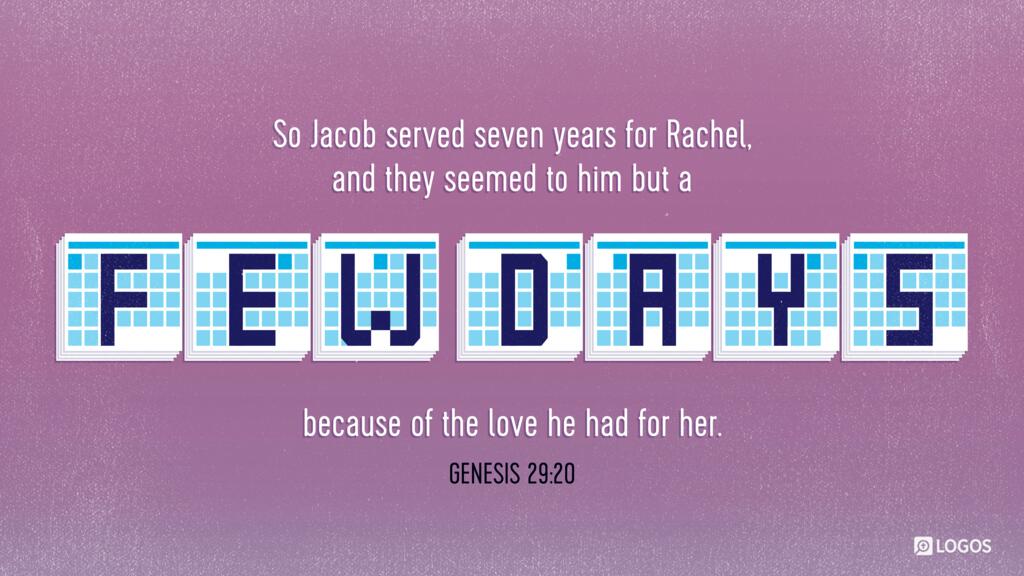
20So Jacob worked seven years for Rachel. But it only seemed like a few days, he loved her so much.
Copyright 2005 Eugene H. Peterson.