2 Samuel 7:12–29
The NET BibleOther versions
English
- NET The NET Bible
- DARBY 1890 Darby Bible
- ASV American Standard Version
- AV 1873 The Cambridge Paragraph Bible of the Authorized English Version
- CSB Christian Standard Bible
- D-R Douay-Rheims Bible
- ESV English Standard Version
- GW GOD’S WORD Translation
- GNB Good News Translation
- HCSB The Holman Christian Standard Bible
- KJV 1900 King James Version
- LSB Legacy Standard Bible
- LEB The Lexham English Bible
- MSG The Message: The Bible in Contemporary Language
- NASB95 New American Standard Bible (1995)
- NCV New Century Version
- NIrV New International Reader’s Version (1998)
- NIV New International Version (2011)
- NKJV The New King James Version
- NLT New Living Translation
- NRSVue New Revised Standard Version: Updated Edition
- RSV The Revised Standard Version
- RSVCE The Revised Standard Version, Catholic Edition
- TNIV Today’s New International Version
- YLT Young’s Literal Translation
Arabic
Czech
French
German
Hebrew
Hungarian
Italian
Korean
Latin
Portuguese
Russian
Simplified Chinese
Spanish
Traditional Chinese
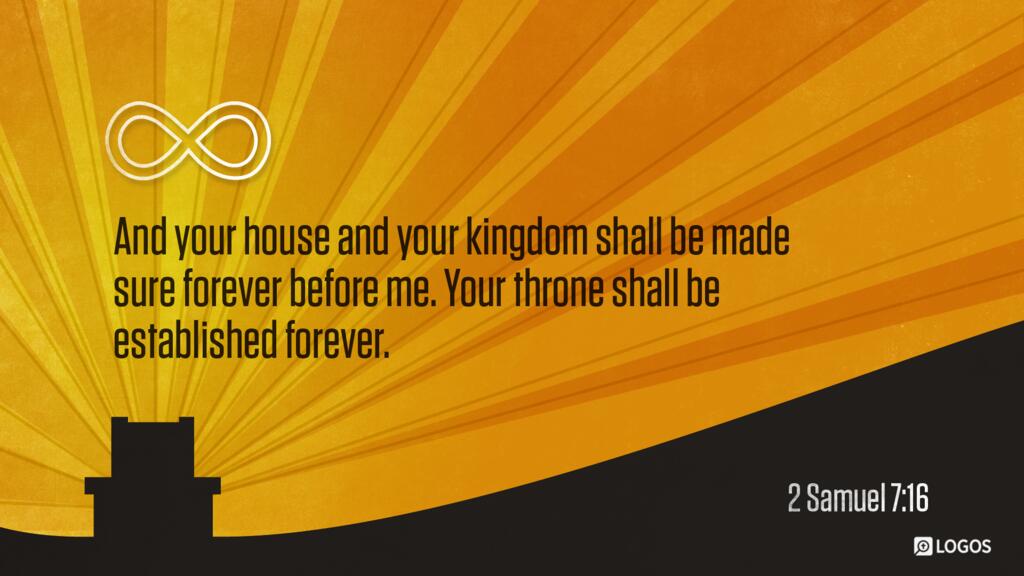
7:12When the time comes for you to die,21 I will raise up your descendant, one of your own sons, to succeed you,22 and I will establish his kingdom. 7:13He will build a house for my name, and I will make his dynasty permanent.237:14I will become his father and he will become my son. When he sins, I will correct him with the rod of men and with wounds inflicted by human beings. 7:15But my loyal love will not be removed from him as I removed it from Saul, whom I removed from before you. 7:16Your house and your kingdom will stand before me24 permanently; your dynasty25 will be permanent.’ ” 7:17Nathan told David all these words that were revealed to him.26
David Offers a Prayer to God
7:18King David went in, sat before the Lord, and said, “Who am I, O Lord God, and what is my family,27 that you should have brought me to this point? 7:19And you didn’t stop there, O Lord God! You have also spoken about the future of your servant’s family.28 Is this your usual way of dealing with men,29 O Lord God? 7:20What more can David say to you? You have given your servant special recognition,30 O Lord God! 7:21For the sake of your promise and according to your purpose31 you have done this great thing in order to reveal it to your servant.327:22Therefore you are great, O Lord God, for there is none like you! There is no God besides you! What we have heard is true!337:23Who is like your people, Israel, a unique nation34 on the earth? Their God35 went36 to claim37 a nation for himself and to make a name for himself! You did great and awesome acts for your land,38 before your people whom you delivered for yourself from the Egyptian empire and its gods.397:24You made Israel your very own people for all time.40 You, O Lord, became their God. 7:25So now, O Lord God, make this promise you have made about your servant and his family a permanent reality.41 Do as you promised,427:26so you may gain lasting fame,43 as people say,44 ‘The Lord of hosts is God over Israel!’ The dynasty45 of your servant David will be established before you, 7:27for you, O Lord of hosts, the God of Israel, have told46 your servant, ‘I will build you a dynastic house.’47 That is why your servant has had the courage48 to pray this prayer to you. 7:28Now, O sovereign Lord, you are the true God!49 May your words prove to be true!50 You have made this good promise to your servant!517:29Now be willing to bless your servant’s dynasty52 so that it may stand permanently before you, for you, O sovereign Lord, have spoken. By your blessing may your servant’s dynasty be blessed on into the future!”53
Footnotes
- 21 Heb, “when your days are full and you lie down with your ancestors.”
- 22 Heb “your seed after you who comes out from your insides.”
- 23 Heb “and I will establish the throne of his kingdom permanently.”
- 24 Heb “before you.” A few medieval Hebrew read instead “before me,” which makes better sense contextually. (See also the and the .) The reading is probably the result of dittography (note the ך [kaf] at the beginning of the next form), with the extra ך then being interpreted as a pronominal suffix.
- 25 Heb “throne.”
- 26 Heb “according to all these words and according to all this revelation, so Nathan said to David.”
- 27 Heb “house.”
- 28 Heb “and this was small in your eyes, O Lord God, so you spoke concerning the house of your servant for a distance.”
- 29 Heb “and this [is] the law of man”; “is this the manner of man, O Lord God?”; “this too you have shown to man”; “May this be instruction for the people, O Lord God!” This part of the verse is very enigmatic; no completely satisfying solution has yet been suggested. The present translation tries to make sense of the by understanding the phrase as a question that underscores the uniqueness of God’s dealings with David as described here. The parallel passage in 1 Chr 17:17 reads differently (see the there).
- 30 Heb “and you know your servant.” The verb here refers to recognizing another in a special way and giving them special treatment (see 1 Chr 17:18). Some English versions take this to refer to the Lord’s knowledge of David himself: “you know my thoughts”; “know what I am really like.”
- 31 Heb “for the sake of your word and according to your heart.”
- 32 Heb “to make known, your servant.”
- 33 Heb “in all which we heard with our ears.” The phrase translated “in all” בְּכֹל (békhol) should probably be emended to “according to all” כְּכֹל (kékhol).
- 34 Heb “a nation, one.”
- 35 Heb “whose God” or “because God.” In the Hebrew text this clause is subordinated to what precedes. The clauses are separated in the translation for stylistic reasons.
- 36 The verb is plural in Hebrew, agreeing grammatically with the divine name, which is a plural of degree.
- 37 Heb “redeem.”
- 38 Heb “and to do for you [plural form] the great [thing] and awesome [things] for your land.”
- 39 Heb “from Egypt, nations and their gods.” The has “nations and tents,” which reflects a mistaken metathesis of letters in אֶלֹהָיו (e’lohav, “its gods”) and אֹהָלָיו (’ohalav, “its tents”).
- 40 Heb “and you established for yourself your people Israel for yourself for a people permanently.”
- 41 Heb “and now, O Lord God, the word which you spoke concerning your servant and concerning his house, establish permanently.”
- 42 Heb “as you have spoken.”
- 43 Heb “and your name might be great permanently.” Following the imperative in v. 23b, the prefixed verbal form with vav conjunctive indicates purpose/result.
- 44 Heb “saying.” The words “as people” are supplied in the translation for clarification and stylistic reasons.
- 45 Heb “the house.” See the note on “dynastic house” in the following verse.
- 46 Heb “have uncovered the ear of.”
- 47 Heb “a house.” This maintains the wordplay from v. 11 (see the on the word “house” there) and is continued in v. 29.
- 48 Heb “has found his heart.”
- 49 Heb “the God.” The article indicates uniqueness here.
- 50 The translation understands the prefixed verb form as a jussive, indicating David’s wish/prayer. Another option is to take the form as an imperfect and translate “your words are true.”
- 51 Heb “and you have spoken to your servant this good thing.”
- 52 Heb “house” (again later in this verse). See the note on “dynastic house” in v. .
- 53 Or “permanently”; cf. “it is an eternal blessing.”
The NET Bible First Edition, Copyright 1996-2005 by Biblical Studies Press