Revelation 5:1–10
New American Standard Bible (1995)Other versions
English
- NASB95 New American Standard Bible (1995)
- DARBY 1890 Darby Bible
- ASV American Standard Version
- AV 1873 The Cambridge Paragraph Bible of the Authorized English Version
- CSB Christian Standard Bible
- D-R Douay-Rheims Bible
- ESV English Standard Version
- GW GOD’S WORD Translation
- GNB Good News Translation
- HCSB The Holman Christian Standard Bible
- KJV 1900 King James Version
- LSB Legacy Standard Bible
- LEB The Lexham English Bible
- MSG The Message: The Bible in Contemporary Language
- NET The NET Bible
- NCV New Century Version
- NIrV New International Reader’s Version (1998)
- NIV New International Version (2011)
- NKJV The New King James Version
- NLT New Living Translation
- NRSVue New Revised Standard Version: Updated Edition
- RSV The Revised Standard Version
- RSVCE The Revised Standard Version, Catholic Edition
- YLT Young’s Literal Translation
Arabic
Czech
French
German
Greek
Hungarian
Italian
Korean
Latin
Portuguese
Russian
Simplified Chinese
Spanish
Traditional Chinese
The Book with Seven Seals
1I saw 1in the right hand of Him who asat on the throne a 2bbook written inside and on the back, csealed up with seven seals.
2And I saw a astrong angel proclaiming with a loud voice, “Who is worthy to open the 1book and to break its seals?”
3And no one ain heaven or on the earth or under the earth was able to open the 1book or to look into it.
4Then I began to weep greatly because no one was found worthy to open the 1book or to look into it;
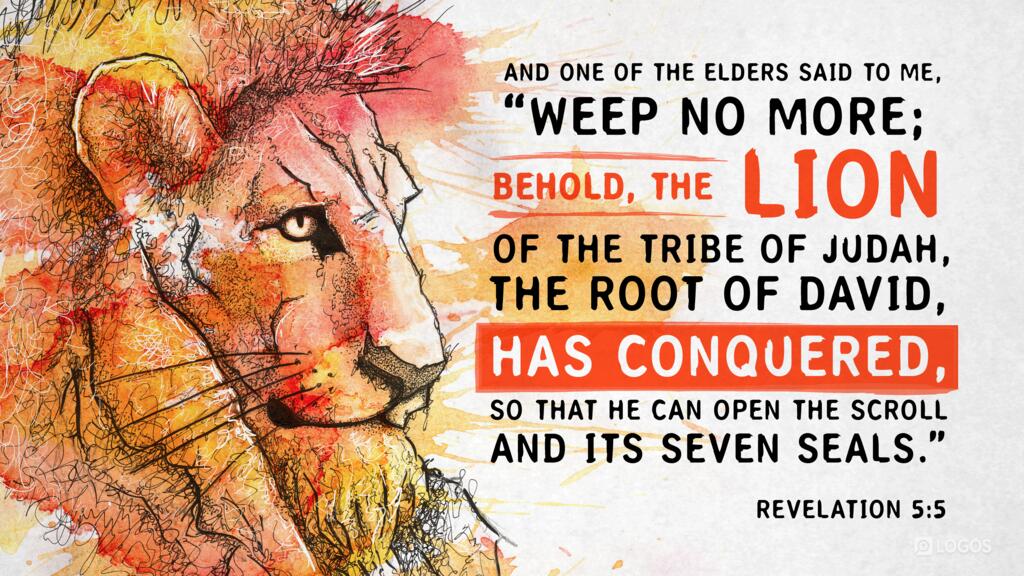
5and one of the elders *said to me, “Stop weeping; behold, the aLion that is bfrom the tribe of Judah, the cRoot of David, has overcome so as to open the 1book and its seven seals.”
6And I saw 1between the throne (with the four living creatures) and athe elders a bLamb standing, as if cslain, having seven dhorns and eseven eyes, which are fthe seven Spirits of God, sent out into all the earth.
7And He came and took athe book out of the right hand of Him who sat on the throne.
8When He had taken the 1book, the afour living creatures and the btwenty-four elders cfell down before the dLamb, each one holding a eharp and fgolden bowls full of incense, which are the gprayers of the 2saints.
9And they *sang a anew song, saying,
“bWorthy are You to take the 1book and to break its seals; for You were cslain, and dpurchased for God with Your blood men from eevery tribe and tongue and people and nation.
10“You have made them to be a akingdom and priests to our God; and they will breign upon the earth.”
Footnotes
- 1Lit upon
- 2Or scroll
- 1Or scroll
- 1Or scroll
- 1Or scroll
- *A star (*) is used to mark verbs that are historical presents in the Greek which have been translated with an English past tense in order to conform to modern usage. The translators recognized that in some contexts the present tense seems more unexpected and unjustified to the English reader than a past tense would have been. But Greek authors frequently used the present tense for the sake of heightened vividness, thereby transporting their readers in imagination to the actual scene at the time of occurence. However, the translators felt that it would be wise to change these historical presents to English past tenses.
- 1Or scroll
- 1Lit in the middle of the throne and of the four living creatures, and in the middle of the elders
- 1Or scroll
- 2Or holy ones
- 1Or scroll
Cross references
- aRev 4:9; 5:7, 13
- bEzek 2:9, 10
- cIs 29:11; Dan 12:4
- aRev 10:1; 18:21
- aPhil 2:10; Rev 5:13
- aGen 49:9
- bHeb 7:14
- cIs 11:1, 10; Rom 15:12; Rev 22:16
- aRev 4:4; 5:8, 14
- bJohn 1:29; Rev 5:8, 12f; 13:8
- cRev 5:9, 12; 13:8
- dDan 8:3f
- eZech 3:9; 4:10
- fRev 1:4
- aRev 5:1
- aRev 4:6; 5:6, 11, 14
- bRev 4:4; 5:14
- cRev 4:10
- dJohn 1:29; Rev 5:6, 12f; 13:8
- eRev 14:2; 15:2
- fRev 15:7
- gPs 141:2; Rev 8:3f
- aPs 33:3; 40:3; 98:1; 149:1; Is 42:10; Rev 14:3; 15:3
- bRev 4:11
- cRev 5:6, 12; 13:8
- d1 Cor 6:20; Rev 14:3f
- eDan 3:4; 5:19; Rev 7:9; 10:11; 11:9; 13:7; 14:6; 17:15
- aRev 1:6
- bRev 3:21; 20:4
Copyright 1960, 1962, 1963, 1971, 1972, 1973, 1975, 1977, 1995 The Lockman Foundation