Ecclesiastes 5:1–6:12
New American Standard Bible (1995)Other versions
English
- NASB95 New American Standard Bible (1995)
- DARBY 1890 Darby Bible
- ASV American Standard Version
- AV 1873 The Cambridge Paragraph Bible of the Authorized English Version
- CSB Christian Standard Bible
- D-R Douay-Rheims Bible
- ESV English Standard Version
- GW GOD’S WORD Translation
- GNB Good News Translation
- HCSB The Holman Christian Standard Bible
- KJV 1900 King James Version
- LSB Legacy Standard Bible
- LEB The Lexham English Bible
- MSG The Message: The Bible in Contemporary Language
- NET The NET Bible
- NCV New Century Version
- NIrV New International Reader’s Version (1998)
- NIV New International Version (2011)
- NKJV The New King James Version
- NLT New Living Translation
- NRSVue New Revised Standard Version: Updated Edition
- RSV The Revised Standard Version
- RSVCE The Revised Standard Version, Catholic Edition
- YLT Young’s Literal Translation
Arabic
Czech
French
German
Hebrew
Hungarian
Italian
Korean
Latin
Portuguese
Russian
Simplified Chinese
Spanish
Traditional Chinese
Your Attitude Toward God
11aGuard your steps as you go to the house of God and draw near to listen rather than to offer the bsacrifice of fools; for they do not know they are doing evil.
21Do not be ahasty 2in word or 3impulsive in thought to bring up a matter in the presence of God. For God is in heaven and you are on the earth; therefore let your bwords be few.
3For the dream comes through much 1effort and the voice of a afool through many words.
4When you amake a vow to God, do not be late in paying it; for He takes no delight in fools. bPay what you vow!
5It is abetter that you should not vow than that you should vow and not pay.
6Do not let your 1speech cause 2you to sin and do not say in the presence of the messenger of God that it was a amistake. Why should God be angry on account of your voice and destroy the work of your hands?
7For in many dreams and in many words there is 1emptiness. Rather, 2afear God.
8If you see aoppression of the poor and bdenial of justice and righteousness in the province, do not be cshocked at the 1sight; for one 2official watches over another official, and there are higher 3officials over them.
9After all, a king who cultivates the field is an advantage to the land.
The Folly of Riches
10aHe who loves money will not be satisfied with money, nor he who loves abundance with its income. This too is 1vanity.
11aWhen good things increase, those who consume them increase. So what is the advantage to their owners except to 1look on?
12The sleep of the working man is apleasant, whether he eats little or much; but the 1full stomach of the rich man does not allow him to sleep.
13There is a grievous evil which I have seen under the sun: ariches being 1hoarded by their owner to his hurt.
14When those riches were lost through 1a bad investment and he had fathered a son, then there was nothing 2to support him.
15aAs he had come naked from his mother’s womb, so will he return as he came. He will btake nothing from the fruit of his labor that he can carry in his hand.
16This also is a grievous evil—exactly as a man 1is born, thus will he 2die. So awhat is the advantage to him who btoils for the wind?
17Throughout his life ahe also eats in darkness with bgreat vexation, sickness and anger.
18Here is what I have seen to be agood and 1fitting: to eat, to drink and 2enjoy oneself in all one’s labor in which he toils under the sun during the few 3years of his life which God has given him; for this is his 4breward.
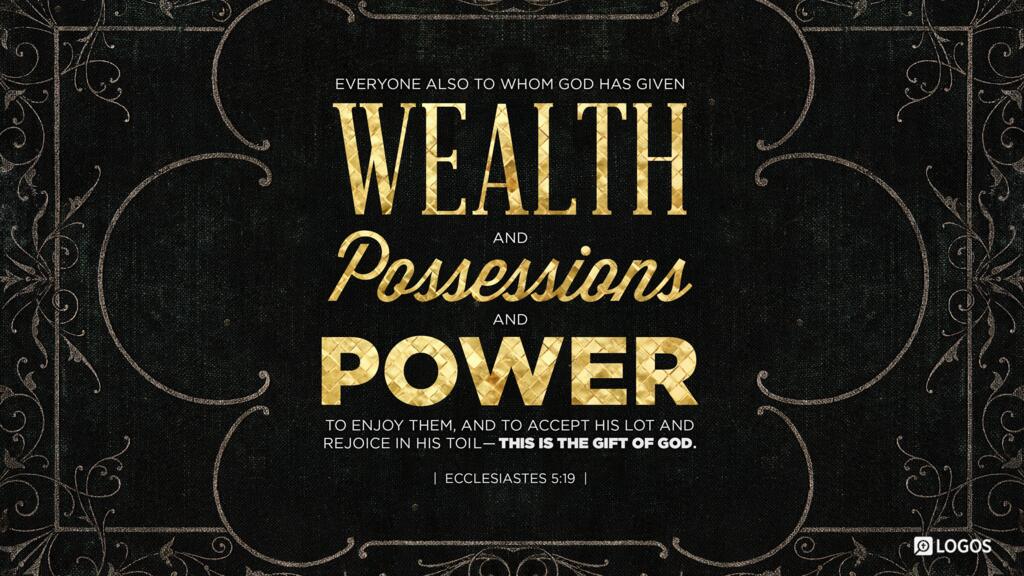
19Furthermore, as for every man to whom aGod has given riches and wealth, He has also bempowered him to eat from them and to receive his 1reward and rejoice in his labor; this is the cgift of God.
20For he will not often 1consider the 2years of his life, because aGod keeps 3him occupied with the gladness of his heart.
Chapter 6
The Futility of Life
1There is an aevil which I have seen under the sun and it is prevalent 1among men—
2a man to whom God has agiven riches and wealth and honor so that his soul blacks nothing of all that he desires; yet God has not empowered him to eat from them, for a foreigner 1enjoys them. This is 2vanity and a severe affliction.
3If a man fathers a hundred children and lives many years, however many 1they be, but his soul is not satisfied with good things and he does not even have a proper aburial, then I say, “Better bthe miscarriage than he,
4for it comes in futility and goes into obscurity; and its name is covered in obscurity.
5“It never sees the sun and it never knows anything; 1it is better off than he.
6“Even if the other man lives a thousand years twice and does not 1enjoy good things—ado not all go to one place?”
7aAll a man’s labor is for his mouth and yet the 1appetite is not 2satisfied.
8For awhat advantage does the wise man have over the fool? What advantage does the poor man have, knowing how to walk before the living?
9What the eyes asee is better than what the soul 1desires. This too is bfutility and a striving after wind.
10Whatever aexists has already been named, and it is known what man is; for he bcannot dispute with him who is stronger than he is.
11For there are many words which increase futility. What then is the advantage to a man?
12For who knows what is good for a man during his lifetime, during the few 1years of his futile life? He will 2spend them like a shadow. For who can tell a man awhat will be after him under the sun?
Footnotes
- 1Ch 4:17 in Heb
- 1Ch 5:1 in Heb
- 2Lit with your mouth
- 3Lit hurry your heart
- 1Lit task
- 1Lit mouth
- 2Lit your body
- 1Lit vanity
- 2Or revere
- 1Lit delight
- 2Lit high one
- 3Lit ones
- 1Or futility
- 1Lit see with their eyes
- 1Lit satiety
- 1Lit guarded
- 1Lit an evil task
- 2Lit in his hand
- 1Lit comes
- 2Lit go
- 1Lit beautiful
- 2Lit see good
- 3Or days
- 4Or share
- 1Or share
- 1Lit remember
- 2Or days
- 3So with Gr
- 1Lit upon
- 1Lit eats from them
- 2Or futility
- 1Lit the days of his years
- 1Lit more rest has this one than that
- 1Lit see
- 1Lit soul
- 2Lit filled
- 1Lit goes after
- 1Lit days
- 2Lit do
Cross references
- aEx 3:5; 30:18–20; Is 1:12
- b1 Sam 15:22; Prov 15:8; 21:27
- aProv 20:25
- bProv 10:19; Matt 6:7
- aJob 11:2; Prov 15:2; Eccl 10:14
- aNum 30:2; Ps 50:14; 76:11
- bPs 66:13, 14
- aProv 20:25; Acts 5:4
- aLev 4:2, 22; Num 15:25
- aEccl 3:14; 7:18; 8:12, 13; 12:13
- aEccl 4:1
- bEzek 18:18
- c1 Pet 4:12
- aEccl 1:8; 2:10, 11; 4:8
- aEccl 2:9
- aProv 3:24
- aEccl 6:2
- aJob 1:21
- bPs 49:17; 1 Tim 6:7
- aEccl 1:3; 2:11; 3:9
- bProv 11:29
- aPs 127:2
- bEccl 2:23
- aEccl 2:24
- bEccl 2:10
- a2 Chr 1:12; Eccl 6:2
- bEccl 6:2
- cEccl 3:13
- aEx 23:25
- aEccl 5:13
- a1 Kin 3:13
- bPs 17:14; 73:7; Eccl 2:10
- aIs 14:20; Jer 8:2; 22:19
- bJob 3:16; Eccl 4:3
- aEccl 2:14
- aProv 16:26
- aEccl 2:15
- aEccl 11:9
- bEccl 1:14
- aEccl 1:9; 3:15
- bJob 9:32; 40:2; Prov 21:30; Is 45:9
- aEccl 3:22
Copyright 1960, 1962, 1963, 1971, 1972, 1973, 1975, 1977, 1995 The Lockman Foundation