Luke 17:1–10
The Message: The Bible in Contemporary LanguageOther versions
English
- MSG The Message: The Bible in Contemporary Language
- DARBY 1890 Darby Bible
- ASV American Standard Version
- AV 1873 The Cambridge Paragraph Bible of the Authorized English Version
- CSB Christian Standard Bible
- D-R Douay-Rheims Bible
- ESV English Standard Version
- GW GOD’S WORD Translation
- GNB Good News Translation
- HCSB The Holman Christian Standard Bible
- KJV 1900 King James Version
- LSB Legacy Standard Bible
- LEB The Lexham English Bible
- NET The NET Bible
- NASB95 New American Standard Bible (1995)
- NCV New Century Version
- NIrV New International Reader’s Version (1998)
- NIV New International Version (2011)
- NKJV The New King James Version
- NLT New Living Translation
- NRSVue New Revised Standard Version: Updated Edition
- RSV The Revised Standard Version
- RSVCE The Revised Standard Version, Catholic Edition
- TNIV Today’s New International Version
- YLT Young’s Literal Translation
Arabic
Czech
French
German
Greek
Hungarian
Italian
Korean
Latin
Portuguese
Russian
Simplified Chinese
Spanish
Traditional Chinese
A Kernel of Faith
1–217He said to his disciples, “Hard trials and temptations are bound to come, but too bad for whoever brings them on! Better to wear a millstone necklace and take a swim in the deep blue sea than give even one of these dear little ones a hard time!
3–4“Be alert. If you see your friend going wrong, correct him. If he responds, forgive him. Even if it’s personal against you and repeated seven times through the day, and seven times he says, ‘I’m sorry, I won’t do it again,’ forgive him.”
5The apostles came up and said to the Master, “Give us more faith.”
6But the Master said, “You don’t need more faith. There is no ‘more’ or ‘less’ in faith. If you have a bare kernel of faith, say the size of a poppy seed, you could say to this sycamore tree, ‘Go jump in the lake,’ and it would do it.
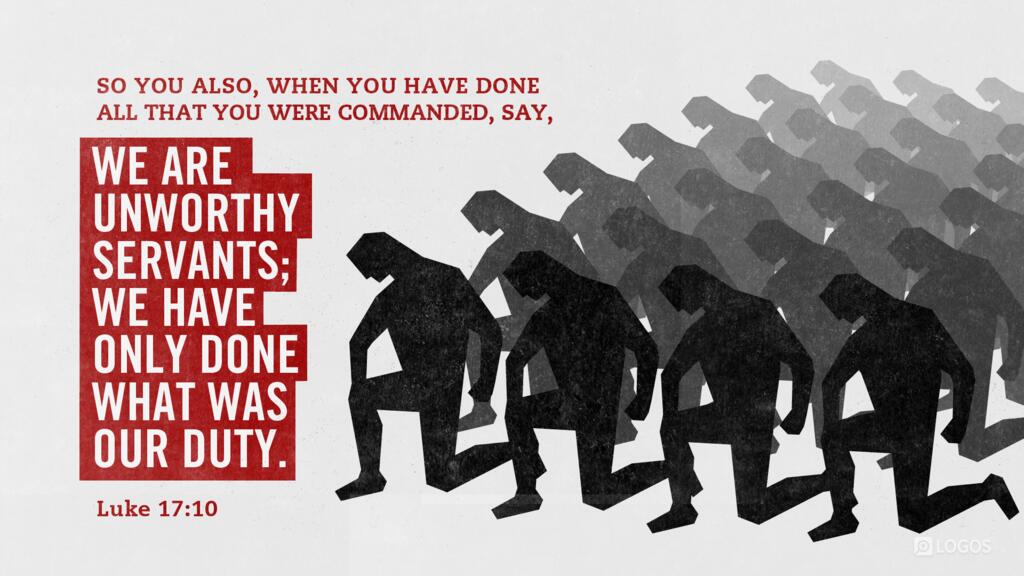
7–10“Suppose one of you has a servant who comes in from plowing the field or tending the sheep. Would you take his coat, set the table, and say, ‘Sit down and eat’? Wouldn’t you be more likely to say, ‘Prepare dinner; change your clothes and wait table for me until I’ve finished my coffee; then go to the kitchen and have your supper’? Does the servant get special thanks for doing what’s expected of him? It’s the same with you. When you’ve done everything expected of you, be matter-of-fact and say, ‘The work is done. What we were told to do, we did.’ ”
Copyright 2005 Eugene H. Peterson.