Luke 17:1–10
The Lexham English BibleOther versions
English
- LEB The Lexham English Bible
- DARBY 1890 Darby Bible
- ASV American Standard Version
- AV 1873 The Cambridge Paragraph Bible of the Authorized English Version
- CSB Christian Standard Bible
- D-R Douay-Rheims Bible
- ESV English Standard Version
- GW GOD’S WORD Translation
- GNB Good News Translation
- HCSB The Holman Christian Standard Bible
- KJV 1900 King James Version
- LSB Legacy Standard Bible
- MSG The Message: The Bible in Contemporary Language
- NET The NET Bible
- NASB95 New American Standard Bible (1995)
- NCV New Century Version
- NIrV New International Reader’s Version (1998)
- NIV New International Version (2011)
- NKJV The New King James Version
- NLT New Living Translation
- NRSVue New Revised Standard Version: Updated Edition
- RSV The Revised Standard Version
- RSVCE The Revised Standard Version, Catholic Edition
- TNIV Today’s New International Version
- YLT Young’s Literal Translation
Arabic
Czech
French
German
Greek
Hungarian
Italian
Korean
Latin
Portuguese
Russian
Simplified Chinese
Spanish
Traditional Chinese
Sin, Forgiveness, Faith, and Service
17And he said to his disciples, “It is impossible for causes for stumbling not to come, but woe to him through whom they come! 2It would be better for him if a millstonea is placed around his neck and he is thrown into the sea than that he causes one of these little ones to sin.
3“Be concerned about yourselves! If your brother sins, rebuke him, and if he repents, forgive him. 4And if he sins against you seven times in a day, and seven times he returns to you saying, ‘I repent,’ you must forgive him.”
5And the apostles said to the Lord, “Increase our faith!” 6So the Lord said, “If you have faith like a mustard seed, you could say to this mulberry tree, ‘Be uprooted and planted in the sea,’ and it would obey you.
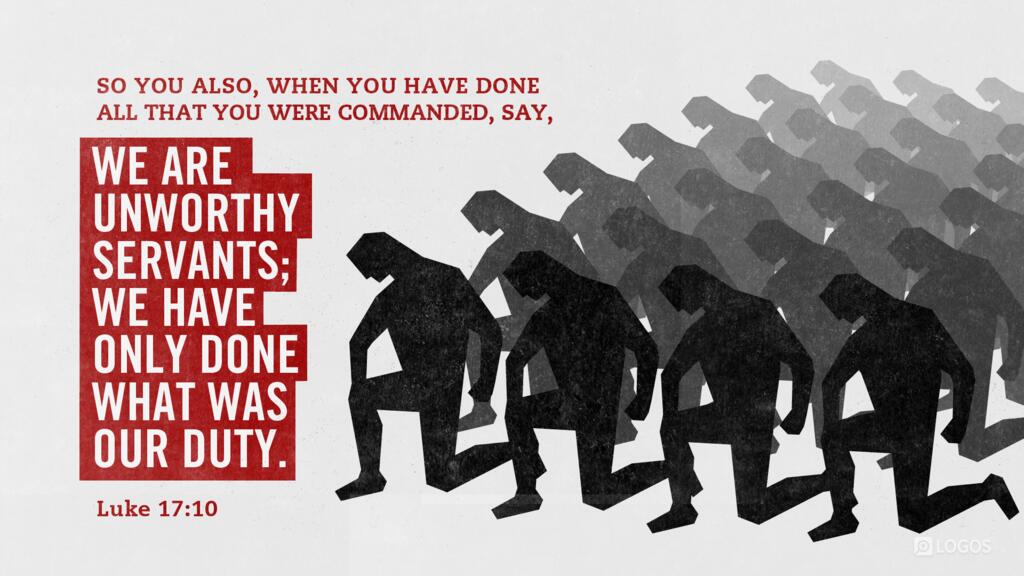
7“And which of you who has a slave plowing or shepherding sheep* who comes in from the field will say to him, ‘Come here at once and* recline at the table’? 8Will he not rather say to him, ‘Prepare something that I may eat, and dress yourself to serve me while I eat and drink, and after these things you will eat and drink.’ 9He will not be gratefulb to the slave because he did what was ordered, will he?* 10Thus you also, when you have done all the things you were ordered to do,c say, ‘We are unworthy slaves; we have done what we were obligated to do.’ ”
Footnotes
- aLiterally “a stone belonging to a mill”
- *Here the direct object is supplied from context in the English translation
- *Here “and” is supplied because the previous participle (“come here”) has been translated as a finite verb
- bLiterally “have gratitude”
- *The negative construction in Greek anticipates a negative answer here, indicated by “will he”
- cLiterally “things that were ordered to you”
Copyright 2012 Lexham Press