Luke 17:1–10
The Holman Christian Standard BibleOther versions
English
- HCSB The Holman Christian Standard Bible
- DARBY 1890 Darby Bible
- ASV American Standard Version
- AV 1873 The Cambridge Paragraph Bible of the Authorized English Version
- CSB Christian Standard Bible
- D-R Douay-Rheims Bible
- ESV English Standard Version
- GW GOD’S WORD Translation
- GNB Good News Translation
- KJV 1900 King James Version
- LSB Legacy Standard Bible
- LEB The Lexham English Bible
- MSG The Message: The Bible in Contemporary Language
- NET The NET Bible
- NASB95 New American Standard Bible (1995)
- NCV New Century Version
- NIrV New International Reader’s Version (1998)
- NIV New International Version (2011)
- NKJV The New King James Version
- NLT New Living Translation
- NRSVue New Revised Standard Version: Updated Edition
- RSV The Revised Standard Version
- RSVCE The Revised Standard Version, Catholic Edition
- YLT Young’s Literal Translation
Arabic
Czech
French
German
Greek
Hungarian
Italian
Korean
Latin
Portuguese
Russian
Simplified Chinese
Spanish
Traditional Chinese
Warnings from Jesus
17He nsaid to His disciples, “Offenses owill certainly come, pbut woe qto the one they come rthrough! 2It would be better for him if a millstone swere hung around his neck and he were thrown into the sea than for him to cause one of these little ones to •stumble. t3Be uon your guard. If your brother sins, vrebuke whim, and if he repents, forgive xhim. 4And if he sins against you seven times in a day, and comes back to you seven times, saying, ‘I repent,’ you must forgive him.”
Faith and Duty
5The yapostles zsaid to the Lord, “Increase our faith.” a
6“If you have faith the size of ba mustard seed,” c the Lord said, “you can say to this mulberry tree, ‘Be uprooted and planted in the sea,’ and it will obey you.
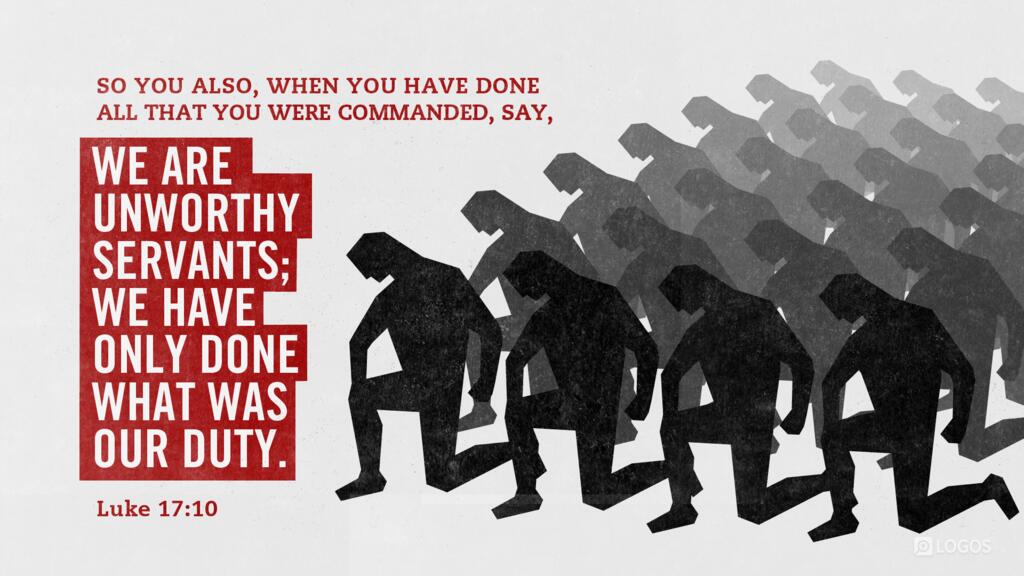
7“Which one of you having a •slave tending sheep or plowing will say to him when he comes in from the field, ‘Come at once and sit down to eat’? 8Instead, will he not tell him, ‘Prepare something for me to eat, get ready, dand serve me while I eat and drink; later you can eat and drink’? e9Does he thank that slave because he did what was commanded? f10In the same way, when you have done all that you were commanded, you should say, ‘We are good-for-nothing gslaves; we’ve only done our duty.’ ”
Footnotes
- o17:1 Or Traps, or Bait-sticks, or Causes of stumbling, or Causes of sin
- p17:1 It is impossible for offenses not to come
- s17:2 Large stone used for grinding grains into flour
- •The Greek word skandalizo has a root meaning of snare or trap but has no real English counterpart.
- v17:3 Other add against you
- b17:6 faith like
- •The strong Greek word doulos cannot be accurately translated in English as servant or bond servant; the HCSB translates this word as slave, not out of insensitivity to the legitimate concerns of modern English speakers, but out of a commitment to accurately convey the brutal reality of the Roman empire’s inhumane institution as well as the ownership called for by Christ.
- d17:8 Or eat, gird yourself; eat, tuck in your robe
- f17:9 Other add I don’t think so
Cross references
Copyright 2002, 2003, 2009 Holman Bible Publishers