Galatians 3:14–29
The Message: The Bible in Contemporary LanguageOther versions
English
- MSG The Message: The Bible in Contemporary Language
- DARBY 1890 Darby Bible
- ASV American Standard Version
- AV 1873 The Cambridge Paragraph Bible of the Authorized English Version
- CSB Christian Standard Bible
- D-R Douay-Rheims Bible
- ESV English Standard Version
- GW GOD’S WORD Translation
- GNB Good News Translation
- HCSB The Holman Christian Standard Bible
- KJV 1900 King James Version
- LSB Legacy Standard Bible
- LEB The Lexham English Bible
- NET The NET Bible
- NASB95 New American Standard Bible (1995)
- NCV New Century Version
- NIrV New International Reader’s Version (1998)
- NIV New International Version (2011)
- NKJV The New King James Version
- NLT New Living Translation
- NRSVue New Revised Standard Version: Updated Edition
- RSV The Revised Standard Version
- RSVCE The Revised Standard Version, Catholic Edition
- TNIV Today’s New International Version
- YLT Young’s Literal Translation
Arabic
Czech
French
German
Greek
Hungarian
Italian
Korean
Latin
Portuguese
Russian
Simplified Chinese
Spanish
Traditional Chinese
And now, because of that, the air is cleared and we can see that Abraham’s blessing is present and available for non-Jews, too. We are all able to receive God’s life, his Spirit, in and with us by believing—just the way Abraham received it.
15–18Friends, let me give you an example from everyday affairs of the free life I am talking about. Once a person’s will has been ratified, no one else can annul it or add to it. Now, the promises were made to Abraham and to his descendant. You will observe that Scripture, in the careful language of a legal document, does not say “to descendants,” referring to everybody in general, but “to your descendant” (the noun, note, is singular), referring to Christ. This is the way I interpret this: A will, earlier ratified by God, is not annulled by an addendum attached 430 years later, thereby negating the promise of the will. No, this addendum, with its instructions and regulations, has nothing to do with the promised inheritance in the will.
18–20What is the point, then, of the law, the attached addendum? It was a thoughtful addition to the original covenant promises made to Abraham. The purpose of the law was to keep a sinful people in the way of salvation until Christ (the descendant) came, inheriting the promises and distributing them to us. Obviously this law was not a firsthand encounter with God. It was arranged by angelic messengers through a middleman, Moses. But if there is a middleman as there was at Sinai, then the people are not dealing directly with God, are they? But the original promise is the direct blessing of God, received by faith.
21–22If such is the case, is the law, then, an anti-promise, a negation of God’s will for us? Not at all. Its purpose was to make obvious to everyone that we are, in ourselves, out of right relationship with God, and therefore to show us the futility of devising some religious system for getting by our own efforts what we can only get by waiting in faith for God to complete his promise. For if any kind of rule-keeping had power to create life in us, we would certainly have gotten it by this time.
23–24Until the time when we were mature enough to respond freely in faith to the living God, we were carefully surrounded and protected by the Mosaic law. The law was like those Greek tutors, with which you are familiar, who escort children to school and protect them from danger or distraction, making sure the children will really get to the place they set out for.
25–27But now you have arrived at your destination: By faith in Christ you are in direct relationship with God. Your baptism in Christ was not just washing you up for a fresh start. It also involved dressing you in an adult faith wardrobe—Christ’s life, the fulfillment of God’s original promise.
In Christ’s Family
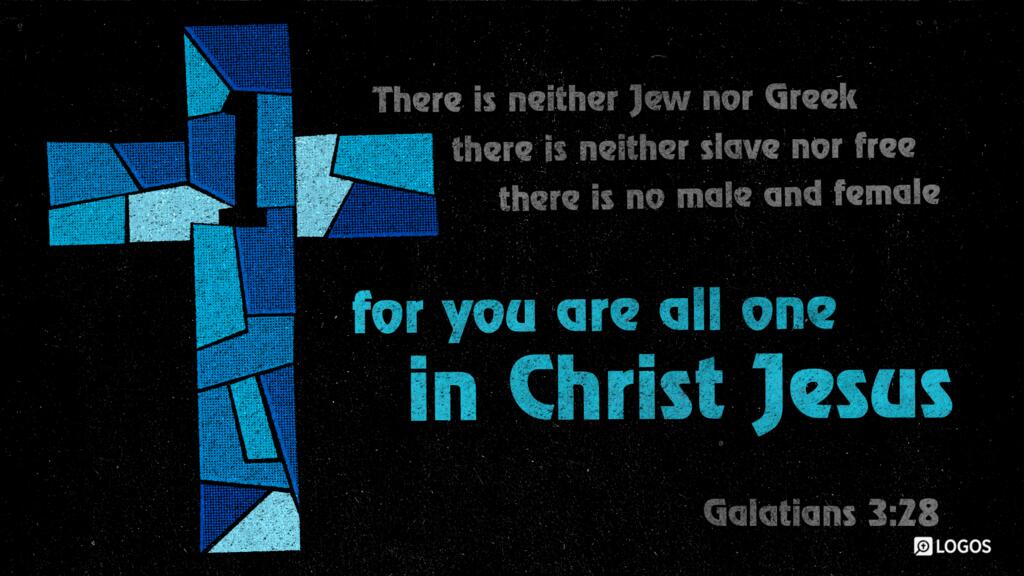
28–29In Christ’s family there can be no division into Jew and non-Jew, slave and free, male and female. Among us you are all equal. That is, we are all in a common relationship with Jesus Christ. Also, since you are Christ’s family, then you are Abraham’s famous “descendant,” heirs according to the covenant promises.
Copyright 2005 Eugene H. Peterson.