2 Chronicles 22:11–24:27
The Message: The Bible in Contemporary LanguageOther versions
English
- MSG The Message: The Bible in Contemporary Language
- DARBY 1890 Darby Bible
- ASV American Standard Version
- AV 1873 The Cambridge Paragraph Bible of the Authorized English Version
- CSB Christian Standard Bible
- D-R Douay-Rheims Bible
- ESV English Standard Version
- GW GOD’S WORD Translation
- GNB Good News Translation
- HCSB The Holman Christian Standard Bible
- KJV 1900 King James Version
- LSB Legacy Standard Bible
- LEB The Lexham English Bible
- NET The NET Bible
- NASB95 New American Standard Bible (1995)
- NCV New Century Version
- NIrV New International Reader’s Version (1998)
- NIV New International Version (2011)
- NKJV The New King James Version
- NLT New Living Translation
- NRSVue New Revised Standard Version: Updated Edition
- RSV The Revised Standard Version
- RSVCE The Revised Standard Version, Catholic Edition
- YLT Young’s Literal Translation
Arabic
Czech
French
German
Hebrew
Hungarian
Italian
Korean
Latin
Portuguese
Russian
Simplified Chinese
Spanish
Traditional Chinese
Jehosheba, daughter of King Jehoram, took Ahaziah’s son Joash, and kidnapped him from among the king’s sons slated for slaughter. She hid him and his nurse in a private room away from Athaliah. So Jehosheba, daughter of King Jehoram and Ahaziah’s sister—she was also the wife of Jehoiada the priest—saved Joash from the murderous Queen Athaliah. He was there with her, hidden away for six years in The Temple of God. Athaliah, oblivious to his existence, ruled the country.
1–323In the seventh year the priest Jehoiada decided to make his move and worked out a strategy with certain influential officers in the army. He picked Azariah son of Jeroham, Ishmael son of Jehohanan, Azariah son of Obed, Maaseiah son of Adaiah, and Elishaphat son of Zicri as his associates. They dispersed throughout Judah and called in the Levites from all the towns in Judah along with the heads of families. They met in Jerusalem. The gathering met in The Temple of God. They made a covenant there in The Temple.
3–7The priest Jehoiada showed them the young prince and addressed them: “Here he is—the son of the king. He is going to rule just as God promised regarding the sons of David. Now this is what you must do: A third of you priests and Levites who come on duty on the Sabbath are to be posted as security guards at the gates; another third will guard the palace; and the other third will guard the foundation gate. All the people will gather in the courtyards of The Temple of God. No one may enter The Temple of God except the priests and designated Levites—they are permitted in because they’ve been consecrated, but all the people must do the work assigned them. The Levites are to form a ring around the young king, weapons at the ready. Kill anyone who tries to break through your ranks. Your job is to stay with the king at all times and places, coming and going.”
8–10All the Levites and officers obeyed the orders of Jehoiada the priest. Each took charge of his men, both those who came on duty on the Sabbath and those who went off duty on the Sabbath, for Jehoiada the priest hadn’t exempted any of them from duty. Then the priest armed the officers with spears and the large and small shields originally belonging to King David that were stored in The Temple of God. Well-armed, the guards took up their assigned positions for protecting the king, from one end of The Temple to the other, surrounding both Altar and Temple.
11Then the priest brought the prince into view, crowned him, handed him the scroll of God’s covenant, and made him king. As Jehoiada and his sons anointed him they shouted, “Long live the king!”
12–13Athaliah, hearing all the commotion, the people running around and praising the king, came to The Temple to see what was going on. Astonished, she saw the young king standing at the entrance flanked by the captains and heralds, with everybody beside themselves with joy, trumpets blaring, the choir and orchestra leading the praise. Athaliah ripped her robes in dismay and shouted, “Treason! Treason!”
14–15Jehoiada the priest ordered the military officers, “Drag her outside—and kill anyone who tries to follow her!” (The priest had said, “Don’t kill her inside The Temple of God.”) So they dragged her out to the palace’s horse corral and there they killed her.
16Jehoiada now made a covenant between himself and the king and the people: they were to be God’s special people.
17The people poured into the temple of Baal and tore it down, smashing altar and images to smithereens. They killed Mattan the priest of Baal in front of the altar.
18–21Jehoiada turned the care of God’s Temple over to the priests and Levites, the way David had directed originally. They were to offer the Whole-Burnt-Offerings of God as set out in The Revelation of Moses, and with praise and song as directed by David. He also assigned security guards at the gates of God’s Temple so that no one who was unprepared could enter. Then he got everyone together—officers, nobles, governors, and the people themselves—and escorted the king down from The Temple of God, through the Upper Gate, and placed him on the royal throne. Everybody celebrated the event. And the city was safe and undisturbed—Athaliah had been killed; no more Athaliah terror.
King Joash
124Joash was seven years old when he became king; he was king for forty years in Jerusalem. His mother’s name was Gazelle (Zibiah). She was from Beer-sheba.
2–3Taught and trained by Jehoiada the priest, Joash did what pleased God throughout Jehoiada’s lifetime. Jehoiada picked out two wives for him; he had a family of both sons and daughters.
4–6The time came when Joash determined to renovate The Temple of God. He got the priests and Levites together and said, “Circulate through the towns of Judah every year and collect money from the people to repair The Temple of your God. You are in charge of carrying this out.” But the Levites dragged their feet and didn’t do anything.
7Then the king called in Jehoiada the chief priest and said, “Why haven’t you made the Levites bring in from Judah and Jerusalem the tax Moses, servant of God and the congregation, set for the upkeep of the place of worship? You can see how bad things are—wicked Queen Athaliah and her sons let The Temple of God go to ruin and took all its sacred artifacts for use in Baal worship.”
8–9Following the king’s orders, they made a chest and placed it at the entrance to The Temple of God. Then they sent out a tax notice throughout Judah and Jerusalem: “Pay the tax that Moses the servant of God set when Israel was in the wilderness.”
10The people and their leaders were glad to do it and cheerfully brought their money until the chest was full.
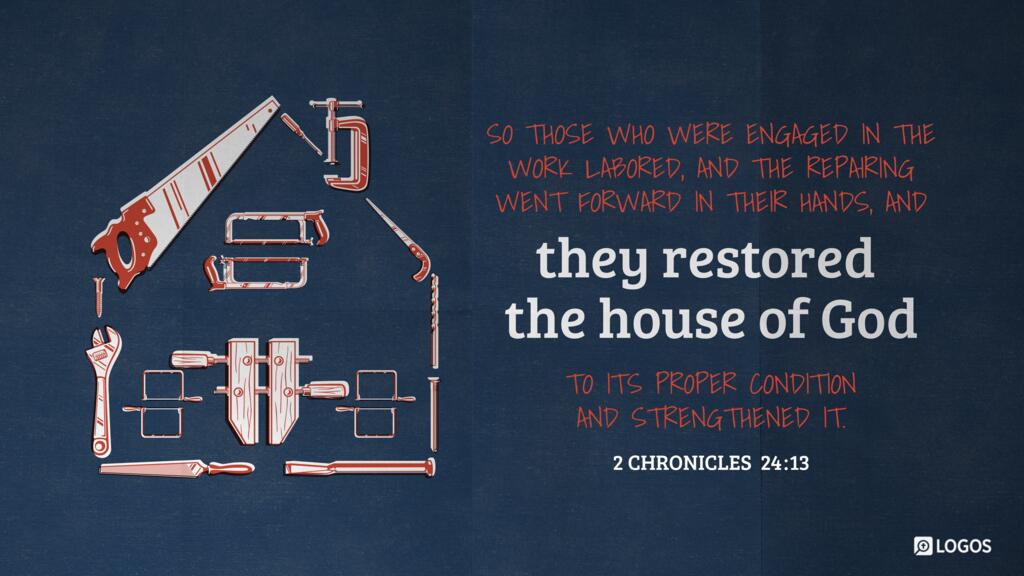
11–14Whenever the Levites brought the chest in for a royal audit and found it to be full, the king’s secretary and the official of the chief priest would empty the chest and put it back in its place. Day after day they did this and collected a lot of money. The king and Jehoiada gave the money to the managers of The Temple project; they in turn paid the masons and carpenters for the repair work on The Temple of God. The construction workers kept at their jobs steadily until the restoration was complete—the house of God as good as new! When they had finished the work, they returned the surplus money to the king and Jehoiada, who used the money for making sacred vessels for Temple worship, vessels for the daily worship, for the Whole-Burnt-Offerings, bowls, and other gold and silver liturgical artifacts.
14–16Whole-Burnt-Offerings were made regularly in The Temple of God throughout Jehoiada’s lifetime. He died at a ripe old age—130 years old! They buried him in the royal cemetery because he had such a distinguished life of service to Israel and God and God’s Temple.
17–19But after the death of Jehoiada things fell apart. The leaders of Judah made a formal presentation to the king and he went along with them. Things went from bad to worse; they deserted The Temple of God and took up with the cult of sex goddesses. An angry cloud hovered over Judah and Jerusalem because of this sin. God sent prophets to straighten them out, warning of judgment. But nobody paid attention.
20Then the Spirit of God moved Zechariah son of Jehoiada the priest to speak up: “God’s word: Why have you deliberately walked away from God’s commandments? You can’t live this way! If you walk out on God, he’ll walk out on you.”
21–22But they worked out a plot against Zechariah, and with the complicity of the king—he actually gave the order!—they murdered him, pelting him with rocks, right in the court of The Temple of God. That’s the thanks King Joash showed the loyal Jehoiada, the priest who had made him king. He murdered Jehoiada’s son. Zechariah’s last words were, “Look, God! Make them pay for this!”
23–24A year or so later Aramean troops attacked Joash. They invaded Judah and Jerusalem, massacred the leaders, and shipped all their plunder back to the king in Damascus. The Aramean army was quite small, but God used them to wipe out Joash’s large army—their punishment for deserting God, the God of their ancestors. Arameans implemented God’s judgment against Joash.
25–27They left Joash badly wounded and his own servants finished him off—it was a palace conspiracy, avenging the murder of the son of Jehoiada the priest. They killed him in his bed. Afterward they buried him in the City of David, but he was not honored with a grave in the royal cemetery. The temple conspirators were Zabad, whose mother was Shimeath from Ammon, and Jehozabad, whose mother was Shimrith from Moab. The story of his sons, the many sermons preached to Joash, and the account of his repairs on The Temple of God can be found contained in the commentary on the royal history.
Amaziah, Joash’s son, was the next king.
Copyright 2005 Eugene H. Peterson.