Song of Solomon 2:4–16
The Lexham English BibleOther versions
English
- LEB The Lexham English Bible
- DARBY 1890 Darby Bible
- ASV American Standard Version
- AV 1873 The Cambridge Paragraph Bible of the Authorized English Version
- CSB Christian Standard Bible
- D-R Douay-Rheims Bible
- ESV English Standard Version
- GW GOD’S WORD Translation
- GNB Good News Translation
- HCSB The Holman Christian Standard Bible
- KJV 1900 King James Version
- LSB Legacy Standard Bible
- MSG The Message: The Bible in Contemporary Language
- NET The NET Bible
- NASB95 New American Standard Bible (1995)
- NCV New Century Version
- NIrV New International Reader’s Version (1998)
- NIV New International Version (2011)
- NKJV The New King James Version
- NLT New Living Translation
- NRSVue New Revised Standard Version: Updated Edition
- RSV The Revised Standard Version
- RSVCE The Revised Standard Version, Catholic Edition
- YLT Young’s Literal Translation
Arabic
Czech
French
German
Hebrew
Hungarian
Italian
Korean
Latin
Portuguese
Russian
Simplified Chinese
Spanish
Traditional Chinese
Banquet Hall of Love
4He brought me to the house of the wine,
and his intention was love toward me.
5Sustain me with the raisins,
refresh me with the apples,
for I am lovesick.d
Double Refrain: Embrace and Adjuration
6His left hand is under my head,
and his right hand embracese me.
7I adjure you, O maidens of Jerusalem,f
by the gazelles or by the does of the field,
do not arouse or awaken love until it pleases!g
Rendezvous in the Countryside
8The voice of my beloved!
Look! Here heh comes leaping upon the mountains,
bounding over the hills!
9My beloved is like a gazelle or a young stag.i
Look! He isj standing behind our wall,
gazing throughk the window,
looking throughl the lattice.
10My beloved answered and said to me,
“Arise,m my beloved! Come, my beauty!n
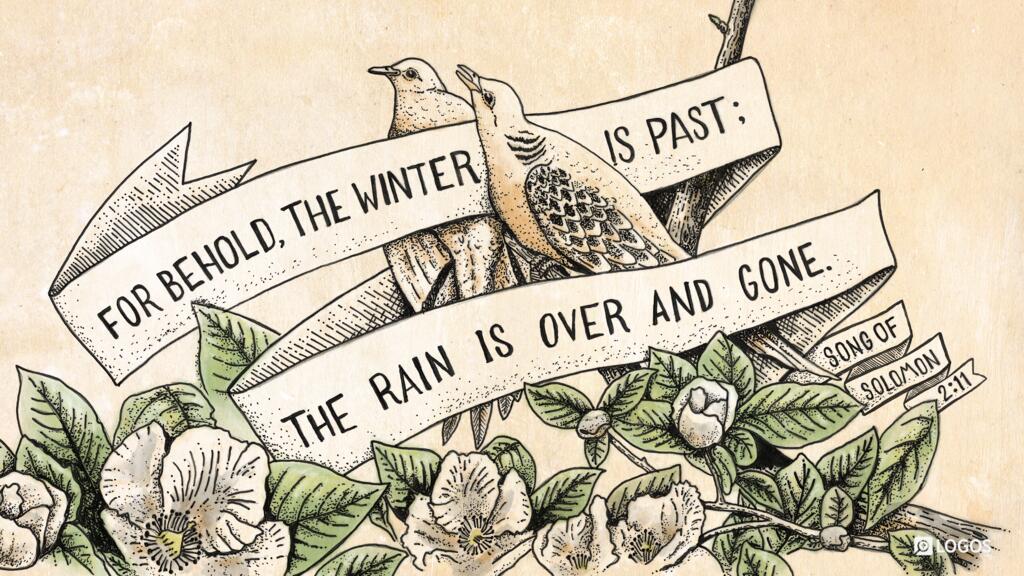
11For look! The winter is over;
the rainy seasono has turned and gone away.p
12The blossoms appearq in the land;r
the time of singings has arrived;t
the voice of the turtledove is heard in our land.
13The fig tree puts forth her figs,
and the vines are in blossom; they give fragrance.
Arise,u my beloved! Come, my beauty!”v
14My dove, in the clefts of the rock,
in the secluded placewx in the mountain,yz
Let me see your face,
let me hear your voice;
for your voice is sweet and your face is lovely.
15Catch for us the foxes,
the little foxes destroying vineyards,
fora our vineyards are in blossom!
Poetic Refrain
16My beloved belongs to me and I belong to him;b
he pastures his flock among the lilies.
Footnotes
- dLiterally “for I myself am sick with love”
- eOr “would embrace me”
- fLiterally “O daughters of Jerusalem”
- gOr “Do not stir up or awaken the love until it is willing,” or “Do not disturb or interrupt our lovemaking until it is satisfied”
- hLiterally “this one”
- iLiterally “the fawn of the stag”
- jLiterally “This is he”
- kLiterally “from”
- lLiterally “from”
- mLiterally “Arise, you”
- nLiterally “And come, you”
- oLiterally “the rain”
- pLiterally “is over; it is gone”
- qLiterally “is seen”
- rLiterally “on the earth”
- sMost likely, a subtle word play occurs here since there are two different words in Hebrew spelled the same way: “pruning” and “singing.” The former plays upon the first line and the latter upon the third line
- tLiterally “the time of the song arrived”
- uLiterally “Arise, to you!”
- vLiterally “My beauty, come, you”
- wLiterally “in the secret place”
- xOr “in the covering”
- yLiterally “foothold in the rock”
- zOr “cliff”
- aOr “while”
- bLiterally “My beloved for me and I for him”
Copyright 2012 Lexham Press