Matthew 5:1–16
The Lexham English BibleOther versions
English
- LEB The Lexham English Bible
- DARBY 1890 Darby Bible
- ASV American Standard Version
- AV 1873 The Cambridge Paragraph Bible of the Authorized English Version
- CSB Christian Standard Bible
- D-R Douay-Rheims Bible
- ESV English Standard Version
- GW GOD’S WORD Translation
- GNB Good News Translation
- HCSB The Holman Christian Standard Bible
- KJV 1900 King James Version
- LSB Legacy Standard Bible
- MSG The Message: The Bible in Contemporary Language
- NET The NET Bible
- NASB95 New American Standard Bible (1995)
- NCV New Century Version
- NIrV New International Reader’s Version (1998)
- NIV New International Version (2011)
- NKJV The New King James Version
- NLT New Living Translation
- NRSVue New Revised Standard Version: Updated Edition
- RSV The Revised Standard Version
- RSVCE The Revised Standard Version, Catholic Edition
- YLT Young’s Literal Translation
Arabic
Czech
French
German
Greek
Hungarian
Italian
Korean
Latin
Portuguese
Russian
Simplified Chinese
Spanish
Traditional Chinese
The Sermon on the Mount: The Beatitudes
5Now when he* saw the crowds, he went up the mountain and after he* sat down, his disciples approached him. 2And opening his mouth he began to teach them, saying,
3“Blessed are the poor in spirit,
because theirs is the kingdom of heaven.
4Blessed are the ones who mourn,
because they will be comforted.
5Blessed are the meek,
because they will inherit the earth.
6Blessed are the ones who hunger and thirst for righteousness,
because they will be satisfied.
7Blessed are the merciful,
because they will be shown mercy.
8Blessed are the pure in heart,
because they will see God.
9Blessed are the peacemakers,
because they will be called sons of God.
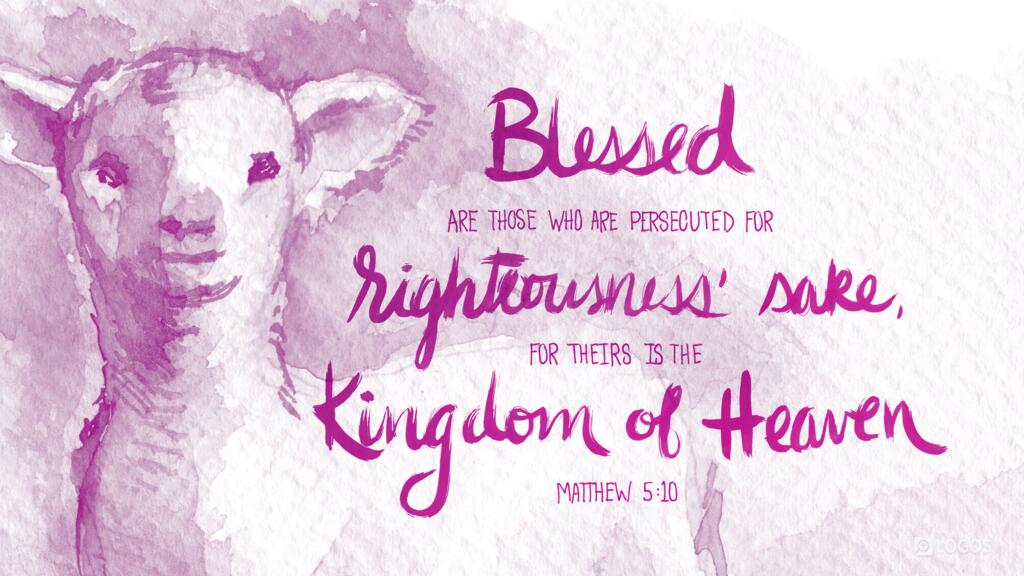
10Blessed are those who are persecuted because of righteousness,
because theirs is the kingdom of heaven.
11Blessed are you
when they insult you and persecute you and say all kinds of evil things against you, lying on account of me. 12Rejoice and be glad, because your reward is great in heaven, for in the same way they persecuted the prophets before you.
The Sermon on the Mount: Salt and Light
13“You are the salt of the earth. But if salt becomes tasteless, by what will it be made salty? It is good for nothing any longer except to be thrown outside and* trampled under foot by people. 14You are the light of the world. A city located on top of a hill cannot be hidden, 15nor do they light a lamp and place it under a basket, but on a lampstand, and it shines on all those in the house. 16In the same way let your light shine before people, so that they can see your good works and glorify your Father who is in heaven.
Footnotes
- *Here “when” is supplied as a component of the participle (“saw”) which is understood as temporal
- *Here “after” is supplied as a component of the participle (“sat down”) which is understood as temporal
- *Here “and” is supplied because the previous participle (“thrown”) has been translated as a finite verb
Copyright 2012 Lexham Press