Matthew 13:24–46
The Lexham English BibleOther versions
English
- LEB The Lexham English Bible
- DARBY 1890 Darby Bible
- ASV American Standard Version
- AV 1873 The Cambridge Paragraph Bible of the Authorized English Version
- CSB Christian Standard Bible
- D-R Douay-Rheims Bible
- ESV English Standard Version
- GW GOD’S WORD Translation
- GNB Good News Translation
- HCSB The Holman Christian Standard Bible
- KJV 1900 King James Version
- LSB Legacy Standard Bible
- MSG The Message: The Bible in Contemporary Language
- NET The NET Bible
- NASB95 New American Standard Bible (1995)
- NCV New Century Version
- NIrV New International Reader’s Version (1998)
- NIV New International Version (2011)
- NKJV The New King James Version
- NLT New Living Translation
- NRSVue New Revised Standard Version: Updated Edition
- RSV The Revised Standard Version
- RSVCE The Revised Standard Version, Catholic Edition
- TNIV Today’s New International Version
- YLT Young’s Literal Translation
Arabic
Czech
French
German
Greek
Hungarian
Italian
Korean
Latin
Portuguese
Russian
Simplified Chinese
Spanish
Traditional Chinese
The Parable of the Weeds Among the Wheat
24He put before them another parable, saying, “The kingdom of heaven may be compared to a man who sowed good seed in his field. 25But while hisj people were sleeping, his enemy came and sowed darnelk in the midst of the wheat and went away. 26So when the wheatl sprouted and yielded grain, then the darnel appeared also. 27So the slaves of the master of the house came and* said to him, ‘Master, did you not sow good seed in your field? How then does it have darnel?’ 28And he said to them, ‘An enemy has done this!’ So the slaves said to him, ‘Then do you want us to go and* gather them?’ 29But he said, “No, lest when you* gather the darnel you uproot the wheat together with it. 30Let both grow together until the harvest, and at the season of the harvest I will tell the reapers, “First gather the darnel and tie it into bundles to burn them, but gather the wheat into my storehouse.” ’ ”
The Parable of the Mustard Seed
31He put before them another parable, saying, “The kingdom of heaven is like a mustard seed that a man took and* sowed in his field. 32Itm is the smallest of all the seeds, but when it is grown it is larger than the garden herbs and becomes a tree, so that the birds of the sky come and nest in its branches.”
The Parable of the Yeast
33He told them another parable: “The kingdom of heaven is like yeast that a woman took and* put into three measures of wheat flour until the whole batch was leavened.”
Parables Fulfill Prophecy
34Jesus spoke all these things to the crowds in parables, and he was saying nothing to them without a parable, 35in order that what was spoken through the prophet would be fulfilled, who said,
“I will open my mouth in parables;
I will proclaim what has been hidden since the creation.”no
The Parable of the Weeds Interpreted
36Then he left the crowds and* came into the house, and his disciples came to him saying, “Explain the parable of the darnel in the field to us.” 37So he answered and* said, “The one who sows the good seed is the Son of Man, 38and the field is the world. And the good seed—these are the sons of the kingdom, but the darnel are the sons of the evil one. 39And the enemy who sowed them is the devil, and the harvest is the end of the age, and the reapers are angels. 40Thus just as the darnel is gathered and burnedp with fire, so it will be at the end of the age. 41The Son of Man will send out his angels and they will gather out of his kingdom all the causes of sin and those who do lawless deeds, 42and throw them into the fiery furnace.q In that place there will be weeping and gnashing of teeth! 43Then the righteous will shine like the sun in the kingdom of their Father.r The one who has ears, let him hear!
The Parable of the Treasure Hidden in a Field
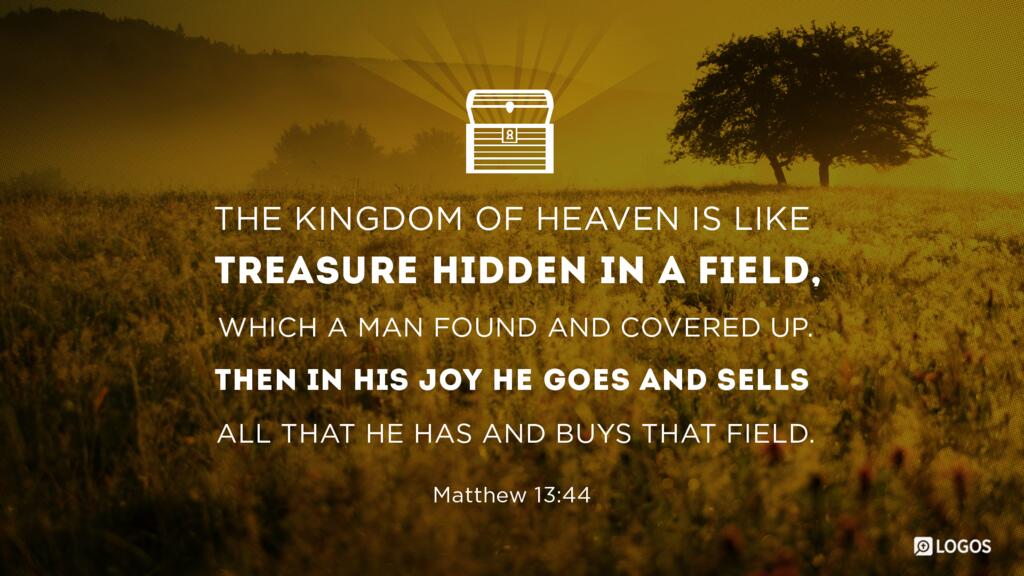
44“The kingdom of heaven is like treasure hidden in a field, that a man found and* concealed, and in his joy he goes and sells everything that he has and buys that field.
The Parable of the Valuable Pearl
45“Again, the kingdom of heaven is like a merchant searching for fine pearls. 46And when he* found one very valuable pearl, he went and* sold everything that he possessed and purchased it.
Footnotes
- jLiterally “the”; the Greek article is used here as a possessive pronoun
- kA weed that looks similar to wheat but has poisonous seeds
- lLiterally “grass,” “hay,” but in this context referring to the good plants as opposed to the weeds
- *Here “and” is supplied because the previous participle (“came”) has been translated as a finite verb
- *Here “and” is supplied because the previous participle (“go”) has been translated as an English infinitive
- *Here “when” is supplied as a component of the participle (“gather”) which is understood as temporal
- *Here “and” is supplied because the previous participle (“took”) has been translated as a finite verb
- mLiterally “which,” but a new sentence is started here in the English translation
- *Here “and” is supplied because the previous participle (“took”) has been translated as a finite verb
- nA quotation from Ps 78:2
- oSome manuscripts have “since the creation of the world”
- *Here “and” is supplied because the previous participle (“left”) has been translated as a finite verb
- *Here “and” is supplied because the previous participle (“answered”) has been translated as a finite verb
- pSome manuscripts have “burned up”
- qAn allusion to Dan 3:6
- rAn allusion to Dan 12:3
- *Here “and” is supplied because the previous participle (“found”) has been translated as a finite verb
- *Here “when” is supplied as a component of the participle (“found”) which is understood as temporal
- *Here “and” is supplied because the previous participle (“went”) has been translated as a finite verb
Copyright 2012 Lexham Press