Mark 10:1–31
The Lexham English BibleOther versions
English
- LEB The Lexham English Bible
- DARBY 1890 Darby Bible
- ASV American Standard Version
- AV 1873 The Cambridge Paragraph Bible of the Authorized English Version
- CSB Christian Standard Bible
- D-R Douay-Rheims Bible
- ESV English Standard Version
- GW GOD’S WORD Translation
- GNB Good News Translation
- HCSB The Holman Christian Standard Bible
- KJV 1900 King James Version
- LSB Legacy Standard Bible
- MSG The Message: The Bible in Contemporary Language
- NET The NET Bible
- NASB95 New American Standard Bible (1995)
- NCV New Century Version
- NIrV New International Reader’s Version (1998)
- NIV New International Version (2011)
- NKJV The New King James Version
- NLT New Living Translation
- NRSVue New Revised Standard Version: Updated Edition
- RSV The Revised Standard Version
- RSVCE The Revised Standard Version, Catholic Edition
- YLT Young’s Literal Translation
Arabic
Czech
French
German
Greek
Hungarian
Italian
Korean
Latin
Portuguese
Russian
Simplified Chinese
Spanish
Traditional Chinese
On Divorce
10And from there he set out and* came to the region of Judea and the other side of the Jordan, and again crowds came together to him. And again, as he was accustomed to do,* he began to teacha them. 2And they askedb him if it was permitted for a man to divorce hisc wife, in order to* test him. 3And he answered and* said to them, “What did Moses command you?” 4So they said, “Moses permitted a man* to write a certificate of divorce and to send her* away.” 5But Jesus said to them, “He wrote this commandment for you because of your hardness of heart. 6But from the beginning of creation ‘he made them male and female.d 7Because of this a man will leave his father and mother and will be joined to his wife,e 8and the two will become one flesh,’f so that they are no longer two but one flesh. 9Therefore what God has joined together, man must not separate.”
10And in the house again the disciples began to askg him about this. 11And he said to them, “Whoever divorces his wife and marries another commits adultery against her. 12And if she divorces her husband and* marries another, she commits adultery.”
Little Children Brought to Jesus
13And they were bringing young children to him so that he could touch them, but the disciples rebuked them. 14But when* Jesus saw it,* he was indignant, and said to them, “Let the young children come to me. Do not forbid them, for to such belongsh the kingdom of God. 15Truly I say to you, whoever does not welcome the kingdom of God like a young child will never enter into it.” 16And after* taking them* into his arms, he blessed them, placing hisi hands on them.
A Rich Young Man
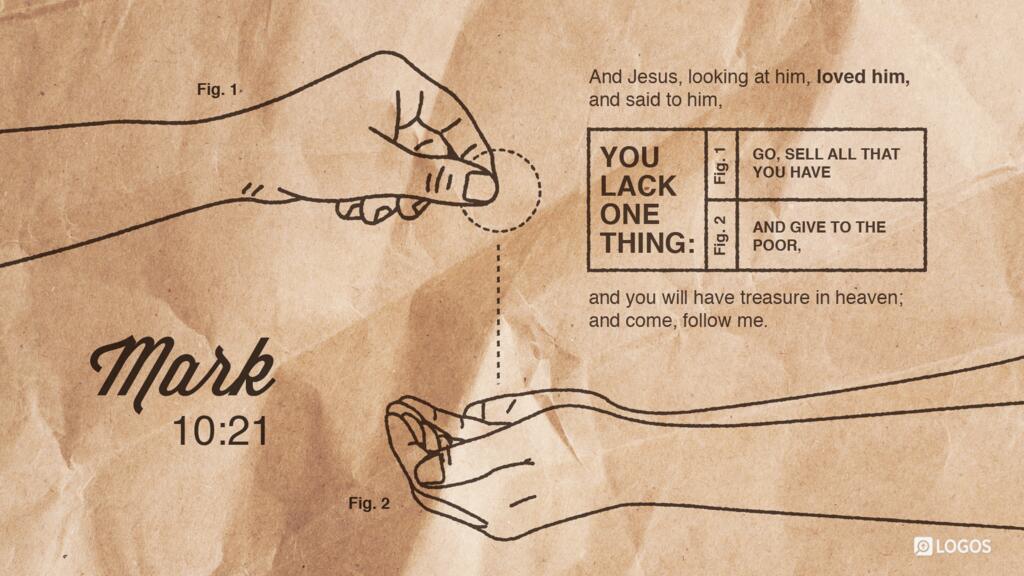
17And as* he was setting out on his way, one individual ran up and knelt down before him and* asked him, “Good Teacher, what must I do so that I will inherit eternal life?” 18So Jesus said to him, “Why do you call me good? No one is good except God alone. 19You know the commandments: ‘Do not murder, do not commit adultery, do not steal, do not give false testimony, do not defraud, honor your father and mother.’ ”j 20And he said to him, “Teacher, all these I have observed from my youth.” 21And Jesus, looking at him, loved him, and said to him, “You lack one thing: Go, sell all that you have, and give the proceeds* to the poor—and you will have treasure in heaven—and come, follow me.” 22But he looked gloomy at the statement and* went away sorrowful, because he hadk many possessions.
23And Jesus looked around and* said to his disciples, “How difficult it is forl those who possess wealth to enter into the kingdom of God!” 24And the disciples were astounded at his words. But Jesus answered and* said to them again, “Children, how difficult it is to enter into the kingdom of God! 25It is easier for a camel to go through the eye of a needle than for a rich person to enter into the kingdom of God.” 26And they were very astounded, saying to one another, “And who can be saved?” 27Jesus looked at them and* said, “With human beings it is impossible, but not with God. For all things are possible with God.” 28Peter began to say to him, “Behold, we have left everything and followed you.” 29Jesus said, “Truly I say to you, there is no one who has left house or brothers or sisters or mother or father or children or fields on account of me and on account of the gospel 30who will notm receive a hundred times as much now in this time—houses and brothers and sisters and mothers and children and fields, together with persecutions—and in the age to come, eternal life. 31But many who are first will be last, and the last first.”
Footnotes
- *Here “and” is supplied because the previous participle (“set out”) has been translated as a finite verb
- *The words “to do” are not in the Greek text but are implied
- aThe imperfect tense has been translated as ingressive here (“began to teach”)
- bSome manuscripts have “And Pharisees came up and asked”
- cThe pronoun “his” is not in the Greek text but is implied
- *Here “in order to” is supplied as a component of the participle (“test”) which is understood as purpose
- *Here “and” is supplied because the previous participle (“answered”) has been translated as a finite verb
- *Here the direct object is supplied from context in the English translation
- *Here the direct object is supplied from context in the English translation
- dA quotation from Gen 1:27; 5:2
- eThe earliest and most important manuscripts do not contain the phrase “and be joined to his wife”
- fA quotation from Gen 2:24
- gThe imperfect tense has been translated as ingressive here (“began to ask”)
- *Here “and” is supplied because the previous participle (“divorces”) has been translated as a finite verb
- *Here “when” is supplied as a component of the participle (“saw”) which is understood as temporal
- *Here the direct object is supplied from context in the English translation
- hLiterally “for of such is”
- *Here “after” is supplied as a component of the participle (“taking … into his arms”) which is understood as temporal
- *Here the direct object is supplied from context in the English translation
- iLiterally “the”; the Greek article is used here as a possessive pronoun
- *Here “as” is supplied as a component of the temporal genitive absolute participle (“was setting out”)
- *Here “and” is supplied because the two previous participles (“ran up” and “knelt down before”) have been translated as finite verbs
- jA quotation from Exod 20:12–16; Deut 5:16–20, except for “do not defraud” which is an allusion to Deut 24:14
- *Here the direct object is supplied from context in the English translation
- *Here “and” is supplied because the previous participle (“looked gloomy”) has been translated as a finite verb
- kLiterally “because he was having”
- *Here “and” is supplied because the previous participle (“looked around”) has been translated as a finite verb
- lLiterally “with difficulty”
- *Here “and” is supplied because the previous participle (“answered”) has been translated as a finite verb
- *Here “and” is supplied because the previous participle (“looked at”) has been translated as a finite verb
- mLiterally “unless he will not”
Copyright 2012 Lexham Press