Mark 10:13–12:12
The Lexham English BibleOther versions
English
- LEB The Lexham English Bible
- DARBY 1890 Darby Bible
- ASV American Standard Version
- AV 1873 The Cambridge Paragraph Bible of the Authorized English Version
- CSB Christian Standard Bible
- D-R Douay-Rheims Bible
- ESV English Standard Version
- GW GOD’S WORD Translation
- GNB Good News Translation
- HCSB The Holman Christian Standard Bible
- KJV 1900 King James Version
- LSB Legacy Standard Bible
- MSG The Message: The Bible in Contemporary Language
- NET The NET Bible
- NASB95 New American Standard Bible (1995)
- NCV New Century Version
- NIrV New International Reader’s Version (1998)
- NIV New International Version (2011)
- NKJV The New King James Version
- NLT New Living Translation
- NRSVue New Revised Standard Version: Updated Edition
- RSV The Revised Standard Version
- RSVCE The Revised Standard Version, Catholic Edition
- YLT Young’s Literal Translation
Arabic
Czech
French
German
Greek
Hungarian
Italian
Korean
Latin
Portuguese
Russian
Simplified Chinese
Spanish
Traditional Chinese
Little Children Brought to Jesus
13And they were bringing young children to him so that he could touch them, but the disciples rebuked them. 14But when* Jesus saw it,* he was indignant, and said to them, “Let the young children come to me. Do not forbid them, for to such belongsh the kingdom of God. 15Truly I say to you, whoever does not welcome the kingdom of God like a young child will never enter into it.” 16And after* taking them* into his arms, he blessed them, placing hisi hands on them.
A Rich Young Man
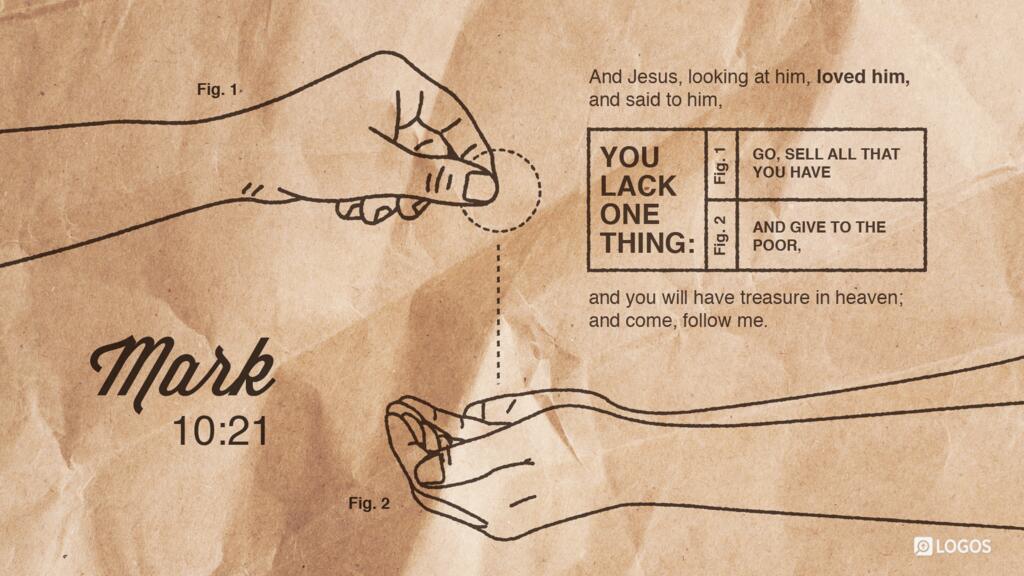
17And as* he was setting out on his way, one individual ran up and knelt down before him and* asked him, “Good Teacher, what must I do so that I will inherit eternal life?” 18So Jesus said to him, “Why do you call me good? No one is good except God alone. 19You know the commandments: ‘Do not murder, do not commit adultery, do not steal, do not give false testimony, do not defraud, honor your father and mother.’ ”j 20And he said to him, “Teacher, all these I have observed from my youth.” 21And Jesus, looking at him, loved him, and said to him, “You lack one thing: Go, sell all that you have, and give the proceeds* to the poor—and you will have treasure in heaven—and come, follow me.” 22But he looked gloomy at the statement and* went away sorrowful, because he hadk many possessions.
23And Jesus looked around and* said to his disciples, “How difficult it is forl those who possess wealth to enter into the kingdom of God!” 24And the disciples were astounded at his words. But Jesus answered and* said to them again, “Children, how difficult it is to enter into the kingdom of God! 25It is easier for a camel to go through the eye of a needle than for a rich person to enter into the kingdom of God.” 26And they were very astounded, saying to one another, “And who can be saved?” 27Jesus looked at them and* said, “With human beings it is impossible, but not with God. For all things are possible with God.” 28Peter began to say to him, “Behold, we have left everything and followed you.” 29Jesus said, “Truly I say to you, there is no one who has left house or brothers or sisters or mother or father or children or fields on account of me and on account of the gospel 30who will notm receive a hundred times as much now in this time—houses and brothers and sisters and mothers and children and fields, together with persecutions—and in the age to come, eternal life. 31But many who are first will be last, and the last first.”
Jesus Predicts His Death and Resurrection a Third Time
32Now they were on the road going up to Jerusalem, and Jesus was going on ahead of them. And they were astounded, but those who were following him* were afraid. And taking aside the twelve again, he began to tell them the things that were about to happen to him: 33“Behold, we are going up to Jerusalem, and the Son of Man will be handed over to the chief priests and the scribes, and they will condemn him to death and will hand him over to the Gentiles. 34And they will mock him and spit on him and flog him and kill him,* and after three days he will rise.”
A Request by James and John
35And James and John, the sons of Zebedee, came up to him and* said to him, “Teacher, we want you to do for us whatever we ask you.” 36And he said to them, “What do you want that I don for you?” 37So they said to him, “Grant to us that we may sit one at your right hand and one at your left in your glory.” 38But Jesus said to them, “You do not know what you are asking! Are you able to drink the cup that I drink, or to be baptized with the baptism that I am baptized with?” 39And they said to him, “We are able.” So Jesus said to them, “You will drink the cup that I drink, and you will be baptized with the baptism that I am baptized with, 40but to sit at my right hand or at my left is not mine to grant, but is for those for whom it has been prepared.” 41And when they* heard this,* the ten began to be indignant about James and John. 42And Jesus called them to himself and* said to them, “You know that those who are considered to rule over the Gentiles lord it over them, and their people in high positions exercise authority over them. 43But it is not like this among you! But whoever wants to become great among you must be your servant, 44and whoever wants to be most prominent among you must be the slave of all. 45For even the Son of Man did not come to be served, but to serve, and to give his life as a ransom for many.”
A Blind Man Healed at Jericho
46And they came to Jericho. And as* he was setting out from Jericho along with his disciples and a large crowd, a blind beggar, Bartimaeus the son of Timaeus, was sitting beside the road. 47And when he* heard that it was Jesus the Nazarene, he began to cry out and say, “Jesus, Son of David, have mercy on me!” 48And many people warned him that he should be quiet. But he was crying out even more loudly,o “Son of David, have mercy on me!” 49And Jesus stopped and* said, “Call him.” And they called the blind man and* said to him, “Have courage! Get up! He is calling you.” 50And he threw off his cloak, jumped up, and* came to Jesus. 51And Jesus answered him and* said, “What do you want me to dop for you?” And the blind man said to him, “Rabboni,q that I may regain my sight.” 52And Jesus said to him, “Go, your faith has healed you.” And immediately he regained his sight and began to followr him on the road.
The Triumphal Entry
11And when they came near to Jerusalem, to Bethphage and Bethany at the Mount of Olives, he sent two of his disciples 2and said to them, “Go into the village before you, and right away as you* enter into it you will find a colt tied, on which no one has ever sat. Untie it and bring it.* 3And if anyone says to you, ‘Why are you doing this?’ saya ‘The Lord has need of it, and will send it here again at once.’ ” 4And they went away and found a colt tied at a door outside in the street, and they untied it. 5And some of those who were standing there said to them, “What are you doing, untying the colt?” 6So they told them, just as Jesus had said, and they allowed them to take it.b 7And they brought the colt to Jesus and threw their cloaks over it, and he sat on it. 8And many people spread their cloaks on the road, and others spread* leafy branches they* had cut from the fields. 9And those who went ahead and those who were following were shouting,
“Hosanna!
Blessed is the one who comes in the name of the Lord!c
10Blessed is the coming kingdom of our father David!
Hosanna in the highest heaven!”*
11And he went into Jerusalem to the temple, and after* looking around at everything, because* the hour was already late, he went out to Bethany with the twelve.
A Barren Fig Tree Cursed
12And on the next day as* they were departing from Bethany, he was hungry. 13And when he* saw from a distance a fig tree that had leaves, he went to see if perhaps he would find anything on it. And when he* came up to it he found nothing except leaves, because it was not the season for figs. 14And he responded and* said to it, “Let no one eat fruit from you any more forever!”d And his disciples heard it.*
The Cleansing of the Temple
15And they came to Jerusalem. And he entered into the temple courts* and* began to drive out those who were selling and those who were buying in the temple courts,* and overturned the tables of the money changers and the chairs of those who were selling doves. 16And he did not permit anyone to carry objectse through the temple courts.* 17And he began to teachf and was saying to them, “Is it not written,
‘My house will be called a house of prayer
for all the nations,’g
but you have made it a cave of robbers!” 18And the chief priests and the scribes heard it,* and began consideringh how they could destroy him. For they were afraid of him because the whole crowd was astounded by his teaching. 19And when evening came they went out of the city.
The Barren Fig Tree Withered
20And as they* passed by early in the morning, they saw the fig tree withered from the roots. 21And Peter remembered and* said to him, “Rabbi, look! The fig tree that you cursed has withered!” 22And Jesus answered and* said to them, “Have faith in God! 23Truly I say to you that whoever says to this mountain, ‘Be lifted up and thrown into the sea!’ and does not doubt in his heart, but believes that what he says will happen, it will be done for him. 24For this reason I say to you, whatever you pray and ask for, believe that you have received it,* and it will be done for you. 25And whenever you stand praying, if you have anything against anyone, forgive him,* so that your Father who is in heaven will also forgive you your sins.”i
Jesus’ Authority Challenged
27And they came again to Jerusalem. And as* he was walking in the temple courts,* the chief priests and the scribes and the elders came up to him 28and said to him, “By what authority are you doing these things, or who gave you this authority that you do these things?” 29So Jesus said to them, “I will ask you one question. Answer me and I will tell you by what authority I am doing these things. 30The baptism of John—was it from heaven or from men? Answer me!” 31And they began to discussj this* with one another, saying, “What should we say?k If we say ‘From heaven,’ he will say, ‘Why then did you not believe him?’ 32But if we say, ‘From men’ ”—they were afraid of the crowd, because they all looked upon John as truly a prophet.l 33And they replied to Jesus saying, “We do not know.” And Jesus said to them, “Neither will I tell you by what authority I am doing these things.”
The Parable of the Tenant Farmers in the Vineyard
12And he began to speak to them in parables: “A man planted a vineyard, and put a fence around it, and dug a trough for the winepress, and built a watchtower, and leased it to tenant farmers, and went on a journey. 2And he sent a slave to the tenant farmers at the proper time, so that he could collect some of the fruit of the vineyard…
This passage has been shortened. Keep reading Mark 10:13–12:12 in Logos
Footnotes
- *Here “when” is supplied as a component of the participle (“saw”) which is understood as temporal
- *Here the direct object is supplied from context in the English translation
- hLiterally “for of such is”
- *Here “after” is supplied as a component of the participle (“taking … into his arms”) which is understood as temporal
- *Here the direct object is supplied from context in the English translation
- iLiterally “the”; the Greek article is used here as a possessive pronoun
- *Here “as” is supplied as a component of the temporal genitive absolute participle (“was setting out”)
- *Here “and” is supplied because the two previous participles (“ran up” and “knelt down before”) have been translated as finite verbs
- jA quotation from Exod 20:12–16; Deut 5:16–20, except for “do not defraud” which is an allusion to Deut 24:14
- *Here the direct object is supplied from context in the English translation
- *Here “and” is supplied because the previous participle (“looked gloomy”) has been translated as a finite verb
- kLiterally “because he was having”
- *Here “and” is supplied because the previous participle (“looked around”) has been translated as a finite verb
- lLiterally “with difficulty”
- *Here “and” is supplied because the previous participle (“answered”) has been translated as a finite verb
- *Here “and” is supplied because the previous participle (“looked at”) has been translated as a finite verb
- mLiterally “unless he will not”
- *Here the direct object is supplied from context in the English translation
- *Here the direct object is supplied from context in the English translation
- *Here “and” is supplied because the participle (“said”) has been translated as a finite verb in keeping with English style
- nSome manuscripts have “do you want me to do”
- *Here “when” is supplied as a component of the participle (“heard”) which is understood as temporal
- *Here the direct object is supplied from context in the English translation
- *Here “and” is supplied because the previous participle (“called … to himself”) has been translated as a finite verb
- *Here “as” is supplied as a component of the temporal genitive absolute participle (“was setting out”)
- *Here “when” is supplied as a component of the participle (“heard”) which is understood as temporal
- oLiterally “by much more”
- *Here “and” is supplied because the previous participle (“stopped”) has been translated as a finite verb
- *Here “and” is supplied because the previous participle (“called”) has been translated as a finite verb
- *Here “and” is supplied because the two previous participles (“threw off” and “jumped up”) have been translated as finite verbs
- *Here “and” is supplied because the previous participle (“answered”) has been translated as a finite verb
- pLiterally “that I do”
- qThe Aramaic term is an elevated form of Rabbi
- rThe imperfect tense has been translated as ingressive here (“began to follow”)
- *Here “as” is supplied as a component of the participle (“enter”) which is understood as temporal
- *Here the direct object is supplied from context in the English translation
- aSome manuscripts omit “that” after “say” here; though understood to be present in the underlying Greek text, it introduces direct discourse here and is left untranslated, functioning much like English quotation marks
- bThe phrase “to take it” is not in the Greek text, but is implied
- *Here the verb “spread” is an understood repetition of the verb earlier in this verse
- *Here the participle “had cut” has been translated as a finite verb; it agrees in number, gender, and case with “others,” so “they’ has been supplied to indicate this
- cA quotation from Ps 118:25–26
- *Here “heaven” is understood
- *Here “after” is supplied as a component of the participle (“looking around”) which is understood as temporal
- *Here “because” is supplied as a component of the participle (“was”) which is understood as causal
- *Here “as” is supplied as a component of the temporal genitive absolute participle (“were departing”)
- *Here “when” is supplied as a component of the participle (“saw”) which is understood as temporal
- *Here “when” is supplied as a component of the participle (“came up”) which is understood as temporal
- *Here “and” is supplied because the previous participle (“responded”) has been translated as a finite verb
- dLiterally “for the age”
- *Here the direct object is supplied from context in the English translation
- *Here “courts” is supplied to distinguish this area from the interior of the temple building itself
- *Here “and” is supplied because the previous participle (“entered”) has been translated as a finite verb
- *Here “courts” is supplied to distinguish this area from the interior of the temple building itself
- eOr “merchandise”
- *Here “courts” is supplied to distinguish this area from the interior of the temple building itself
- fThe imperfect tense has been translated as ingressive here (“began to teach”)
- gA quotation from Isa 56:7
- *Here the direct object is supplied from context in the English translation
- hThe imperfect tense has been translated as ingressive here (“began considering”)
- *Here “as” is supplied as a component of the participle (“passed by”) which is understood as temporal
- *Here “and” is supplied because the previous participle (“remembered”) has been translated as a finite verb
- *Here “and” is supplied because the previous participle (“answered”) has been translated as a finite verb
- *Here the direct object is supplied from context in the English translation
- *Here the direct object is supplied from context in the English translation
- iMost later Greek manuscripts add v. 26 after v. 25, “But if you do not forgive, neither will your Father in heaven forgive your sins”
- *Here “as” is supplied as a component of the temporal genitive absolute participle (“was walking”)
- *Here “courts” is supplied to distinguish this area from the interior of the temple building itself
- jThe imperfect tense has been translated as ingressive here (“began to discuss”)
- *Here the direct object is supplied from context in the English translation
- kSome manuscripts omit “What should we say?”
- lLiterally “that he was truly a prophet”
Copyright 2012 Lexham Press