John 7:34–44
The Lexham English BibleOther versions
English
- LEB The Lexham English Bible
- DARBY 1890 Darby Bible
- ASV American Standard Version
- AV 1873 The Cambridge Paragraph Bible of the Authorized English Version
- CSB Christian Standard Bible
- D-R Douay-Rheims Bible
- ESV English Standard Version
- GW GOD’S WORD Translation
- GNB Good News Translation
- HCSB The Holman Christian Standard Bible
- KJV 1900 King James Version
- LSB Legacy Standard Bible
- MSG The Message: The Bible in Contemporary Language
- NET The NET Bible
- NASB95 New American Standard Bible (1995)
- NCV New Century Version
- NIrV New International Reader’s Version (1998)
- NIV New International Version (2011)
- NKJV The New King James Version
- NLT New Living Translation
- NRSVue New Revised Standard Version: Updated Edition
- RSV The Revised Standard Version
- RSVCE The Revised Standard Version, Catholic Edition
- YLT Young’s Literal Translation
Arabic
Czech
French
German
Greek
Hungarian
Italian
Korean
Latin
Portuguese
Russian
Simplified Chinese
Spanish
Traditional Chinese
34You will seek me and will not find me,*h and where I am, you cannot come.”
35So the Jews said to one another, “Where is this one going to go, that we will not find him? He is not going to go to the Dispersion among the Greeks and teach the Greeks, is he?* 36What is this saying that he said, ‘You will seek me and will not find me,*i and where I am, you cannot come’?”
The Promise of the Spirit
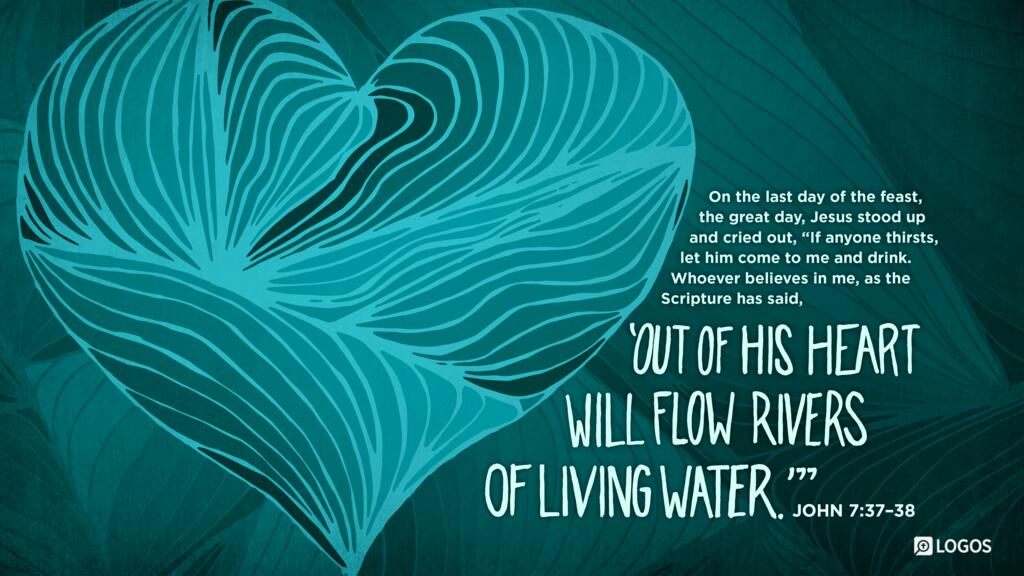
37Now on the last day of the feast—the great day—Jesus stood and cried out, saying, “If anyone is thirsty, let him come to me, and let him drink, 38the one who believes in me.j Just as the scripture said, ‘Out of his belly will flow rivers of living water.’ ”k 39(Now he said this concerning the Spirit, whom those who believed in him were about to receive. For the Spirit was not yet given,l because Jesus had not yet been glorified.)
Different Opinions About Jesus
40Then, when they* heard these words, some from the crowd began to say,* “This man is truly the Prophet!” 41Others were saying, “This man is the Christ!” But others were saying, “No, for the Christ does not come from Galilee, does he?* 42Has not the scripture said that the Christ comes from the descendants of David, and from Bethlehem, the village where David was?” 43So there was a division in the crowd because of him. 44And some of them were wanting to seize him, but no one laid hands on him.
Footnotes
- *Here the direct object is supplied from context in the English translation
- hSome manuscripts explicitly state “me”
- *The negative construction in Greek anticipates a negative answer here, indicated in the translation by the phrase “is he”
- *Here the direct object is supplied from context in the English translation
- iSome manuscripts explicitly state “me”
- jAn alternative punctuation of vv. 37–38 reads: “If anyone is thirsty, let him come to me and let him drink. 38 The one who believes in me, just as the scripture said, ‘Out of his belly will flow rivers of living water.’ ”
- kA quotation from the Old Testament of uncertain origin; texts most often suggested are Isa 44:3; 55:1; 58:11; Zech 14:8
- lA few manuscripts supply the participle “given” here; while it is unlikely this represents the original reading, many English versions nevertheless supply “given” to avoid the impression that the Spirit did not exist prior to this point
- *Here “when” is supplied as a component of the participle (“heard”) which is understood as temporal
- *The imperfect tense has been translated as ingressive here (“began to say”)
- *The negative construction in Greek anticipates a negative answer here, indicated in the translation by the phrase “does he”
Copyright 2012 Lexham Press