John 6:1–24
The Lexham English BibleOther versions
English
- LEB The Lexham English Bible
- DARBY 1890 Darby Bible
- ASV American Standard Version
- AV 1873 The Cambridge Paragraph Bible of the Authorized English Version
- CSB Christian Standard Bible
- D-R Douay-Rheims Bible
- ESV English Standard Version
- GW GOD’S WORD Translation
- GNB Good News Translation
- HCSB The Holman Christian Standard Bible
- KJV 1900 King James Version
- LSB Legacy Standard Bible
- MSG The Message: The Bible in Contemporary Language
- NET The NET Bible
- NASB95 New American Standard Bible (1995)
- NCV New Century Version
- NIrV New International Reader’s Version (1998)
- NIV New International Version (2011)
- NKJV The New King James Version
- NLT New Living Translation
- NRSVue New Revised Standard Version: Updated Edition
- RSV The Revised Standard Version
- RSVCE The Revised Standard Version, Catholic Edition
- YLT Young’s Literal Translation
Arabic
Czech
French
German
Greek
Hungarian
Italian
Korean
Latin
Portuguese
Russian
Simplified Chinese
Spanish
Traditional Chinese
The Feeding of Five Thousand
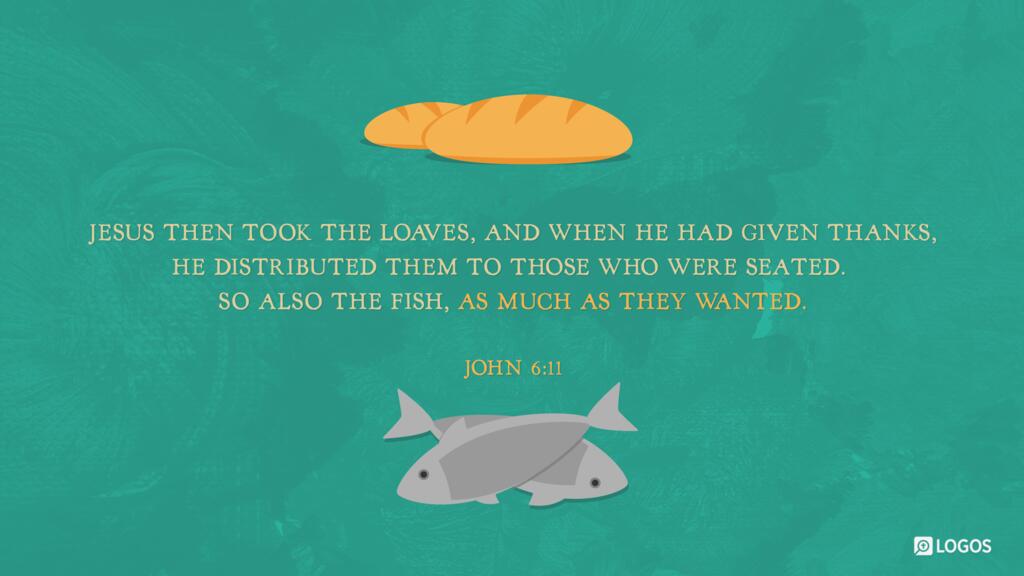
6After these things Jesus went away to the other side of the sea of Galilee (that is, Tiberias). 2And a large crowd was following him because they were observing the signs that he was doing on those who were sick. 3So Jesus went up on the mountain and sat down there with his disciples. 4(Now the Passover, the feast of the Jews, was near.) 5Then Jesus, when he looked upa * and saw that a large crowd was coming to him, said to Philip, “Where can we buy bread so that these people can eat?” 6(Now he said this to test him, because he knew what he was going to do.) 7Philip replied to him, “Two hundred denarii worth of bread would not be enough for them, in order that each one could receive a little.” 8One of his disciples, Andrew the brother of Simon Peter, said to him, 9“Here is a boy who has five barley loaves and two fish, but what are these for so many people?” 10Jesus said, “Make the people recline.” (Now there was a lot of grass in the place.) So the men reclined, approximately five thousand in number. 11Then Jesus took the bread, and after he* had given thanks, he distributed it* to those who were reclining—likewise also of the fish, as much as they wanted. 12And when they were satisfied, he said to his disciples, “Gather the remaining fragments so that nothing is lost.” 13So they gathered them,* and filled twelve baskets with fragments from the five barley loaves which were left over by those who had eaten.
14Now when* the people saw the sign that he performed, they began to say,* “This one is truly the Prophet who is to come into the world!” 15Then Jesus, because he* knew that they were about to come and seize him in order to make him* king, withdrew again up the mountain by himself alone.
Jesus Walks on the Water
16Now when evening came, his disciples went down to the sea. 17And getting into a boat, they began to go* to the other side of the sea, to Capernaum. And it had already become dark, and Jesus had not yet come to them. 18And the sea began to be stirred up* because* a strong wind was blowing. 19Then when they* had rowed about twenty-five or thirty stadia,b they saw Jesus walking on the sea and coming near the boat, and they were afraid. 20But he said to them, “It is I! Do not be afraid!” 21So they were wanting to take him into the boat, and immediately the boat came to the land to which they were going.
Discourse About the Bread of Life
22On the next day, the crowd that was on the other side of the sea saw that other boats were not there (except one), and that Jesus had not entered with his disciples into the boat, but his disciples had departed alone. 23Other boats from Tiberias came near the place where they had eaten the bread after* the Lord had given thanks. 24So when the crowd saw that Jesus was not there, nor his disciples, they themselves got into the boats and came to Capernaum seeking Jesus.
Footnotes
- aLiterally “then Jesus lifting up the eyes”
- *Here “when” in the translation is supplied as a component of the participle “lifting up” which is understood as temporal
- *Here “after” is supplied as a component of the participle (“had given thanks”) which is understood as temporal
- *Here the direct object is supplied from context in the English translation
- *Here the direct object is supplied from context in the English translation
- *Here “when” is supplied as a component of the participle (“saw”) which is understood as temporal
- *The imperfect tense has been translated as ingressive here (“began to say”)
- *Here “because” is supplied as a component of the participle (“knew”) which is understood as causal
- *Here the direct object is supplied from context in the English translation
- *The imperfect tense has been translated as ingressive here (“began to go”)
- *The imperfect tense has been translated as ingressive here (“began to be stirred up”)
- *Here “because” is supplied as a component of the participle (“was blowing”) which is understood as causal
- *Here “when” is supplied as a component of the participle (“had rowed”) which is understood as temporal
- bA “stade” or “stadium” (plur. “stadia”) is about 607 ft (187 m), so this was around 3 miles (5 km)
- *Here “after” is supplied as a component of the temporal genitive absolute participle (“had given thanks”)
Copyright 2012 Lexham Press