John 4:27–38
The Lexham English BibleOther versions
English
- LEB The Lexham English Bible
- DARBY 1890 Darby Bible
- ASV American Standard Version
- AV 1873 The Cambridge Paragraph Bible of the Authorized English Version
- CSB Christian Standard Bible
- D-R Douay-Rheims Bible
- ESV English Standard Version
- GW GOD’S WORD Translation
- GNB Good News Translation
- HCSB The Holman Christian Standard Bible
- KJV 1900 King James Version
- LSB Legacy Standard Bible
- MSG The Message: The Bible in Contemporary Language
- NET The NET Bible
- NASB95 New American Standard Bible (1995)
- NCV New Century Version
- NIrV New International Reader’s Version (1998)
- NIV New International Version (2011)
- NKJV The New King James Version
- NLT New Living Translation
- NRSVue New Revised Standard Version: Updated Edition
- RSV The Revised Standard Version
- RSVCE The Revised Standard Version, Catholic Edition
- YLT Young’s Literal Translation
Arabic
Czech
French
German
Greek
Hungarian
Italian
Korean
Latin
Portuguese
Russian
Simplified Chinese
Spanish
Traditional Chinese
The Disciples and the Harvest
27And at this point* his disciples came, and they were astonished that he was speaking with a woman. However, no one said, “What do you seek?” or “Why are you speaking with her?” 28So the woman left her water jar and went away into the town and said to the people,a 29“Come, see a man who told me everything I have ever done! Perhaps this one is the Christ?” 30They went out from the town and were coming to him.
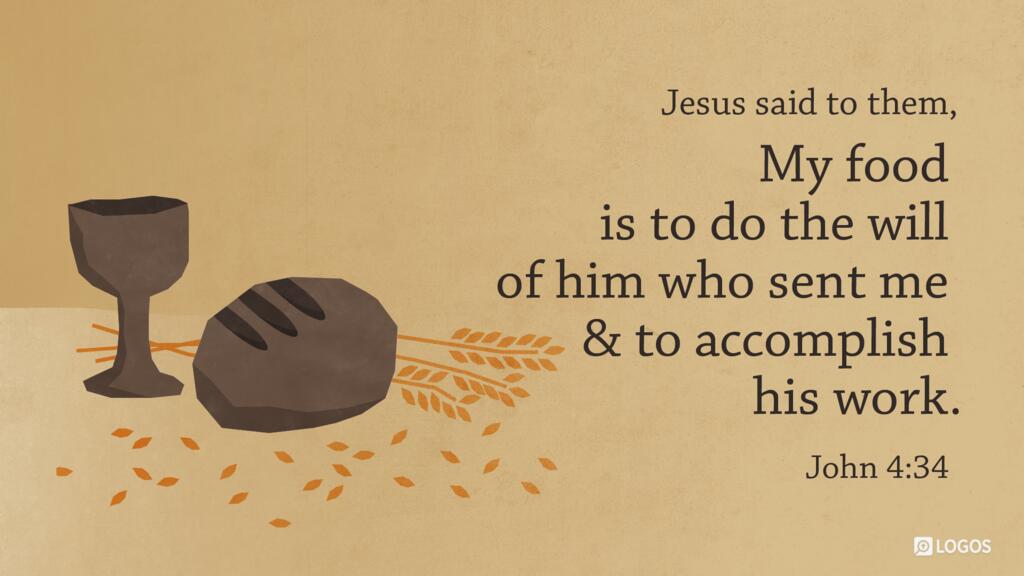
31In the meanwhile the disciples were asking him, saying, “Rabbi, eat something!”* 32But he said to them, “I have food to eat that you do not know about.” 33So the disciples began to say* to one another, “No one brought him anything* to eat, did they?”* 34Jesus said to them, “My food is that I do the will of the one who sent me and complete his work. 35Do you not say, ‘There are yet four months and the harvest comes’? Behold, I say to you, lift up your eyes and look at the fields, that they are white for harvest already.b 36The one who reaps receives wages and gathers fruit for eternal life, in order that the one who sows and the one who reaps can rejoice together. 37For in this instance* the saying is true, ‘It is one who sows and another who reaps.’ 38I sent you to reap what you did not work for; others have worked, and you have entered into their work.”
Footnotes
- *The word “point” is not in the Greek text but is implied
- aAssuming the term is used here in a generic sense to refer to persons of either gender, it should be translated “people”; if instead the term here refers only to the town leaders or elders who met at the town gate, then “men” would be appropriate
- *Here the direct object is supplied from context in the English translation
- *The imperfect tense has been translated as ingressive here (“began to say”)
- *Here the direct object is supplied from context in the English translation
- *The negative construction in Greek anticipates a negative answer here, indicated by the supplied phrase “did they” in the translation
- bSome interpreters and Bible translations place the word “already” at the beginning of the next verse: “Already the one who reaps receives wages …”
- *The word “point” is not in the Greek text but is implied
Copyright 2012 Lexham Press