2 Peter 3:1–10
The Lexham English BibleOther versions
English
- LEB The Lexham English Bible
- DARBY 1890 Darby Bible
- ASV American Standard Version
- AV 1873 The Cambridge Paragraph Bible of the Authorized English Version
- CSB Christian Standard Bible
- D-R Douay-Rheims Bible
- ESV English Standard Version
- GW GOD’S WORD Translation
- GNB Good News Translation
- HCSB The Holman Christian Standard Bible
- KJV 1900 King James Version
- LSB Legacy Standard Bible
- MSG The Message: The Bible in Contemporary Language
- NET The NET Bible
- NASB95 New American Standard Bible (1995)
- NCV New Century Version
- NIrV New International Reader’s Version (1998)
- NIV New International Version (2011)
- NKJV The New King James Version
- NLT New Living Translation
- NRSVue New Revised Standard Version: Updated Edition
- RSV The Revised Standard Version
- RSVCE The Revised Standard Version, Catholic Edition
- YLT Young’s Literal Translation
Arabic
Czech
French
German
Greek
Hungarian
Italian
Korean
Latin
Portuguese
Russian
Simplified Chinese
Spanish
Traditional Chinese
The Coming Day of the Lord
3Dear friends, this is already the second letter I am writing to you, in both of which I am attempting to stir up your sincere mind by a reminder, 2to remember the words proclaimed beforehand by the holy prophets and the commandment of the Lord and Savior through your apostles, 3above all knowing this, that in the last days scoffers will come with scoffing, following according to their own desires 4and saying, “Where is the promise of his coming? For ever sincea the fathers fell asleep, all things have continued just as they have been from the beginning of creation.” 5For when* they maintain this, it escapes their notice that the heavens existed long ago and the earth held together out of water and through water by the word of God, 6by means of which things the world that existed at that time was destroyed by* being inundated with water. 7But by the same word the present heavens and earth are reserved for fire, being kept for the day of judgment and destruction of ungodly people.
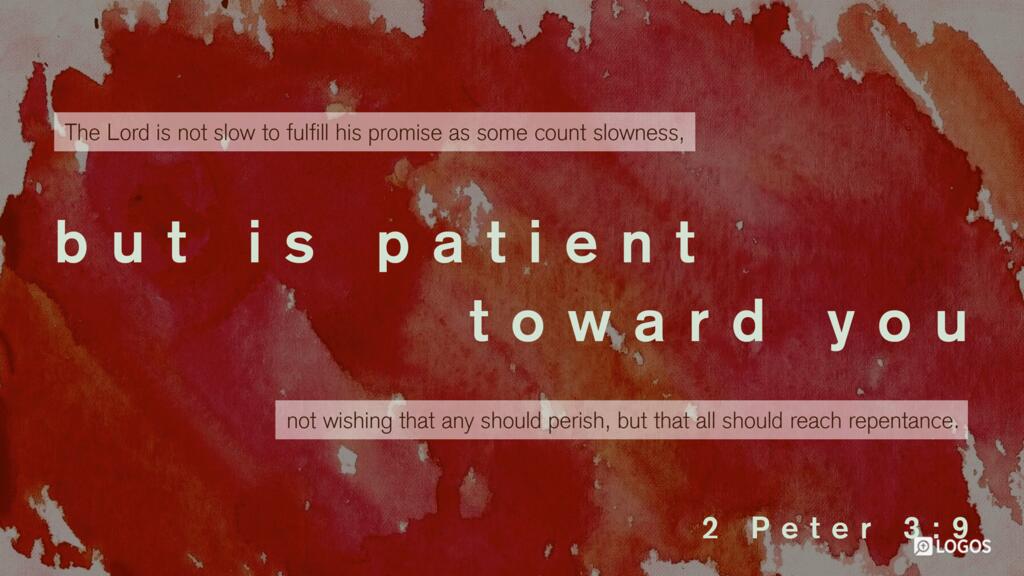
8Now, dear friends, do not let this one thing escape your notice, that one day with the Lord is like a thousand years, and a thousand years is like one day. 9The Lord is not delaying the promise, as some consider slowness, but is being patient toward you, because he* does not want any to perish, but all to come to repentance. 10But the day of the Lord will come like a thief, in which the heavens will disappear with a rushing noise, and the celestial bodies will be destroyed by* being burned up, and the earth and the deeds done on it will be disclosed.
Footnotes
- aLiterally “from which time”
- *Here “when” is supplied as a component of the participle (“maintain”) which is understood as temporal
- *Here “by” is supplied as a component of the participle (“being inundated”) which is understood as means
- *Here “because” is supplied as a component of the participle (“want”) which is understood as causal
- *Here “by” is supplied as a component of the participle (“being burned up”) which is understood as means
Copyright 2012 Lexham Press