1 Samuel 2:1–10
The Lexham English BibleOther versions
English
- LEB The Lexham English Bible
- DARBY 1890 Darby Bible
- ASV American Standard Version
- AV 1873 The Cambridge Paragraph Bible of the Authorized English Version
- CSB Christian Standard Bible
- D-R Douay-Rheims Bible
- ESV English Standard Version
- GW GOD’S WORD Translation
- GNB Good News Translation
- HCSB The Holman Christian Standard Bible
- KJV 1900 King James Version
- LSB Legacy Standard Bible
- MSG The Message: The Bible in Contemporary Language
- NET The NET Bible
- NASB95 New American Standard Bible (1995)
- NCV New Century Version
- NIrV New International Reader’s Version (1998)
- NIV New International Version (2011)
- NKJV The New King James Version
- NLT New Living Translation
- NRSVue New Revised Standard Version: Updated Edition
- RSV The Revised Standard Version
- RSVCE The Revised Standard Version, Catholic Edition
- TNIV Today’s New International Version
- YLT Young’s Literal Translation
Arabic
Czech
French
German
Hebrew
Hungarian
Italian
Korean
Latin
Portuguese
Russian
Simplified Chinese
Spanish
Traditional Chinese
Then Hannah prayed and said,
“My heart exults in Yahweh, my strength is exalted in Yahweh; I grina over my enemies, for I rejoice over your salvation.
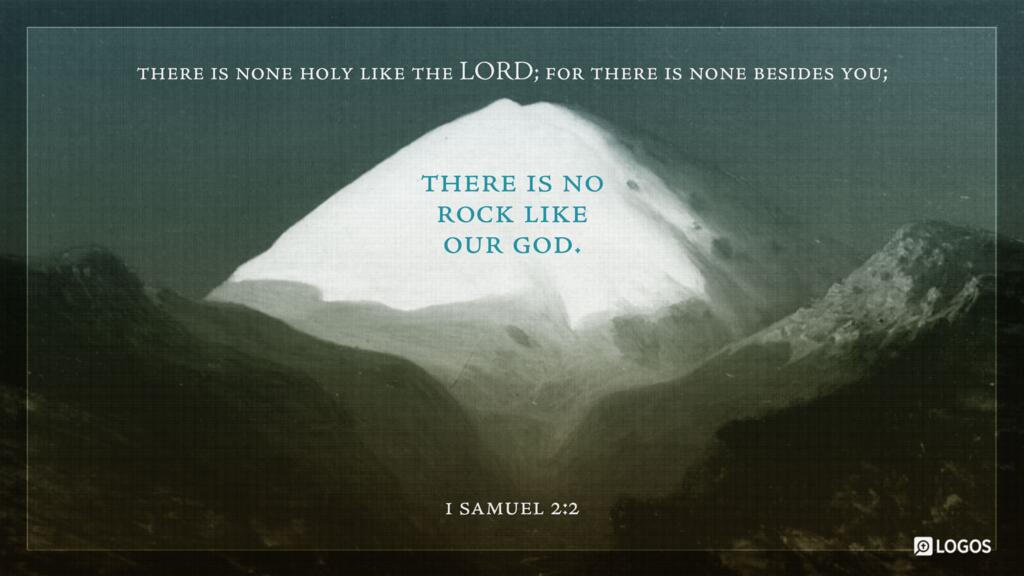
2There is no one holy like Yahweh, for there is no one besides you,
and there is no rock like our God.
3Do not increase speaking very proudb words!
Let no arrogance go forth from your mouth,
for Yahweh is a God of knowledge
whose deeds are not weighed.c
4The bows of mighty warriors are shattered,
but those who stumble gird themselves with strength.
5Those who were full must hire themselves out for bread,
but those who are hungry will become fat.
As for the infertile, she will bear seven,
but she who has many sons withers away.
6Yahweh kills and restores alive,
he brings down to Sheold and raises up.
7Yahweh makes poor and makes rich;
he brings low and also exalts.
8He raises up the poor from the dust.
From the ash heap he lifts up the needy,
to cause them to sit with noble people
and to cause them to inherit a seat of honor.
For the pillars of the earth belong to Yahweh
and he has set the inhabited world on them.
9He will guard the feet of his faithfule ones,
but the wicked will be destroyedf in the darkness,
because a man will not prevail by his might.
10Yahweh will shatterg his adversaries;h
he will thunder against them in the heavens.
Yahweh will judge the ends of the earth.
He will give strength to his king
and will exalt the might of his anointed one.
Footnotes
- aLiterally “my mouth is broad”
- bLiterally “proud, proud”
- cSo Masoretic Hebrew text (Kethib); the reading tradition (Qere) reads “and by him deeds are weighed”
- d“Sheol” is a Hebrew term for the place where the dead reside, i.e., the underworld.
- eOr “loyal”
- fOr “will be silenced”
- gSingular verb supported by Syriac, Targums, Septuagint, and Old Latin versions.
- hThe Masoretic Hebrew text (Kethib) has the singular “adversary”; the reading tradition (Qere) reads the plural
Copyright 2012 Lexham Press