Proverbs 3:28–34
The NET BibleOther versions
English
- NET The NET Bible
- DARBY 1890 Darby Bible
- ASV American Standard Version
- AV 1873 The Cambridge Paragraph Bible of the Authorized English Version
- CSB Christian Standard Bible
- D-R Douay-Rheims Bible
- ESV English Standard Version
- GW GOD’S WORD Translation
- GNB Good News Translation
- HCSB The Holman Christian Standard Bible
- KJV 1900 King James Version
- LSB Legacy Standard Bible
- LEB The Lexham English Bible
- MSG The Message: The Bible in Contemporary Language
- NASB95 New American Standard Bible (1995)
- NCV New Century Version
- NIrV New International Reader’s Version (1998)
- NIV New International Version (2011)
- NKJV The New King James Version
- NLT New Living Translation
- NRSVue New Revised Standard Version: Updated Edition
- RSV The Revised Standard Version
- RSVCE The Revised Standard Version, Catholic Edition
- YLT Young’s Literal Translation
Arabic
Czech
French
German
Hebrew
Hungarian
Italian
Korean
Latin
Portuguese
Russian
Simplified Chinese
Spanish
Traditional Chinese
3:28Do not say to your neighbor, “Go! Return tomorrow
and I will give it,” when87 you have it with you at the time.88
3:29Do not plot89 evil against your neighbor
when90 he dwells by you unsuspectingly.
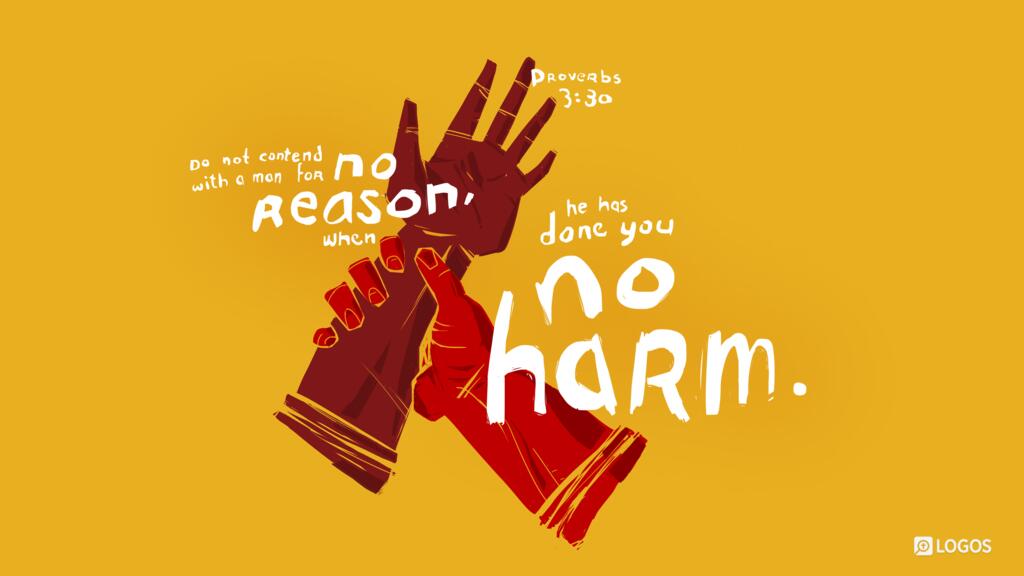
3:30Do not accuse91 anyone92 without legitimate cause,93
if he has not treated you wrongly.
3:31Do not envy a violent man,94
and do not choose to imitate95 any of his ways;
3:32for one who goes astray96 is an abomination97 to the Lord,
but he reveals98 his intimate counsel99 to the upright.
3:33The Lord’s curse100 is on the household101 of the wicked,102
but he blesses103 the home104 of the righteous.105
Footnotes
- 87 Heb “and it is with you.” The prefixed vav introduces a circumstantial clause: “when …”
- 88 The words “at the time” are not in the Hebrew text, but are supplied in the translation for clarity.
- 89 The verb חָרַשׁ (kharash) means “to cut in; to engrave; to plough; to devise.” The idea of plotting is metaphorical for working, practicing or fabricating ( 360 ).
- 90 The vav (ו) prefixed to the pronoun introduces a disjunctive circumstantial clause: “when.…”
- 91 The term רִיב (riv) can mean “quarrel” or “legal accusation” ( 936 ). Both ideas would work but the more technical legal accusation fits the context better. This is a warning to not bring legal accusations against anyone without a legitimate reason.
- 92 Heb “a man.”
- 93 Heb “gratuitously”; , “for no (+ good ) reason.” The adverb חִנָּם (khinam) means “without cause, undeservedly,” especially of groundless hostility ( 3; 336 c).
- 94 Heb “a man of violence.” The noun חָמָס (khamas, “violence”) functions as an attributive genitive. The word itself means “violence, wrong” ( ) and refers to physical violence, social injustice, harsh treatment, wild ruthlessness, injurious words, hatred, and general rudeness ( 329 ).
- 95 Heb “do not choose.”
- 96 The basic meaning of the verb לוּז (luz) is “to turn aside; to depart” ( 531 ). The Niphal stem is always used figuratively of moral apostasy from the path of righteousness: (1) “to go astray” (Prov 2:15; 3:32; 14:2) and (2) “crookedness” in action (Isa 30:12; see לוז nif; 531 Niph).
- 97 Heb “abomination of the Lord.” The term יְהוָה (yéhvah, “the Lord”) functions as a genitive of respect: “abomination to the Lord.” It is loathsome or detestable to him. Things that are repugnant to the Lord are usually the most heinous of crimes and gross violations of rituals.
- 98 Heb “but with the upright is his intimate counsel.” The phrase “he reveals” does not appear in the Hebrew text, but is supplied in the translation for the sake of smoothness and clarity.
- 99 Heb “his counsel.” The noun סוֹד (sod) can refer to (1) “intimate circle” of friends and confidants, (2) “confidential discussion” among friends and confidants, or “secret counsel” revealed from one confidant to another and kept secret and (3) relationship of “intimacy” with a person ( 691 ; ). God reveals his secret counsel to the heavenly assembly (Job 15:8; Jer 23:18, 22) and his prophets (Amos 3:7). God has brought the angels into his “intimate circle” (Ps 89:8). Likewise, those who fear the Lord enjoy an intimate relationship with him (Job 29:4; Ps 25:14; Prov 3:32). The perverse are repugnant to the Lord, but he takes the upright into his confidence and brings him into his intimate circle.
- 100 Heb “the curse of the Lord.” This expression features a genitive of possession or source: “the Lord’s curse” or “a curse from the Lord.” The noun מְאֵרַה (mé’erah, “curse”) connotes banishment or separation from the place of blessing. It is the antonym of בְּרָכָה (bérakhah, “blessing”). The curse of God brings ruin and failure to crops, land in general, an individual, or the nation (Deut 28:20; Mal 2:2; 3:9; see 76 מְאֵרַה; ).
- 101 Heb “house.” The term בֵּית (bet, “house”) functions as a synecdoche of container (= house) for the persons contained (= household). See, e.g., Exod 1:21; Deut 6:22; Josh 22:15 ( 109 5.a).
- 102 The term “wicked” is singular; the term “righteous” in the second half of the verse is plural. In scripture such changes often hint at God’s reluctance to curse, but eagerness to bless (e.g., Gen 12:3).
- 103 The term “bless” (בָּרַךְ, barakh) is the antithesis of “curse.” A blessing is a gift, enrichment, or endowment. The blessing of God empowers one with the ability to succeed, and brings vitality and prosperity in the material realm, but especially in one’s spiritual relationship with God.
- 104 Heb “habitation.” The noun נָוֶה (naveh, “habitation; abode”), which is the poetic parallel to בֵּית (bet, “house”), usually refers to the abode of a shepherd in the country: “habitation” in the country ( 627 נָוֶה). It functions as a synecdoche of container (= habitation) for the contents (= people in the habitation and all they possess).
- 105 The Hebrew is structured chiastically (:): “The curse of the Lord / is on the house of the wicked // but the home of the righteous / he blesses.” The word order in the translation is reversed for the sake of smoothness and readability.
- 106 The particle אִם (’im, “though”) introduces a concessive clause: “though.…”
- 107 Heb “he mocks those who mock.” The repetition of the root לִיץ (lits, “to scorn; to mock”) connotes poetic justice; the punishment fits the crime. Scoffers are characterized by arrogant pride (e.g., Prov 21:24), as the antithetical parallelism with “the humble” here emphasizes.
- 108 The prefixed vav (ו) introduces the apodosis to the concessive clause: “Though … yet …”
- 109 The Hebrew is structured chiastically (:): “he scorns / arrogant scoffers // but to the humble / he gives grace.” The word order in the translation is reversed for the sake of smoothness and readability.
The NET Bible First Edition, Copyright 1996-2005 by Biblical Studies Press
In other versions
ESVEnglish Standard Version
Do not say to your neighbor, “Go, and come again,
tomorrow I will give it”—when you have it with you.
Do not plan evil against your neighbor,
who dwells trustingly beside you.
Do not contend with a man for no reason,
when he has done you no harm.
Do not envy a man of violence
and do not choose any of his ways,
for the devious person is an abomination to the Lord,
but the upright are in his confidence.
The Lord’s curse is on the house of the wicked,
but he blesses the dwelling of the righteous.
Toward the scorners he is scornful,
but to the humble he gives favor.
Copyright 2001 Crossway Bibles
NIVNew International Version (2011)
Do not say to your neighbor,
“Come back tomorrow and I’ll give it to you”—
when you already have it with you.
Do not plot harm against your neighbor,
who lives trustfully near you.
Do not accuse anyone for no reason—
when they have done you no harm.
Do not envy the violent
or choose any of their ways.
For the Lord detests the perverse
but takes the upright into his confidence.
The Lord’s curse is on the house of the wicked,
but he blesses the home of the righteous.
He mocks proud mockers
but shows favor to the humble and oppressed.
Copyright 1973, 1978, 1984, 2011 Biblica, Inc.
CSBChristian Standard Bible
Don’t say to your neighbor, “Go away! Come back later.
I’ll give it tomorrow”—when it is there with you.
Don’t plan any harm against your neighbor,
for he trusts you and lives near you.
Don’t accuse anyone without cause,
when he has done you no harm.
Don’t envy a violent man
or choose any of his ways;
for the devious are detestable to the Lord,
but he is a friend to the upright.
The Lord’s curse is on the household of the wicked,
but he blesses the home of the righteous;
He mocks those who mock
but gives grace to the humble.
Copyright 2017 Holman Bible Publishers
NLTNew Living Translation
If you can help your neighbor now, don’t say,
“Come back tomorrow, and then I’ll help you.”
Don’t plot harm against your neighbor,
for those who live nearby trust you.
Don’t pick a fight without reason,
when no one has done you harm.
Don’t envy violent people
or copy their ways.
Such wicked people are detestable to the Lord,
but he offers his friendship to the godly.
The Lord curses the house of the wicked,
but he blesses the home of the upright.
The Lord mocks the mockers
but is gracious to the humble.
Holy Bible, New Living Translation, copyright © 1996, 2004, 2015 by Tyndale House Foundation. Used by permission of Tyndale House Publishers. All rights reserved.
LEBThe Lexham English Bible
Do not say to your neighbor,
“Go and return and tomorrow I will give it,”
when it is with you.
Do not plot harm against your neighbor
who dwells in confidence beside you.
Do not quarrel with anyone without cause,
when he did not do you harm.
Do not envy a man of violence,
and do not choose any of his ways,
for he who is perverse is an abomination of Yahweh,
but those who are upright are his confidence.
The curse of Yahweh is on the house of the wicked,
and the abode of the righteous ones he blesses.
With those who scorn, he is scornful,
but to those who are humble, he gives favor.
Copyright 2012 Lexham Press
KJV 1900King James Version
Say not unto thy neighbour,
Go, and come again, and to morrow I will give;
When thou hast it by thee.
Devise not evil against thy neighbour,
Seeing he dwelleth securely by thee.
Strive not with a man without cause,
If he have done thee no harm.
Envy thou not the oppressor,
And choose none of his ways.
For the froward is abomination to the Lord:
But his secret is with the righteous.
The curse of the Lord is in the house of the wicked:
But he blesseth the habitation of the just.
Surely he scorneth the scorners:
But he giveth grace unto the lowly.
Public Domain