John 11:17–27
The NET BibleOther versions
English
- NET The NET Bible
- DARBY 1890 Darby Bible
- ASV American Standard Version
- AV 1873 The Cambridge Paragraph Bible of the Authorized English Version
- CSB Christian Standard Bible
- D-R Douay-Rheims Bible
- ESV English Standard Version
- GW GOD’S WORD Translation
- GNB Good News Translation
- HCSB The Holman Christian Standard Bible
- KJV 1900 King James Version
- LSB Legacy Standard Bible
- LEB The Lexham English Bible
- MSG The Message: The Bible in Contemporary Language
- NASB95 New American Standard Bible (1995)
- NCV New Century Version
- NIrV New International Reader’s Version (1998)
- NIV New International Version (2011)
- NKJV The New King James Version
- NLT New Living Translation
- NRSVue New Revised Standard Version: Updated Edition
- RSV The Revised Standard Version
- RSVCE The Revised Standard Version, Catholic Edition
- YLT Young’s Literal Translation
Arabic
Czech
French
German
Greek
Hungarian
Italian
Korean
Latin
Portuguese
Russian
Simplified Chinese
Spanish
Traditional Chinese
Speaking with Martha and Mary
11:17When32 Jesus arrived,33 he found that Lazarus34 had been in the tomb four days already.3511:18(Now Bethany was less than two miles36 from Jerusalem,3711:19so many of the Jewish people of the region38 had come to Martha and Mary to console them39 over the loss of their brother.)4011:20So when Martha heard that Jesus was coming, she went out to meet him, but Mary was sitting in the house.4111:21Martha42 said to Jesus, “Lord, if you had been here, my brother would not have died. 11:22But even now I know that whatever you ask from God, God will grant43 you.”44
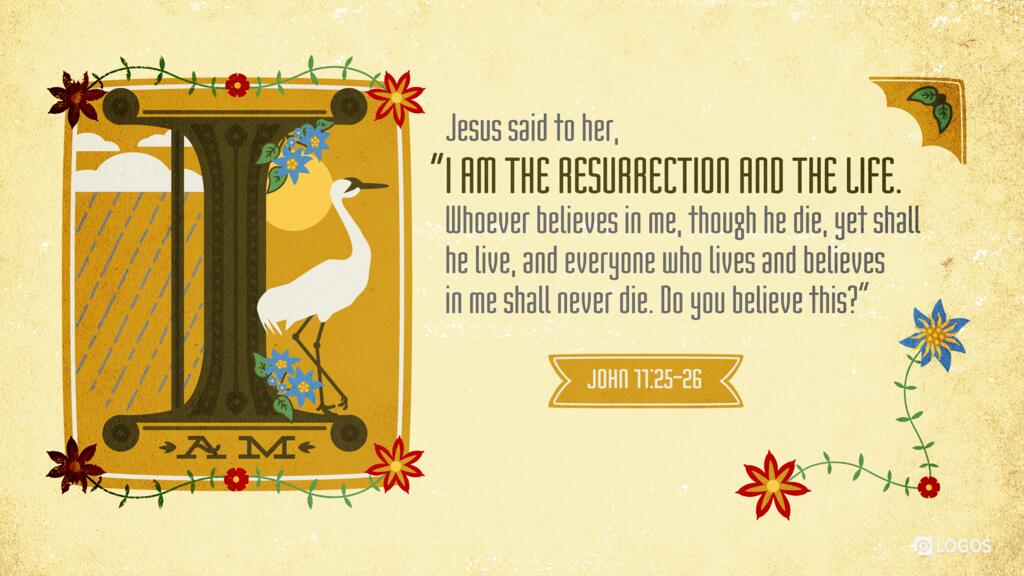
11:23Jesus replied,45 “Your brother will come back to life again.”4611:24Martha said,47 “I know that he will come back to life again48 in the resurrection at the last day.” 11:25Jesus said to her, “I am the resurrection and the life. The one who believes in me will live49 even if he dies, 11:26and the one who lives and believes in me will never die.50 Do you believe this?” 11:27She replied,51 “Yes, Lord, I believe52 that you are the Christ,53 the Son of God who comes into the world.”54
Footnotes
- 32 Grk “Then when.”
- 33 Grk “came.”
- 34 Grk “he”; the referent (Lazarus) has been specified in the translation for clarity.
- 35 Grk “he had already had four days in the tomb” (an idiom). There is no description of the journey itself. The author simply states that when Jesus arrived, he found that Lazarus had been in the tomb four days already. He had died some time before this but probably not very long (cf. Ananias and Sapphira in Acts 5:6, 10 who were buried immediately after they died, as was the common practice of the time). There is some later evidence (early 3rd century) of a rabbinic belief that the soul hovered near the body of the deceased for three days, hoping to be able to return to the body. But on the fourth day it saw the beginning of decomposition and finally departed (Leviticus Rabbah 18.1). If this belief is as old as the 1st century, it might suggest the significance of the four days: After this time, resurrection would be a first-order miracle, an unequivocal demonstration of the power of God. It is not certain if the tradition is this early, but it is suggestive. Certainly the author does not appear to attach any symbolic significance to the four days in the narrative.
- 36 Or “three kilometers”; Grk “fifteen stades” (a stade as a unit of linear measure is about 607 feet or 187 meters).
- 37 For location see ; ; ; ; ; ; ; ; .
- 38 Or “many of the Judeans” (cf. Ἰουδαῖος 2.e); Grk “many of the Jews.” Here the phrase refers to the residents of Jerusalem and the surrounding area in general (those who had been friends or relatives of Lazarus or his sisters would mainly be in view) since the Jewish religious authorities (“the chief priests and the Pharisees”) are specifically mentioned as a separate group in John 11:46–47. See also the note on the phrase “the Jewish leaders” in v. .
- 39 Or “to comfort them” or “to offer them sympathy.”
- 40 Grk “to comfort them concerning their brother”; the words “loss of” are not in the Greek text but are implied. This is a parenthetical note by the author.
- 41 Notice the difference in the response of the two sisters: Martha went out to meet Jesus, while Mary remains sitting in the house. It is similar to the incident in Luke 10:38–42. Here again one finds Martha occupied with the responsibilities of hospitality; she is the one who greets Jesus.
- 42 Grk “Then Martha.” Here οὖν (oun) has not been translated for stylistic reasons.
- 43 Or “give.”
- 44 The statement “whatever you ask from God, God will grant you” by Martha presents something of a dilemma, because she seems to be suggesting here (implicitly at least) the possibility of a resurrection for her brother. However, Martha’s statement in 11:39 makes it clear that she had no idea that a resurrection was still possible. How then are her words in 11:22 to be understood? It seems best to take them as a confession of Martha’s continuing faith in Jesus even though he was not there in time to help her brother. She means, in effect, “Even though you weren’t here in time to help, I still believe that God grants your requests.”
- 45 Grk “Jesus said to her.”
- 46 Or “Your brother will rise again.” Jesus’ remark to Martha that Lazarus would come back to life again is another example of the misunderstood statement. Martha apparently took it as a customary statement of consolation and joined Jesus in professing belief in the general resurrection of the body at the end of the age. However, as Jesus went on to point out in 11:25–26, Martha’s general understanding of the resurrection at the last day was inadequate for the present situation, for the gift of life that conquers death was a present reality to Jesus. This is consistent with the author’s perspective on eternal life in the Fourth Gospel: It is not only a future reality, but something to be experienced in the present as well. It is also consistent with the so-called “realized eschatology” of the Fourth Gospel.
- 47 Grk “Martha said to him.”
- 48 Or “will rise again.”
- 49 That is, will come to life.
- 50 Grk “will never die forever.”
- 51 Grk “She said to him.”
- 52 The perfect tense in Greek is often used to emphasize the results or present state of a past action. Such is the case here. To emphasize this nuance the perfect tense verb πεπίστευκα (pepisteuka) has been translated as a present tense. This is in keeping with the present context, where Jesus asks of her present state of belief in v. 26, and the theology of the Gospel as a whole, which emphasizes the continuing effects and present reality of faith. For discussion on this use of the perfect tense, see and B. M. Fanning, Verbal Aspect, 291–97.
- 53 Or “the Messiah” (Both Greek “Christ” and Hebrew and Aramaic “Messiah” mean “one who has been anointed”). See the note on Christ in .
- 54 Or “the Son of God, the one who comes into the world.”
The NET Bible First Edition, Copyright 1996-2005 by Biblical Studies Press
In other versions
ESVEnglish Standard Version
Now when Jesus came, he found that Lazarus had already been in the tomb four days. Bethany was near Jerusalem, about two miles off, and many of the Jews had come to Martha and Mary to console them concerning their brother. So when Martha heard that Jesus was coming, she went and met him, but Mary remained seated in the house. Martha said to Jesus, “Lord, if you had been here, my brother would not have died. But even now I know that whatever you ask from God, God will give you.” Jesus said to her, “Your brother will rise again.” Martha said to him, “I know that he will rise again in the resurrection on the last day.” Jesus said to her, “I am the resurrection and the life. Whoever believes in me, though he die, yet shall he live, and everyone who lives and believes in me shall never die. Do you believe this?” She said to him, “Yes, Lord; I believe that you are the Christ, the Son of God, who is coming into the world.”
Copyright 2001 Crossway Bibles
NIVNew International Version (2011)
On his arrival, Jesus found that Lazarus had already been in the tomb for four days. Now Bethany was less than two miles from Jerusalem, and many Jews had come to Martha and Mary to comfort them in the loss of their brother. When Martha heard that Jesus was coming, she went out to meet him, but Mary stayed at home.
“Lord,” Martha said to Jesus, “if you had been here, my brother would not have died. But I know that even now God will give you whatever you ask.”
Jesus said to her, “Your brother will rise again.”
Martha answered, “I know he will rise again in the resurrection at the last day.”
Jesus said to her, “I am the resurrection and the life. The one who believes in me will live, even though they die; and whoever lives by believing in me will never die. Do you believe this?”
“Yes, Lord,” she replied, “I believe that you are the Messiah, the Son of God, who is to come into the world.”
Copyright 1973, 1978, 1984, 2011 Biblica, Inc.
CSBChristian Standard Bible
When Jesus arrived, he found that Lazarus had already been in the tomb four days. Bethany was near Jerusalem (less than two miles away). Many of the Jews had come to Martha and Mary to comfort them about their brother. As soon as Martha heard that Jesus was coming, she went to meet him, but Mary remained seated in the house.
Then Martha said to Jesus, “Lord, if you had been here, my brother wouldn’t have died. Yet even now I know that whatever you ask from God, God will give you.”
“Your brother will rise again,” Jesus told her.
Martha said to him, “I know that he will rise again in the resurrection at the last day.”
Jesus said to her, “I am the resurrection and the life. The one who believes in me, even if he dies, will live. Everyone who lives and believes in me will never die. Do you believe this?”
“Yes, Lord,” she told him, “I believe you are the Messiah, the Son of God, who comes into the world.”
Copyright 2017 Holman Bible Publishers
NLTNew Living Translation
When Jesus arrived at Bethany, he was told that Lazarus had already been in his grave for four days. Bethany was only a few miles down the road from Jerusalem, and many of the people had come to console Martha and Mary in their loss. When Martha got word that Jesus was coming, she went to meet him. But Mary stayed in the house. Martha said to Jesus, “Lord, if only you had been here, my brother would not have died. But even now I know that God will give you whatever you ask.”
Jesus told her, “Your brother will rise again.”
“Yes,” Martha said, “he will rise when everyone else rises, at the last day.”
Jesus told her, “I am the resurrection and the life. Anyone who believes in me will live, even after dying. Everyone who lives in me and believes in me will never ever die. Do you believe this, Martha?”
“Yes, Lord,” she told him. “I have always believed you are the Messiah, the Son of God, the one who has come into the world from God.”
Holy Bible, New Living Translation, copyright © 1996, 2004, 2015 by Tyndale House Foundation. Used by permission of Tyndale House Publishers. All rights reserved.
LEBThe Lexham English Bible
So when he arrived, Jesus found he had already been four days in the tomb. (Now Bethany was near Jerusalem, about fifteen stadia. So many of the Jews came to Martha and Mary in order to console them concerning their brother.) Now Martha, when she heard that Jesus was coming, went to meet him, but Mary was sitting in the house. So Martha said to Jesus, “Lord, if you had been here, my brother would not have died. Even now I know that whatever you ask God, God will grant you.” Jesus said to her, “Your brother will rise again.” Martha said to him, “I know that he will rise again in the resurrection at the last day.” Jesus said to her, “I am the resurrection and the life. The one who believes in me, even if he dies, will live, and everyone who lives and believes in me will never die forever. Do you believe this?” She said to him, “Yes, Lord, I have believed that you are the Christ, the Son of God, who comes into the world.”
Copyright 2012 Lexham Press
KJV 1900King James Version
Then when Jesus came, he found that he had lain in the grave four days already. Now Bethany was nigh unto Jerusalem, about fifteen furlongs off: And many of the Jews came to Martha and Mary, to comfort them concerning their brother. Then Martha, as soon as she heard that Jesus was coming, went and met him: but Mary sat still in the house. Then said Martha unto Jesus, Lord, if thou hadst been here, my brother had not died. But I know, that even now, whatsoever thou wilt ask of God, God will give it thee. Jesus saith unto her, Thy brother shall rise again. Martha saith unto him, I know that he shall rise again in the resurrection at the last day. Jesus said unto her, I am the resurrection, and the life: he that believeth in me, though he were dead, yet shall he live: And whosoever liveth and believeth in me shall never die. Believest thou this? She saith unto him, Yea, Lord: I believe that thou art the Christ, the Son of God, which should come into the world.
Public Domain