2 Timothy 2:1–13
The NET BibleOther versions
English
- NET The NET Bible
- DARBY 1890 Darby Bible
- ASV American Standard Version
- AV 1873 The Cambridge Paragraph Bible of the Authorized English Version
- CSB Christian Standard Bible
- D-R Douay-Rheims Bible
- ESV English Standard Version
- GW GOD’S WORD Translation
- GNB Good News Translation
- HCSB The Holman Christian Standard Bible
- KJV 1900 King James Version
- LSB Legacy Standard Bible
- LEB The Lexham English Bible
- MSG The Message: The Bible in Contemporary Language
- NASB95 New American Standard Bible (1995)
- NCV New Century Version
- NIrV New International Reader’s Version (1998)
- NIV New International Version (2011)
- NKJV The New King James Version
- NLT New Living Translation
- NRSVue New Revised Standard Version: Updated Edition
- RSV The Revised Standard Version
- RSVCE The Revised Standard Version, Catholic Edition
- YLT Young’s Literal Translation
Arabic
Czech
French
German
Greek
Hungarian
Italian
Korean
Latin
Portuguese
Russian
Simplified Chinese
Spanish
Traditional Chinese
Serving Faithfully Despite Hardship
2:1So you, my child, be strong in the grace that is in Christ Jesus. 2:2And entrust what you heard me say1 in the presence of many others as witnesses2 to faithful people3 who will be competent4 to teach others as well. 2:3Take your share of suffering5 as a good soldier of Christ Jesus. 2:4No one in military service gets entangled in matters of everyday life; otherwise he will not please6 the one who recruited him. 2:5Also, if anyone competes as an athlete, he will not be crowned as the winner7 unless he competes according to the rules.82:6The farmer who works hard ought to have the first share of the crops. 2:7Think about what I am saying and9 the Lord will give you understanding of all this.10
2:8Remember Jesus Christ, raised from the dead, a descendant of David;11 such is my gospel,122:9for which I suffer hardship to the point of imprisonment13 as a criminal, but God’s message14 is not imprisoned!152:10So I endure all things for the sake of those chosen by God,16 that they too may obtain salvation in Christ Jesus and its eternal glory.172:11This saying18 is trustworthy:19
If we died with him, we will also live with him.
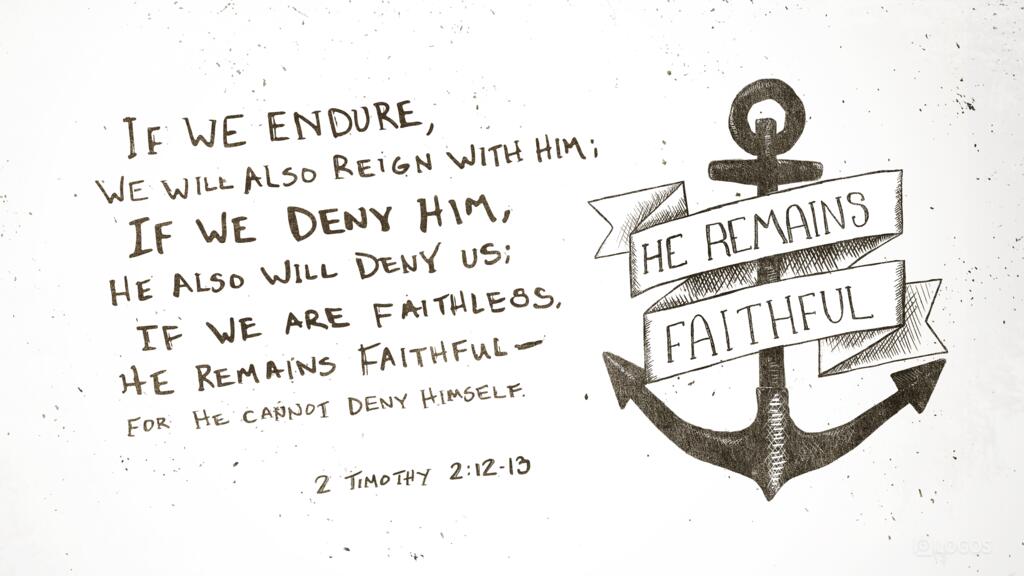
2:12If we endure, we will also reign with him.20
If we deny21 him,22 he will also deny us.
2:13If we are unfaithful, he remains faithful, since he cannot deny himself.23
Footnotes
- 1 Grk “what you heard from me” (cf. 1:13).
- 2 Grk “through many witnesses.” The “through” is used here to show attendant circumstances: “accompanied by,” “in the presence of.”
- 3 Grk “faithful men”; but here ἀνθρώποις (anthrōpois) is generic, referring to both men and women.
- 4 Or “able” (see Paul’s use of this word in regard to ministry in 2 Cor 2:16; 3:5–6).
- 5 Grk “suffer hardship together,” implying “join with me and others in suffering” (cf. 1:8).
- 6 Grk “that he may please.”
- 7 Grk “will not be crowned,” speaking of the wreath awarded to the victor.
- 8 According to the rules (Grk “lawfully, by law”) referring to the rules of competition. In the ancient world these included requirements for training as well as rules for the competition itself.
- 9 The Greek word here usually means “for,” but is used in this verse for a milder continuation of thought.
- 10 Grk “in all things.”
- 11 Grk “of David’s seed” (an idiom for physical descent).
- 12 Grk “according to my gospel.”
- 13 Or “chains,” “bonds.”
- 14 Or “word.”
- 15 Or “chained,” “bound.”
- 16 Grk “the elect.”
- 17 Grk “with eternal glory.”
- 18 This saying (Grk “the saying”) refers to the following citation. See 1 Tim 1:15; 3:1; 4:9; Titus 3:8 for other occurrences of this phrase.
- 19 The following passage has been typeset as poetry because many scholars regard this passage as poetic or hymnic. These terms are used broadly to refer to the genre of writing, not to the content. There are two broad criteria for determining if a passage is poetic or hymnic: “(a) stylistic: a certain rhythmical lilt when the passages are read aloud, the presence of parallelismus membrorum (i.e., an arrangement into couplets), the semblance of some metre, and the presence of rhetorical devices such as alliteration, chiasmus, and antithesis; and (b) linguistic: an unusual vocabulary, particularly the presence of theological terms, which is different from the surrounding context” (P. T. O’Brien, Philippians [], ). Classifying a passage as hymnic or poetic is important because understanding this genre can provide keys to interpretation. However, not all scholars agree that the above criteria are present in this passage, so the decision to typeset it as poetry should be viewed as a tentative decision about its genre.
- 20 Grk “died together … will live together … will reign together,” without “him” stated explicitly. But “him” is implied by the parallel ideas in Rom 6:8; 8:17 and by the reference to Christ in vv. 12b–13.
- 21 Or “renounce,” “disown,” “repudiate.” It is important to note that the object of Christ’s denial is “us.” The text does not contain an implied object complement (“he will deny us [x]”), which would mean that Christ was withholding something from us (for example, “The owner denied his pets water”), since the verb ἀρνέομαι (arneomai) is not one of the category of verbs that normally occurs in these constructions (see ).
- 22 Grk “if we renounce,” but the “him” is implied by the parallel clauses.
- 23 If we are unfaithful … he cannot deny himself. This could be (1) a word of warning (The Lord will exact punishment; he cannot deny his holiness) or (2) a word of hope (Because of who he is, he remains faithful to us despite our lapses). The latter is more likely, since Paul consistently cites God’s faithfulness as a reassurance, not as a warning (cf. especially Rom 3:3; also 1 Cor 1:9; 10:13; 2 Cor 1:18; 1 Thess 5:24; 2 Thess 3:3).
The NET Bible First Edition, Copyright 1996-2005 by Biblical Studies Press