1 Corinthians 9:19–27
The NET BibleOther versions
English
- NET The NET Bible
- DARBY 1890 Darby Bible
- ASV American Standard Version
- AV 1873 The Cambridge Paragraph Bible of the Authorized English Version
- CSB Christian Standard Bible
- D-R Douay-Rheims Bible
- ESV English Standard Version
- GW GOD’S WORD Translation
- GNB Good News Translation
- HCSB The Holman Christian Standard Bible
- KJV 1900 King James Version
- LSB Legacy Standard Bible
- LEB The Lexham English Bible
- MSG The Message: The Bible in Contemporary Language
- NASB95 New American Standard Bible (1995)
- NCV New Century Version
- NIrV New International Reader’s Version (1998)
- NIV New International Version (2011)
- NKJV The New King James Version
- NLT New Living Translation
- NRSVue New Revised Standard Version: Updated Edition
- RSV The Revised Standard Version
- RSVCE The Revised Standard Version, Catholic Edition
- YLT Young’s Literal Translation
Arabic
Czech
French
German
Greek
Hungarian
Italian
Korean
Latin
Portuguese
Russian
Simplified Chinese
Spanish
Traditional Chinese
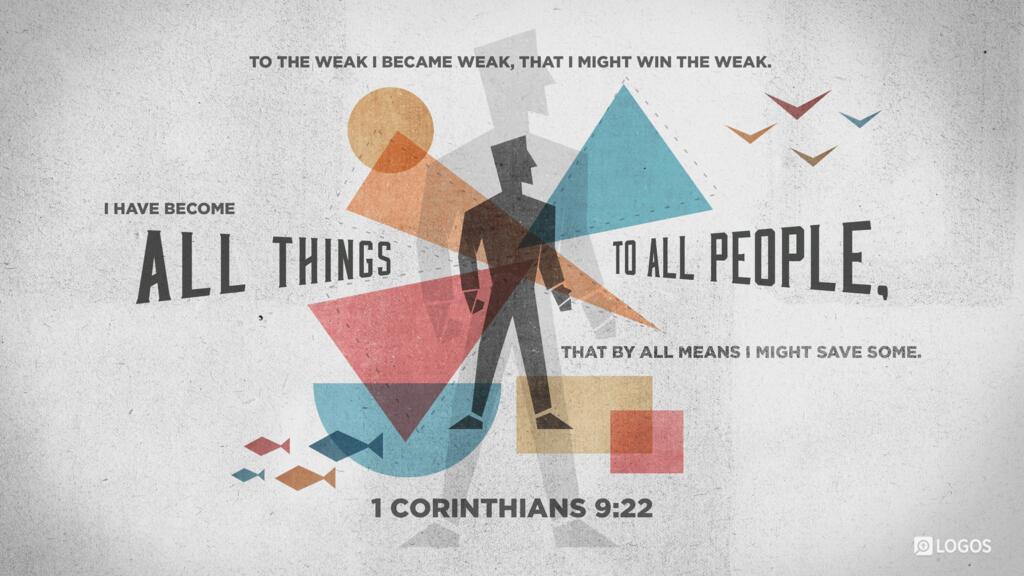
9:19For since I am free from all I can make myself a slave to all, in order to gain even more people.89:20To the Jews I became like a Jew to gain the Jews. To those under the law I became like one under the law (though I myself am not under the law)9 to gain those under the law. 9:21To those free from the law I became like one free from the law (though I am not free from God’s law but under the law of Christ) to gain those free from the law. 9:22To the weak I became weak in order to gain the weak. I have become all things to all people, so that by all means I may save some.
9:23I do all these things because of the gospel, so that I can be a participant in it.
9:24Do you not know that all the runners in a stadium compete, but only one receives the prize? So run to win. 9:25Each competitor must exercise self-control in everything. They do it to receive a perishable crown, but we an imperishable one.
9:26So I do not run uncertainly or box like one who hits only air. 9:27Instead I subdue my body and make it my slave, so that after preaching to others I myself will not be disqualified.
Footnotes
- 8 Or “more converts.” The word “people” is not in the Greek text, but is implied. It has been supplied in the translation to clarify the meaning.
- 9 The Byzantine text, as well as a few other witnesses (D2 [L] Ψ 1881 𝔐) lack this parenthetical material, while geographically widespread, early, and diverse witnesses have the words (so א A B C D* F G P 33 104 365 1175 1505 1739 latt). The phrase may have dropped out accidentally through homoioteleuton (note that both the preceding phrase and the parenthesis end in ὑπὸ νόμον [hupo nomon, “under the law“]), or intentionally by overscrupulous scribes who felt that the statement “I myself am not under the law” could have led to license.
The NET Bible First Edition, Copyright 1996-2005 by Biblical Studies Press