Psalm 68:4–10
The NET BibleOther versions
English
- NET The NET Bible
- DARBY 1890 Darby Bible
- ASV American Standard Version
- AV 1873 The Cambridge Paragraph Bible of the Authorized English Version
- CSB Christian Standard Bible
- D-R Douay-Rheims Bible
- ESV English Standard Version
- GW GOD’S WORD Translation
- GNB Good News Translation
- HCSB The Holman Christian Standard Bible
- KJV 1900 King James Version
- LSB Legacy Standard Bible
- LEB The Lexham English Bible
- MSG The Message: The Bible in Contemporary Language
- NASB95 New American Standard Bible (1995)
- NCV New Century Version
- NIrV New International Reader’s Version (1998)
- NIV New International Version (2011)
- NKJV The New King James Version
- NLT New Living Translation
- NRSVue New Revised Standard Version: Updated Edition
- RSV The Revised Standard Version
- RSVCE The Revised Standard Version, Catholic Edition
- TNIV Today’s New International Version
- YLT Young’s Literal Translation
Arabic
Czech
French
German
Hebrew
Hungarian
Italian
Korean
Latin
Portuguese
Russian
Simplified Chinese
Spanish
Traditional Chinese
68:4Sing to God! Sing praises to his name!
Exalt the one who rides on the clouds!7
For the Lord is his name!8
Rejoice before him!
68:5He is a father to the fatherless
and an advocate for widows.9
God rules from his holy palace.10
68:6God settles those who have been deserted in their own homes;11
he frees prisoners and grants them prosperity.12
But sinful rebels live in the desert.13
68:7O God, when you lead your people into battle,14
when you march through the desert,15
(Selah)
68:8the earth shakes,
yes, the heavens pour down rain
before God, the God of Sinai,16
before God, the God of Israel.17
68:9O God, you cause abundant showers to fall18 on your chosen people.19
When they20 are tired, you sustain them,21
68:10for you live among them.22
You sustain the oppressed with your good blessings, O God.
Footnotes
- 7 Traditionally the Hebrew term עֲרָבוֹת (’aravot) is taken as “steppe-lands” (often rendered “deserts”), but here the form is probably a homonym meaning “clouds.” Verse 33, which depicts God as the one who “rides on the sky” strongly favors this (see as well Deut 33:26), as does the reference in v. 9 to God as the source of rain. The term עֲרָבָה (’aravah, “cloud”) is cognate with Akkadian urpatu/erpetu and with Ugaritic ’rpt. The phrase rkb ’rpt (“one who rides on the clouds”) appears in Ugaritic mythological texts as an epithet of the storm god Baal. The nonphonemic interchange of the bilabial consonants b and p is attested elsewhere in roots common to Hebrew and Ugaritic, though the phenomenon is relatively rare.
- 8 Heb “in the Lord his name.” If the is retained, the preposition -בְ (bet) is introducing the predicate (the so-called bet of identity), “the Lord is his name.” However, some prefer to emend the text to כִּי יָהּ שְׁמוֹ (ki yah shémo, “for Yah is his name”). This emendation, reflected in the present translation, assumes a confusion of bet (ב) and kaf (ך) and haplography of yod (י).
- 9 God is depicted here as a just ruler. In the ancient Near Eastern world a king was responsible for promoting justice, including caring for the weak and vulnerable, epitomized by the fatherless and widows.
- 10 Heb “God [is] in his holy dwelling place.” He occupies his throne and carries out his royal responsibilities.
- 11 Heb “God causes the solitary ones to dwell in a house.” The participle suggests this is what God typically does.
- 12 Heb “he brings out prisoners into prosperity.” Another option is to translate, “he brings out prisoners with singing” (cf. ). The participle suggests this is what God typically does.
- 13 Or “in a parched [land].” God delivers the downtrodden and oppressed, but sinful rebels who oppose his reign are treated appropriately.
- 14 Heb “when you go out before your people.” The Hebrew idiom “go out before” is used here in a militaristic sense of leading troops into battle (see Judg 4:14; 9:39; 2 Sam 5:24).
- 15 When you march through the desert. Some interpreters think that v. 7 alludes to Israel’s exodus from Egypt and its subsequent travels in the desert. Another option is that v. 7, like v. 8, echoes Judg 5:4, which describes how the God of Sinai marched across the desert regions to do battle with Sisera and his Canaanite army.
- 16 Heb “this one of Sinai.” The phrase is a divine title, perhaps indicating that the Lord rules from Sinai.
- 17 The language of vv. 7–8 is reminiscent of Judg 5:4–5, which tells how the God of Sinai came in the storm and annihilated the Canaanite forces led by Sisera. The presence of allusion does not mean, however, that this is a purely historical reference. The psalmist is describing God’s typical appearance as a warrior in terms of his prior self-revelation as ancient events are reactualized in the psalmist’s experience. (For a similar literary technique, see Hab 3.)
- 18 The verb נוּף (nuf, “cause rain to fall”) is a homonym of the more common נוּף (“brandish”).
- 19 Heb “[on] your inheritance.” This refers to Israel as God’s specially chosen people (see Pss 28:9; 33:12; 74:2; 78:62, 71; 79:1; 94:5, 14; 106:40). Some take “your inheritance” with what follows, but the vav (ו) prefixed to the following word (note וְנִלְאָה, vénil’ah) makes this syntactically unlikely.
- 20 Heb “it [is],” referring to God’s “inheritance.”
- 21 Heb “it,” referring to God’s “inheritance.”
- 22 The meaning of the Hebrew text is unclear; it appears to read, “your animals, they live in it,” but this makes little, if any, sense in this context. Some suggest that חָיָּה (khayah) is a rare homonym here, meaning “community” ( 312 ) or “dwelling place” ( III *הַיָּה). In this case one may take “your community/dwelling place” as appositional to the third feminine singular pronominal suffix at the end of v. 9, the antecedent of which is “your inheritance.” The phrase יָשְׁבוּ־בָהּ (yashvu-vah, “they live in it”) may then be understood as an asyndetic relative clause modifying “your community/dwelling place.” A literal translation of vv. 9b–10a would be, “when it [your inheritance] is tired, you sustain it, your community/dwelling place in [which] they live.”
The NET Bible First Edition, Copyright 1996-2005 by Biblical Studies Press
In other versions
ESVEnglish Standard Version
Sing to God, sing praises to his name;
lift up a song to him who rides through the deserts;
his name is the Lord;
exult before him!
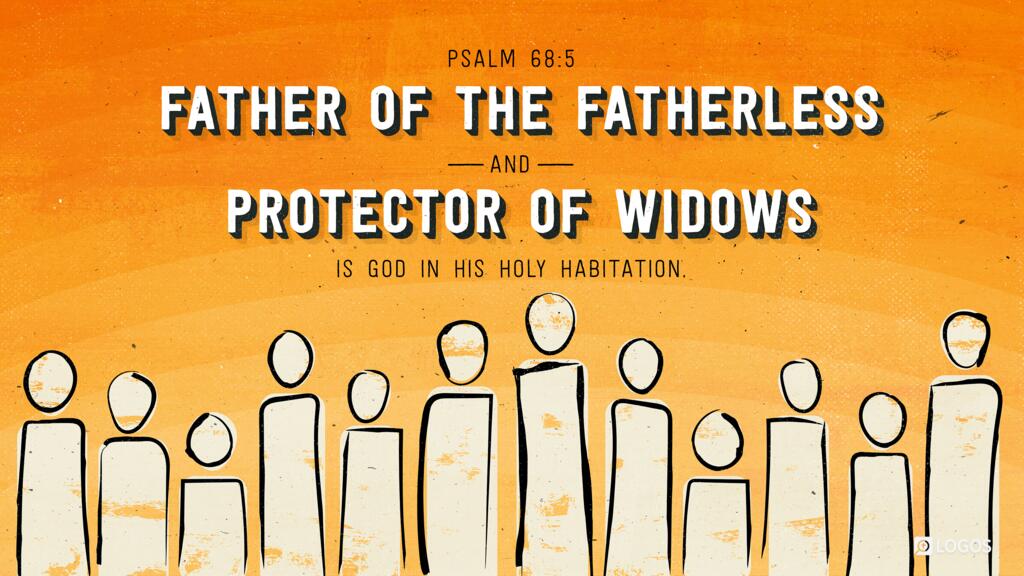
Father of the fatherless and protector of widows
is God in his holy habitation.
God settles the solitary in a home;
he leads out the prisoners to prosperity,
but the rebellious dwell in a parched land.
O God, when you went out before your people,
when you marched through the wilderness, Selah
the earth quaked, the heavens poured down rain,
before God, the One of Sinai,
before God, the God of Israel.
Rain in abundance, O God, you shed abroad;
you restored your inheritance as it languished;
your flock found a dwelling in it;
in your goodness, O God, you provided for the needy.
Copyright 2001 Crossway Bibles
NIVNew International Version (2011)
Sing to God, sing in praise of his name,
extol him who rides on the clouds;
rejoice before him—his name is the Lord.
A father to the fatherless, a defender of widows,
is God in his holy dwelling.
God sets the lonely in families,
he leads out the prisoners with singing;
but the rebellious live in a sun-scorched land.
When you, God, went out before your people,
when you marched through the wilderness,
the earth shook, the heavens poured down rain,
before God, the One of Sinai,
before God, the God of Israel.
You gave abundant showers, O God;
you refreshed your weary inheritance.
Your people settled in it,
and from your bounty, God, you provided for the poor.
Copyright 1973, 1978, 1984, 2011 Biblica, Inc.
CSBChristian Standard Bible
Sing to God! Sing praises to his name.
Exalt him who rides on the clouds—
his name is the Lord—and celebrate before him.
God in his holy dwelling is
a father of the fatherless
and a champion of widows.
God provides homes for those who are deserted.
He leads out the prisoners to prosperity,
but the rebellious live in a scorched land.
God, when you went out before your people,
when you marched through the desert,
Selah
the earth trembled and the skies poured rain
before God, the God of Sinai,
before God, the God of Israel.
You, God, showered abundant rain;
you revived your inheritance when it languished.
Your people settled in it;
God, you provided for the poor by your goodness.
Copyright 2017 Holman Bible Publishers
NLTNew Living Translation
Sing praises to God and to his name!
Sing loud praises to him who rides the clouds.
His name is the Lord—
rejoice in his presence!
Father to the fatherless, defender of widows—
this is God, whose dwelling is holy.
God places the lonely in families;
he sets the prisoners free and gives them joy.
But he makes the rebellious live in a sun-scorched land.
O God, when you led your people out from Egypt,
when you marched through the dry wasteland,
Interlude
the earth trembled, and the heavens poured down rain
before you, the God of Sinai,
before God, the God of Israel.
You sent abundant rain, O God,
to refresh the weary land.
There your people finally settled,
and with a bountiful harvest, O God,
you provided for your needy people.
Holy Bible, New Living Translation, copyright © 1996, 2004, 2015 by Tyndale House Foundation. Used by permission of Tyndale House Publishers. All rights reserved.
LEBThe Lexham English Bible
Sing to God, sing praises to his name.
Lift up a song to the rider on the clouds—his name is Yah—
and rejoice before him.
A father to orphans and a judge for widows
is God in his holy habitation.
God settles the lonely in a home;
he brings prisoners out into prosperity.
But the rebellious abide in a barren land.
O God, when you went out before your people,
when you marched through the desert, Selah
the earth shook; the heavens also dripped rain
at the presence of God who was at Sinai,
at the presence of God, the God of Israel.
You caused abundant rain to fall, O God.
When your inheritance was weary you revived it.
Your community dwelled in it.
You provided in your goodness for the poor, O God.
Copyright 2012 Lexham Press
KJV 1900King James Version
Sing unto God, sing praises to his name:
Extol him that rideth upon the heavens
By his name JAH, and rejoice before him.
A father of the fatherless, and a judge of the widows,
Is God in his holy habitation.
God setteth the solitary in families:
He bringeth out those which are bound with chains:
But the rebellious dwell in a dry land.
O God, when thou wentest forth before thy people,
When thou didst march through the wilderness; Selah:
The earth shook, the heavens also dropped
At the presence of God: even Sinai itself was moved
At the presence of God, the God of Israel.
Thou, O God, didst send a plentiful rain,
Whereby thou didst confirm thine inheritance, when it was weary.
Thy congregation hath dwelt therein:
Thou, O God, hast prepared of thy goodness for the poor.
Public Domain