Psalm 40:1–3
The NET BibleOther versions
English
- NET The NET Bible
- DARBY 1890 Darby Bible
- ASV American Standard Version
- AV 1873 The Cambridge Paragraph Bible of the Authorized English Version
- CSB Christian Standard Bible
- D-R Douay-Rheims Bible
- ESV English Standard Version
- GW GOD’S WORD Translation
- GNB Good News Translation
- HCSB The Holman Christian Standard Bible
- KJV 1900 King James Version
- LSB Legacy Standard Bible
- LEB The Lexham English Bible
- MSG The Message: The Bible in Contemporary Language
- NASB95 New American Standard Bible (1995)
- NCV New Century Version
- NIrV New International Reader’s Version (1998)
- NIV New International Version (2011)
- NKJV The New King James Version
- NLT New Living Translation
- NRSVue New Revised Standard Version: Updated Edition
- RSV The Revised Standard Version
- RSVCE The Revised Standard Version, Catholic Edition
- TNIV Today’s New International Version
- YLT Young’s Literal Translation
Arabic
Czech
French
German
Hebrew
Hungarian
Italian
Korean
Latin
Portuguese
Russian
Simplified Chinese
Spanish
Traditional Chinese
40:1I relied completely1 on the Lord,
and he turned toward me
and heard my cry for help.
40:2He lifted me out of the watery pit,2
out of the slimy mud.3
He placed my feet on a rock
and gave me secure footing.4
40:3He gave me reason to sing a new song,5
praising our God.6
May many see what God has done,
so that they might swear allegiance to him and trust in the Lord!7
Footnotes
- 1 Heb “relying, I relied.” The infinitive absolute precedes the finite verbal form to emphasize the verbal idea. The emphasis is reflected in the translation through the adverb “completely.” Another option is to translate, “I waited patiently” (cf. , , ).
- 2 Heb “cistern of roaring.” The Hebrew noun בּוֹר (bor, “cistern, pit”) is used metaphorically here of Sheol, the place of death, which is sometimes depicted as a raging sea (see Ps 18:4, 15–16). The noun שָׁאוֹן (sha’on, “roaring”) refers elsewhere to the crashing sound of the sea’s waves (see Ps 65:7).
- 3 Heb “from the mud of mud.” The Hebrew phrase translated “slimy mud” employs an appositional genitive. Two synonyms are joined in a construct relationship to emphasize the single idea. For a detailed discussion of the grammatical point with numerous examples, see Y. Avishur, “Pairs of Synonymous Words in the Construct State (and in Appositional Hendiadys) in Biblical Hebrew,” Semitics 2 (1971): 17–81.
- 4 Heb “he established my footsteps.”
- 5 A new song was appropriate because the Lord had intervened in the psalmist’s experience in a fresh and exciting way.
- 6 Heb “and he placed in my mouth a new song, praise to our God.”
- 7 Heb “may many see and fear and trust in the Lord.” The translation assumes that the initial prefixed verbal form is a jussive (“may many see”), rather than an imperfect (“many will see”). The following prefixed verbal forms with vav (ו) conjunctive are taken as indicating purpose or result (“so that they might swear allegiance … and trust”) after the introductory jussive.
The NET Bible First Edition, Copyright 1996-2005 by Biblical Studies Press
In other versions
ESVEnglish Standard Version
I waited patiently for the Lord;
he inclined to me and heard my cry.
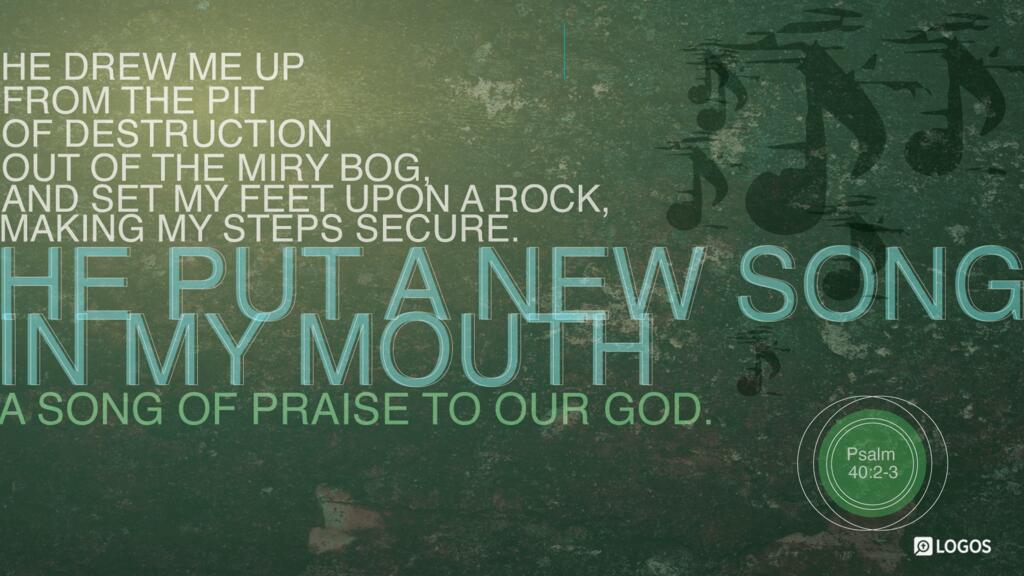
He drew me up from the pit of destruction,
out of the miry bog,
and set my feet upon a rock,
making my steps secure.
He put a new song in my mouth,
a song of praise to our God.
Many will see and fear,
and put their trust in the Lord.
Copyright 2001 Crossway Bibles
NIVNew International Version (2011)
I waited patiently for the Lord;
he turned to me and heard my cry.
He lifted me out of the slimy pit,
out of the mud and mire;
he set my feet on a rock
and gave me a firm place to stand.
He put a new song in my mouth,
a hymn of praise to our God.
Many will see and fear the Lord
and put their trust in him.
Copyright 1973, 1978, 1984, 2011 Biblica, Inc.
CSBChristian Standard Bible
I waited patiently for the Lord,
and he turned to me and heard my cry for help.
He brought me up from a desolate pit,
out of the muddy clay,
and set my feet on a rock,
making my steps secure.
He put a new song in my mouth,
a hymn of praise to our God.
Many will see and fear,
and they will trust in the Lord.
Copyright 2017 Holman Bible Publishers
NLTNew Living Translation
I waited patiently for the Lord to help me,
and he turned to me and heard my cry.
He lifted me out of the pit of despair,
out of the mud and the mire.
He set my feet on solid ground
and steadied me as I walked along.
He has given me a new song to sing,
a hymn of praise to our God.
Many will see what he has done and be amazed.
They will put their trust in the Lord.
Holy Bible, New Living Translation, copyright © 1996, 2004, 2015 by Tyndale House Foundation. Used by permission of Tyndale House Publishers. All rights reserved.
LEBThe Lexham English Bible
I waited patiently for Yahweh,
And he inclined to me
and heard my cry for help.
And so he brought me up from the roaring pit,
from the miry clay.
And he put my feet upon a rock;
he made my steps steady.
Then he put a new song in my mouth,
a praise to our God.
Many will see and fear,
and will trust Yahweh.
Copyright 2012 Lexham Press
KJV 1900King James Version
I waited patiently for the Lord;
And he inclined unto me, and heard my cry.
He brought me up also out of an horrible pit, out of the miry clay,
And set my feet upon a rock, and established my goings.
And he hath put a new song in my mouth, even praise unto our God:
Many shall see it, and fear, and shall trust in the Lord.
Public Domain