Psalm 16:10–11
The NET BibleOther versions
English
- NET The NET Bible
- DARBY 1890 Darby Bible
- ASV American Standard Version
- AV 1873 The Cambridge Paragraph Bible of the Authorized English Version
- CSB Christian Standard Bible
- D-R Douay-Rheims Bible
- ESV English Standard Version
- GW GOD’S WORD Translation
- GNB Good News Translation
- HCSB The Holman Christian Standard Bible
- KJV 1900 King James Version
- LSB Legacy Standard Bible
- LEB The Lexham English Bible
- MSG The Message: The Bible in Contemporary Language
- NASB95 New American Standard Bible (1995)
- NCV New Century Version
- NIrV New International Reader’s Version (1998)
- NIV New International Version (2011)
- NKJV The New King James Version
- NLT New Living Translation
- NRSVue New Revised Standard Version: Updated Edition
- RSV The Revised Standard Version
- RSVCE The Revised Standard Version, Catholic Edition
- YLT Young’s Literal Translation
Arabic
Czech
French
German
Hebrew
Hungarian
Italian
Korean
Latin
Portuguese
Russian
Simplified Chinese
Spanish
Traditional Chinese
16:10You will not abandon me17 to Sheol;18
you will not allow your faithful follower19 to see20 the Pit.21
16:11You lead me in22 the path of life;23
I experience absolute joy in your presence;24
you always give me sheer delight.25
Footnotes
- 17 Or “my life.” The suffixed form of נֶפֶשׁ (nefesh, “being”) is often equivalent to a pronoun in poetic texts.
- 18 In ancient Israelite cosmology Sheol is the realm of the dead, viewed as being under the earth’s surface. See L. I. J. Stadelmann, The Hebrew Conception of the World, 165–76.
- 19 A “faithful follower” (חָסִיד [khasid], traditionally rendered “holy one”) is one who does what is right in God’s eyes and remains faithful to God (see Pss 4:3; 12:1; 18:25; 31:23; 37:28; 86:2; 97:10). The psalmist here refers to himself, as the parallel line (“You will not abandon me to Sheol”) indicates.
- 20 That is, “experience.” The psalmist is confident that the Lord will protect him in his present crisis (see v. 1) and prevent him from dying. According to Peter, the words of Ps 16:8–11 are applicable to Jesus (Acts 2:25–29). Peter goes on to argue that David, being a prophet, foresaw future events and spoke of Jesus’ resurrection from the dead (Acts 2:30–33). Paul seems to concur with Peter in this understanding (see Acts 13:35–37). For a discussion of the NT application of these verses to Jesus’ resurrection, see R. B. Chisholm, Jr., “A Theology of the Psalms,” A Biblical Theology of the Old Testament, 292–95.
- 21 The Hebrew word שָׁחַת (shakhat, “pit”) is often used as a title for Sheol (see Pss 30:9; 49:9; 55:24; 103:4). Note the parallelism with the previous line.
- 22 Heb “cause me to know”; or “cause me to experience.”
- 23 This is a metaphorical way of saying, “you preserve my life.” The phrase “path of life” stands in contrast to death/Sheol in Prov 2:18–19; 5:5–6; 15:24.
- 24 Heb “abundance of joy [is] with your face.” The plural form of the noun שִׂמְחָה (simkhah, “joy”) occurs only here and in Ps 45:15. It may emphasize the degree of joy experienced.
- 25 Heb “delight [is] in your right hand forever.” The plural form of the adjective נָעִים (na’im, “pleasant, delightful”) may here emphasize the degree of delight experienced (see Job 36:11).
The NET Bible First Edition, Copyright 1996-2005 by Biblical Studies Press
In other versions
ESVEnglish Standard Version
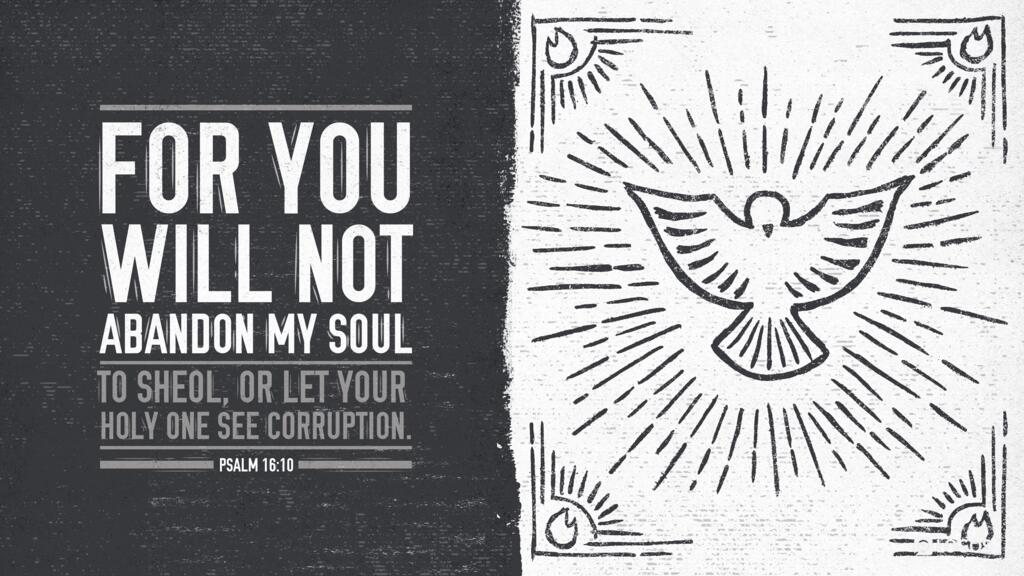
For you will not abandon my soul to Sheol,
or let your holy one see corruption.
You make known to me the path of life;
in your presence there is fullness of joy;
at your right hand are pleasures forevermore.
Copyright 2001 Crossway Bibles
NIVNew International Version (2011)
because you will not abandon me to the realm of the dead,
nor will you let your faithful one see decay.
You make known to me the path of life;
you will fill me with joy in your presence,
with eternal pleasures at your right hand.
Copyright 1973, 1978, 1984, 2011 Biblica, Inc.
CSBChristian Standard Bible
For you will not abandon me to Sheol;
you will not allow your faithful one to see decay.
You reveal the path of life to me;
in your presence is abundant joy;
at your right hand are eternal pleasures.
Copyright 2017 Holman Bible Publishers
NLTNew Living Translation
For you will not leave my soul among the dead
or allow your holy one to rot in the grave.
You will show me the way of life,
granting me the joy of your presence
and the pleasures of living with you forever.
Holy Bible, New Living Translation, copyright © 1996, 2004, 2015 by Tyndale House Foundation. Used by permission of Tyndale House Publishers. All rights reserved.
LEBThe Lexham English Bible
for you will not abandon my soul to Sheol;
you will not give your faithful one to see the grave.
You will make known to me the path of life.
In your presence is fullness of joy.
At your right hand are pleasures forever.
Copyright 2012 Lexham Press
KJV 1900King James Version
For thou wilt not leave my soul in hell;
Neither wilt thou suffer thine Holy One to see corruption.
Thou wilt shew me the path of life:
In thy presence is fulness of joy;
At thy right hand there are pleasures for evermore.
Public Domain