Psalm 127:title–2
The NET BibleOther versions
English
- NET The NET Bible
- DARBY 1890 Darby Bible
- ASV American Standard Version
- AV 1873 The Cambridge Paragraph Bible of the Authorized English Version
- CSB Christian Standard Bible
- D-R Douay-Rheims Bible
- ESV English Standard Version
- GW GOD’S WORD Translation
- GNB Good News Translation
- HCSB The Holman Christian Standard Bible
- KJV 1900 King James Version
- LSB Legacy Standard Bible
- LEB The Lexham English Bible
- MSG The Message: The Bible in Contemporary Language
- NASB95 New American Standard Bible (1995)
- NCV New Century Version
- NIrV New International Reader’s Version (1998)
- NIV New International Version (2011)
- NKJV The New King James Version
- NLT New Living Translation
- NRSVue New Revised Standard Version: Updated Edition
- RSV The Revised Standard Version
- RSVCE The Revised Standard Version, Catholic Edition
- TNIV Today’s New International Version
- YLT Young’s Literal Translation
Arabic
Czech
French
German
Hebrew
Hungarian
Italian
Korean
Latin
Portuguese
Russian
Simplified Chinese
Spanish
Traditional Chinese
A song of ascents,10 by Solomon.
127:1If the Lord does not build a house,1
then those who build it work in vain.
If the Lord does not guard a city,2
then the watchman stands guard in vain.
127:2It is vain for you to rise early, come home late,
and work so hard for your food.3
Yes,4 he can provide for those whom he loves even when they sleep.5
Footnotes
- 10 The precise significance of this title, which appears in Pss 120–134, is unclear. Perhaps worshipers recited these psalms when they ascended the road to Jerusalem to celebrate annual religious festivals. For a discussion of their background see L. C. Allen, Psalms 101–150(), .
- 1 The expression build a house may have a double meaning here. It may refer on the surface level to a literal physical structure in which a family lives, but at a deeper, metaphorical level it refers to building, perpetuating, and maintaining a family line. See Deut 25:9; Ruth 4:11; 1 Sam 2:35; 2 Sam 7:27; 1 Kgs 11:38; 1 Chr 17:10, 25. Having a family line provided security in ancient Israel.
- 2 The city symbolizes community security, which is the necessary framework for family security.
- 3 Heb “[it is] vain for you, you who are early to rise, who delay sitting, who eat the food of hard work.” The three substantival participles are parallel and stand in apposition to the pronominal suffix on the preposition. See לָכֶם (lakhem, “for you”).
- 4 Here the Hebrew particle כֵּן (ken) is used to stress the following affirmation (see Josh 2:4; Ps 63:2).
- 5 Heb “he gives to his beloved, sleep.” The translation assumes that the Hebrew term שֵׁנָא (shena’, “sleep,” an alternate form of שֵׁנָה, shenah) is an adverbial accusative. The point seems to be this: Hard work by itself is not what counts, but one’s relationship to God, for God is able to bless an individual even while he sleeps. (There may even be a subtle allusion to the miracle of conception following sexual intercourse; see the reference to the gift of sons in the following verse.) The statement is not advocating laziness, but utilizing hyperbole to give perspective and to remind the addressees that God must be one’s first priority. Another option is to take “sleep” as the direct object: “yes, he gives sleep to his beloved” (cf. , ). In this case the point is this: Hard work by itself is futile, for only God is able to bless one with sleep, which metonymically refers to having one’s needs met. He blesses on the basis of one’s relationship to him, not on the basis of physical energy expended.
The NET Bible First Edition, Copyright 1996-2005 by Biblical Studies Press
In other versions
ESVEnglish Standard Version
A Song of Ascents. Of Solomon.
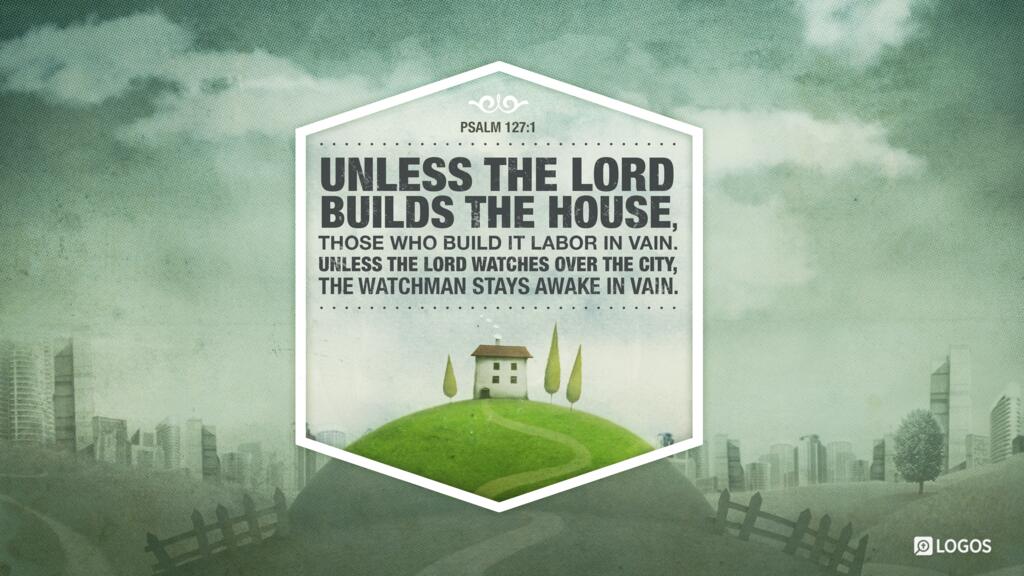
Unless the Lord builds the house,
those who build it labor in vain.
Unless the Lord watches over the city,
the watchman stays awake in vain.
It is in vain that you rise up early
and go late to rest,
eating the bread of anxious toil;
for he gives to his beloved sleep.
Copyright 2001 Crossway Bibles
NIVNew International Version (2011)
A song of ascents. Of Solomon.
Unless the Lord builds the house,
the builders labor in vain.
Unless the Lord watches over the city,
the guards stand watch in vain.
In vain you rise early
and stay up late,
toiling for food to eat—
for he grants sleep to those he loves.
Copyright 1973, 1978, 1984, 2011 Biblica, Inc.
CSBChristian Standard Bible
A song of ascents. Of Solomon.
Unless the Lord builds a house,
its builders labor over it in vain;
unless the Lord watches over a city,
the watchman stays alert in vain.
In vain you get up early and stay up late,
working hard to have enough food—
yes, he gives sleep to the one he loves.
Copyright 2017 Holman Bible Publishers
NLTNew Living Translation
A song for pilgrims ascending to Jerusalem. A psalm of Solomon.
Unless the Lord builds a house,
the work of the builders is wasted.
Unless the Lord protects a city,
guarding it with sentries will do no good.
It is useless for you to work so hard
from early morning until late at night,
anxiously working for food to eat;
for God gives rest to his loved ones.
Holy Bible, New Living Translation, copyright © 1996, 2004, 2015 by Tyndale House Foundation. Used by permission of Tyndale House Publishers. All rights reserved.
LEBThe Lexham English Bible
A song of ascents. Of Solomon.
Unless Yahweh builds a house,
its builders labor at it in vain.
Unless Yahweh guards a city,
a guard watches in vain.
It is in vain for you who rise early and sit late,
eating the bread of anxious toil,
when thus he provides for his beloved in his sleep.
Copyright 2012 Lexham Press
KJV 1900King James Version
A Song of degrees for Solomon.
Except the Lord build the house, they labour in vain that build it:
Except the Lord keep the city, the watchman waketh but in vain.
It is vain for you to rise up early, to sit up late,
To eat the bread of sorrows:
For so he giveth his beloved sleep.
Public Domain