Proverbs 3:21–26
The NET BibleOther versions
English
- NET The NET Bible
- DARBY 1890 Darby Bible
- ASV American Standard Version
- AV 1873 The Cambridge Paragraph Bible of the Authorized English Version
- CSB Christian Standard Bible
- D-R Douay-Rheims Bible
- ESV English Standard Version
- GW GOD’S WORD Translation
- GNB Good News Translation
- HCSB The Holman Christian Standard Bible
- KJV 1900 King James Version
- LSB Legacy Standard Bible
- LEB The Lexham English Bible
- MSG The Message: The Bible in Contemporary Language
- NASB95 New American Standard Bible (1995)
- NCV New Century Version
- NIrV New International Reader’s Version (1998)
- NIV New International Version (2011)
- NKJV The New King James Version
- NLT New Living Translation
- NRSVue New Revised Standard Version: Updated Edition
- RSV The Revised Standard Version
- RSVCE The Revised Standard Version, Catholic Edition
- TNIV Today’s New International Version
- YLT Young’s Literal Translation
Arabic
Czech
French
German
Hebrew
Hungarian
Italian
Korean
Latin
Portuguese
Russian
Simplified Chinese
Spanish
Traditional Chinese
3:21My child, do not let them59 escape from your sight;
safeguard sound wisdom and discretion.60
3:22So61 they will give62 life to you,63
and grace to adorn64 your neck.65
3:23Then you will walk on your way66 with security,
3:24When69 you lie down you will not be filled with fear;70
when71 you lie down your sleep will be pleasant.72
3:25You will not be afraid73 of sudden74 disaster,75
or when destruction overtakes76 the wicked;77
3:26for the Lord will be78 the source of your confidence,79
and he will guard your foot80 from being caught in a trap.81
Footnotes
- 59 The object of the verb “escape” is either (1) wisdom, knowledge, and understanding in vv. 13–20 or (2) “wisdom and discretion” in the second colon of this verse. Several English versions transpose the terms “wisdom and discretion” from the second colon into the first colon for the sake of clarity and smoothness (e.g., , , , , ). takes the subject from the second colon and reverses the clauses to clarify that.
- 60 Or: “purpose,” “power of devising.”
- 61 Heb “and.” The vav probably denotes purpose/result.
- 62 Heb “they will be.”
- 63 Heb “your soul.” The noun נַפְשֶׁךָ (nafshekha, “your soul”) is a synecdoche of part (= inner soul) for the whole person (= you); see 600 4.a.2.
- 64 The phrase “to adorn” does not appear in the Hebrew text, but is supplied in the translation for the sake of clarity and smoothness.
- 65 Heb “grace for your neck.” See note on .
- 66 The noun דַּרְכֶּךָ (darkekha, “your way”) functions as an adverbial accusative of location: “on your way.”
- 67 Heb “your foot.” The term רַגְלְךָ (raglékha, “your foot”) functions as a synecdoche of part (= foot) for the whole person (= you).
- 68 The verb נָגַף (ragaf, “to strike; to smite”) sometimes means “to stumble” against a stone (e.g., Ps 91:12). Here the object (“stone”) is implied ( 619 ). This is a figure (hypocatastasis) comparing stumbling on a stone in the path to making serious mistakes in life that bring harm.
- 69 The particle אִם (’im, “if”) here functions in its rare temporal sense (“when”) followed by an imperfect tense (e.g., Num 36:4; 50 1.b.4.b).
- 70 Heb “terror.” The verb פָּחַד (pakhad, “terror”) describes emotion that is stronger than mere fear—it is dread.
- 71 The construction of vav consecutive + perfect tense followed by vav (ו) consecutive + perfect tense depicts a temporal clause. The temporal nuance is also suggested by the parallelism of the preceding colon.
- 72 The verb עָרְבָה (’orvah) is from III עָרַב (“to be sweet; to be pleasing; to be pleasant”; 787 III עָרַב). It should not be confused with the other five homonymic roots that are also spelled עָרַב (’arav; see 786–88).
- 73 Heb “do not be afraid.” The negative exhortation אַל־תִּירָא (’al-tira’, “do not be afraid”) is used rhetorically to emphasize that the person who seeks wisdom will have no reason to fear the consequences of wicked actions.
- 74 Heb “terror of suddenness.” The noun פִּתְאֹם (pit’om, “sudden”) functions as an attributive genitive: “sudden terror” (e.g., Job 22:10; 837 ).
- 75 Heb “terror.” The noun פַּחַד (pakhad, “terror”) is a metonymy of effect for cause (= disaster); see 808 2. This is suggested by the parallelism with the noun מִשֹּׁאַת (misho’at, “destruction”) in the following colon. The term פַּחַד (“terror”) often refers to the object (or cause) of terror (e.g., Job 3:25; 15:21; 22:10; 31:23; Pss 31:12; 36:2; Isa 24:18; Jer 48:44).
- 76 Heb “or the destruction of the wicked when it comes.”
- 77 Heb “destruction of the wicked.” The noun רְשָׁעִים (résha’im, “wicked ones”) probably functions as an objective genitive (the destruction that comes on the wicked) or a genitive of source (the destruction that the wicked bring on others).
- 78 Or “the Lord will be at your side.” Assuming that the noun כֶּסֶל (kesel) is related to the root II כָסַל (“confidence”; 492 כֶּסֶל 3), the preposition ב (bet) introduces the predicate noun כִּסְלֶךָ (kislekha, “your confidence”) and functions as a beth essentiae ( §119.i) which emphasizes the quality or nature of the noun ( 88 בְּ 7; בְּ 3): “the Lord will be your confidence.” However, if the noun is related to I כסל (“loins; side”; I כֶּסֶל 2), the preposition ב (bet) would function in a locative sense: “the Lord will be at your side.” See on the following phrase “source of your confidence.”
- 79 Heb “your confidence” (so , , ) or “at your side.” There is debate whether the term כֶּסֶל (kesel) is related to the root I כָסַל “loins; side” (so I כֶּסֶל 2) or II כָסַל “confidence” (so 492 כֶּסֶל 3). The relates it to I כָסַל and offers “the Lord will be at your side (latus).” Others relate it to II כָסַל “confidence” (e.g., Job 8:14; 31:24; Ps 78:7) and take it as a metonymy (= confidence) of adjunct (= object of confidence): “the Lord will be the source [or, object] of your confidence.”
- 80 The term רַגְלְךָ (raglekha, “your foot”) functions as a synecdoche of part (= your foot) for the whole person (= you). This synecdoche develops the extended comparison between the hunter’s snare and calamity that afflicts the wicked.
- 81 Heb “from capture.” The noun לָכֶד (lakhed, “capture; snare”) occurs only here in OT ( 540 ; לֶכֶד). It is figurative for the calamity of v. 25. God will protect the wise (or, righteous) from the consequences of sin (snares) that afflict the wicked.
The NET Bible First Edition, Copyright 1996-2005 by Biblical Studies Press
In other versions
ESVEnglish Standard Version
My son, do not lose sight of these—
keep sound wisdom and discretion,
and they will be life for your soul
and adornment for your neck.
Then you will walk on your way securely,
and your foot will not stumble.
If you lie down, you will not be afraid;
when you lie down, your sleep will be sweet.
Do not be afraid of sudden terror
or of the ruin of the wicked, when it comes,
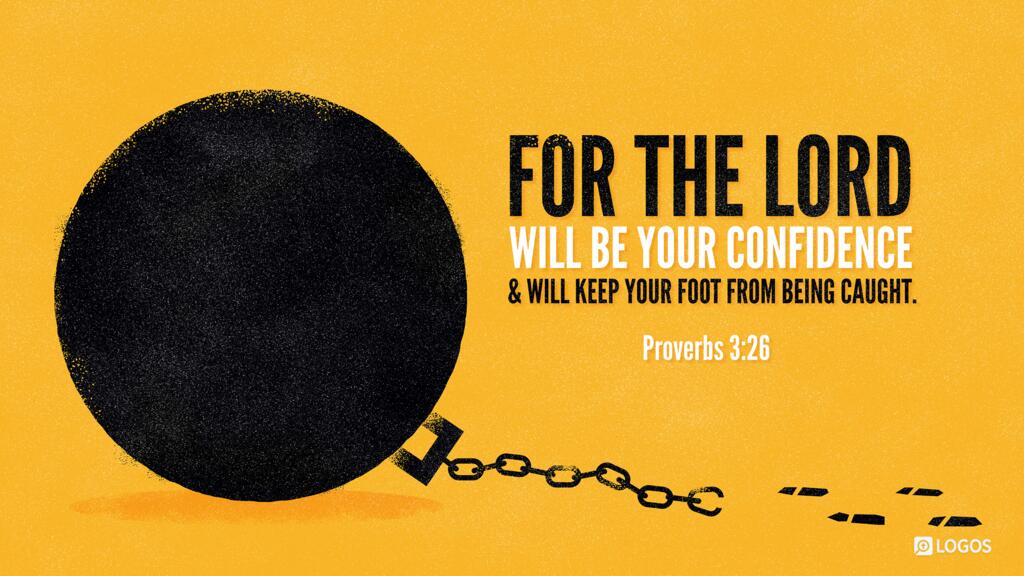
for the Lord will be your confidence
and will keep your foot from being caught.
Copyright 2001 Crossway Bibles
NIVNew International Version (2011)
My son, do not let wisdom and understanding out of your sight,
preserve sound judgment and discretion;
they will be life for you,
an ornament to grace your neck.
Then you will go on your way in safety,
and your foot will not stumble.
When you lie down, you will not be afraid;
when you lie down, your sleep will be sweet.
Have no fear of sudden disaster
or of the ruin that overtakes the wicked,
for the Lord will be at your side
and will keep your foot from being snared.
Copyright 1973, 1978, 1984, 2011 Biblica, Inc.
CSBChristian Standard Bible
Maintain sound wisdom and discretion.
My son, don’t lose sight of them.
They will be life for you
and adornment for your neck.
Then you will go safely on your way;
your foot will not stumble.
When you lie down, you will not be afraid;
you will lie down, and your sleep will be pleasant.
Don’t fear sudden danger
or the ruin of the wicked when it comes,
for the Lord will be your confidence
and will keep your foot from a snare.
Copyright 2017 Holman Bible Publishers
NLTNew Living Translation
My child, don’t lose sight of common sense and discernment.
Hang on to them,
for they will refresh your soul.
They are like jewels on a necklace.
They keep you safe on your way,
and your feet will not stumble.
You can go to bed without fear;
you will lie down and sleep soundly.
You need not be afraid of sudden disaster
or the destruction that comes upon the wicked,
for the Lord is your security.
He will keep your foot from being caught in a trap.
Holy Bible, New Living Translation, copyright © 1996, 2004, 2015 by Tyndale House Foundation. Used by permission of Tyndale House Publishers. All rights reserved.
LEBThe Lexham English Bible
My child, may they not escape from your sight;
may you keep sound wisdom and prudence.
They shall be life for your soul
and adornment for your neck.
Then you will walk in the confidence of your ways,
and your foot will not stumble.
If you sit down, you will not panic,
and if you lie down, then your sleep shall be sweet.
Do not be afraid of sudden panic,
or the storm of wickedness that will come.
Yahweh will be your confidence
and guard your foot from capture.
Copyright 2012 Lexham Press
KJV 1900King James Version
My son, let not them depart from thine eyes:
Keep sound wisdom and discretion:
So shall they be life unto thy soul,
And grace to thy neck.
Then shalt thou walk in thy way safely,
And thy foot shall not stumble.
When thou liest down, thou shalt not be afraid:
Yea, thou shalt lie down, and thy sleep shall be sweet.
Be not afraid of sudden fear,
Neither of the desolation of the wicked, when it cometh.
For the Lord shall be thy confidence,
And shall keep thy foot from being taken.
Public Domain