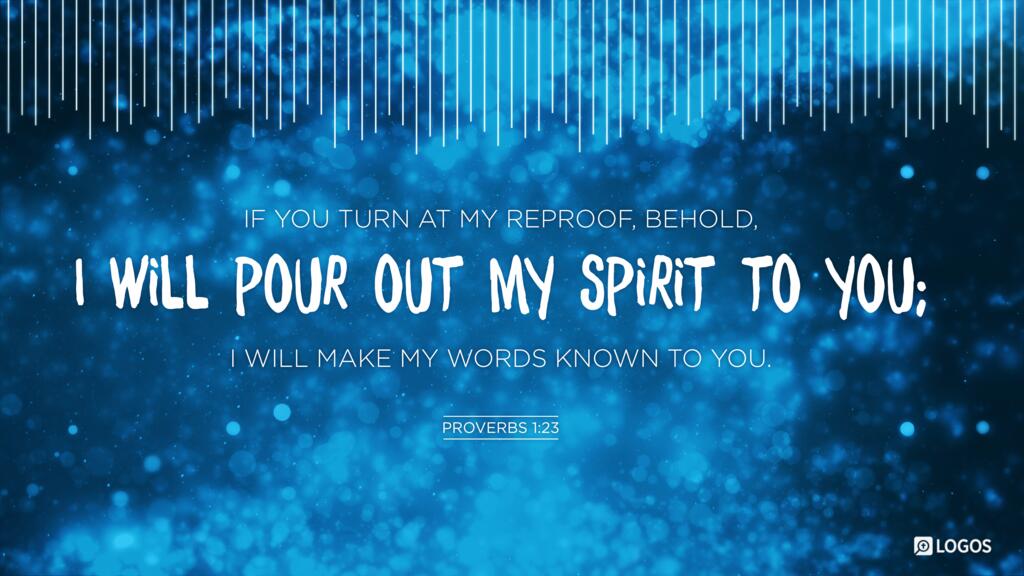
Proverbs 1:23
The NET BibleOther versions
English
- NET The NET Bible
- DARBY 1890 Darby Bible
- ASV American Standard Version
- AV 1873 The Cambridge Paragraph Bible of the Authorized English Version
- CSB Christian Standard Bible
- D-R Douay-Rheims Bible
- ESV English Standard Version
- GW GOD’S WORD Translation
- GNB Good News Translation
- HCSB The Holman Christian Standard Bible
- KJV 1900 King James Version
- LSB Legacy Standard Bible
- LEB The Lexham English Bible
- MSG The Message: The Bible in Contemporary Language
- NASB95 New American Standard Bible (1995)
- NCV New Century Version
- NIrV New International Reader’s Version (1998)
- NIV New International Version (2011)
- NKJV The New King James Version
- NLT New Living Translation
- NRSVue New Revised Standard Version: Updated Edition
- RSV The Revised Standard Version
- RSVCE The Revised Standard Version, Catholic Edition
- TNIV Today’s New International Version
- YLT Young’s Literal Translation
Arabic
Czech
French
German
Hebrew
Hungarian
Italian
Korean
Latin
Portuguese
Russian
Simplified Chinese
Spanish
Traditional Chinese
1:23If only110 you will respond111 to my rebuke,112
Footnotes
- 110 The imperfect tense is in the conditional protasis without the conditional particle, followed by the clause beginning with הִנֵּה (hinneh, “then”). The phrase “If only …” does not appear in the Hebrew but is implied by the syntax; it is supplied in the translation for the sake of clarity.
- 111 Heb “turn.” The verb is from שׁוּב (shuv, “to return; to respond; to repent”).
- 112 The noun תּוֹכַחַת (tokhakhat, “rebuke”) is used in all kinds of disputes including rebuking, arguing, reasoning, admonishing, and chiding. The term is broad enough to include here warning and rebuke. Cf. , , “reproof”; “when I reprimand you”; “correct you.”
- 113 Heb “Behold!”
- 114 The Hiphil cohortative of נָבַע (nava’, “to pour out”) describes the speaker’s resolution to pour out wisdom on those who respond.
- 115 Heb “my spirit.” The term “spirit” (רוּחַ, ruakh) functions as a metonymy (= spirit) of association (= thoughts), as indicated by the parallelism with “my words” (דְּבָרַי, débaray). The noun רוּחַ (ruakh, “spirit”) can have a cognitive nuance, e.g., “spirit of wisdom” (Exod 28:3; Deut 34:9). It is used metonymically for “words” (Job 20:3) and “mind” (Isa 40:13; Ezek 11:5; 20:32; 1 Chr 28:12; see 925 רוּחַ 6). The “spirit of wisdom” produces skill and capacity necessary for success (Isa 11:2; John 7:37–39).
- 116 The conjunction “and” does not appear in the Hebrew text, but is supplied in the translation for the sake of smoothness.
- 117 Here too the form is the cohortative, stressing the resolution of wisdom to reveal herself to the one who responds.
The NET Bible First Edition, Copyright 1996-2005 by Biblical Studies Press
In other versions
ESVEnglish Standard Version
If you turn at my reproof,
behold, I will pour out my spirit to you;
I will make my words known to you.
Copyright 2001 Crossway Bibles
NIVNew International Version (2011)
Repent at my rebuke!
Then I will pour out my thoughts to you,
I will make known to you my teachings.
Copyright 1973, 1978, 1984, 2011 Biblica, Inc.
CSBChristian Standard Bible
If you respond to my warning,
then I will pour out my spirit on you
and teach you my words.
Copyright 2017 Holman Bible Publishers
NLTNew Living Translation
Come and listen to my counsel.
I’ll share my heart with you
and make you wise.
Holy Bible, New Living Translation, copyright © 1996, 2004, 2015 by Tyndale House Foundation. Used by permission of Tyndale House Publishers. All rights reserved.
LEBThe Lexham English Bible
May you turn to my argument!
Behold, I shall pour out my spirit upon you;
I will make my words known to you.
Copyright 2012 Lexham Press
KJV 1900King James Version
Turn you at my reproof:
Behold, I will pour out my spirit unto you,
I will make known my words unto you.
Public Domain