Matthew 10:34–42
The NET BibleOther versions
English
- NET The NET Bible
- DARBY 1890 Darby Bible
- ASV American Standard Version
- AV 1873 The Cambridge Paragraph Bible of the Authorized English Version
- CSB Christian Standard Bible
- D-R Douay-Rheims Bible
- ESV English Standard Version
- GW GOD’S WORD Translation
- GNB Good News Translation
- HCSB The Holman Christian Standard Bible
- KJV 1900 King James Version
- LSB Legacy Standard Bible
- LEB The Lexham English Bible
- MSG The Message: The Bible in Contemporary Language
- NASB95 New American Standard Bible (1995)
- NCV New Century Version
- NIrV New International Reader’s Version (1998)
- NIV New International Version (2011)
- NKJV The New King James Version
- NLT New Living Translation
- NRSVue New Revised Standard Version: Updated Edition
- RSV The Revised Standard Version
- RSVCE The Revised Standard Version, Catholic Edition
- YLT Young’s Literal Translation
Arabic
Czech
French
German
Greek
Hungarian
Italian
Korean
Latin
Portuguese
Russian
Simplified Chinese
Spanish
Traditional Chinese
Not Peace, but a Sword
10:34“Do not think that I have come to bring60 peace to the earth. I have not come to bring peace but a sword. 10:35For I have come to set a man against his father, a daughter against her mother, and a daughter-in-law against her mother-in-law, 10:36and a man’s enemies will be the members of his household.61
10:37“Whoever loves father or mother more than me is not worthy of me, and whoever loves son or daughter more than me is not worthy of me. 10:38And whoever does not take up his cross62 and follow me is not worthy of me. 10:39Whoever finds his life63 will lose it,64 and whoever loses his life because of me65 will find it.
Rewards
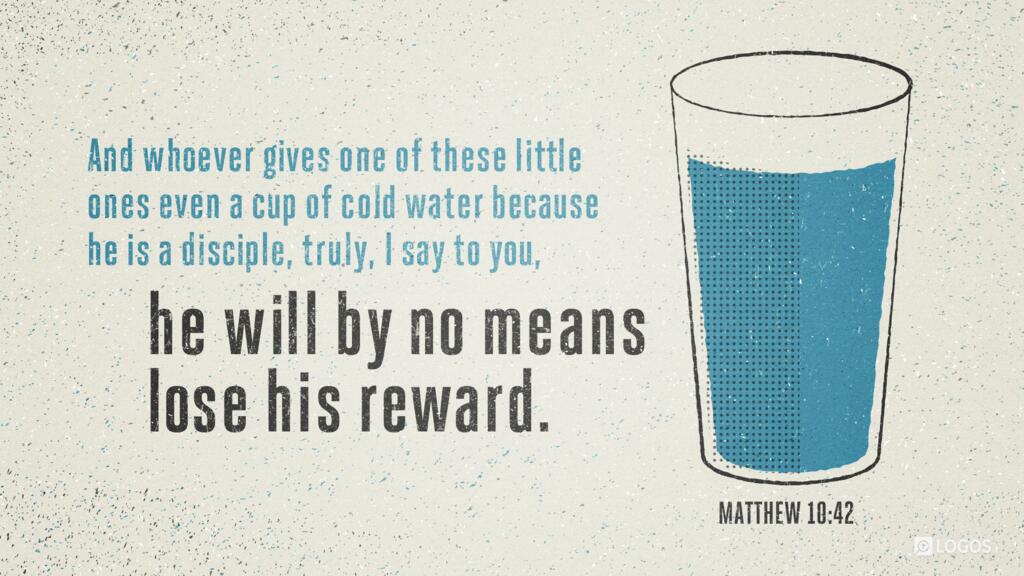
10:40“Whoever receives you receives me, and whoever receives me receives the one who sent me.6610:41Whoever receives a prophet in the name of a prophet will receive a prophet’s reward. Whoever67 receives a righteous person in the name of a righteous person will receive a righteous person’s reward. 10:42And whoever gives only a cup of cold water to one of these little ones in the name of a disciple, I tell you the truth,68 he will never lose his reward.”
Footnotes
- 60 Grk “cast.” For βάλλω (ballō) in the sense of causing a state or condition, see L&N 13.14.
- 61 Matt 10:35–36 are an allusion to Mic 7:6.
- 62 It was customary practice in a Roman crucifixion for the prisoner to be made to carry his own cross. Jesus is speaking figuratively here in the context of rejection. If the priority is not one’s allegiance to Jesus, then one will not follow him in the face of possible rejection.
- 63 Grk “his soul,” but ψυχή (psuchē) is frequently used of one’s physical life. It clearly has that meaning in this context.
- 64 If there is no willingness to suffer the world’s rejection at this point, then one will not respond to Jesus (which is trying to find life) and then will be subject to this judgment (which is losing it).
- 65 Or “for my sake.” The traditional rendering “for my sake” can be understood in the sense of “for my benefit,” but the Greek term ἔνεκα indicates the cause or reason for something ( 1).
- 66 The one who sent me refers to God.
- 67 Grk “And whoever.” Here καί (kai) has not been translated.
- 68 Grk “Truly (ἀμήν, amēn), I say to you.”
The NET Bible First Edition, Copyright 1996-2005 by Biblical Studies Press