Luke 2:41–52
The NET BibleOther versions
English
- NET The NET Bible
- DARBY 1890 Darby Bible
- ASV American Standard Version
- AV 1873 The Cambridge Paragraph Bible of the Authorized English Version
- CSB Christian Standard Bible
- D-R Douay-Rheims Bible
- ESV English Standard Version
- GW GOD’S WORD Translation
- GNB Good News Translation
- HCSB The Holman Christian Standard Bible
- KJV 1900 King James Version
- LSB Legacy Standard Bible
- LEB The Lexham English Bible
- MSG The Message: The Bible in Contemporary Language
- NASB95 New American Standard Bible (1995)
- NCV New Century Version
- NIrV New International Reader’s Version (1998)
- NIV New International Version (2011)
- NKJV The New King James Version
- NLT New Living Translation
- NRSVue New Revised Standard Version: Updated Edition
- RSV The Revised Standard Version
- RSVCE The Revised Standard Version, Catholic Edition
- TNIV Today’s New International Version
- YLT Young’s Literal Translation
Arabic
Czech
French
German
Greek
Hungarian
Italian
Korean
Latin
Portuguese
Russian
Simplified Chinese
Spanish
Traditional Chinese
Jesus in the Temple
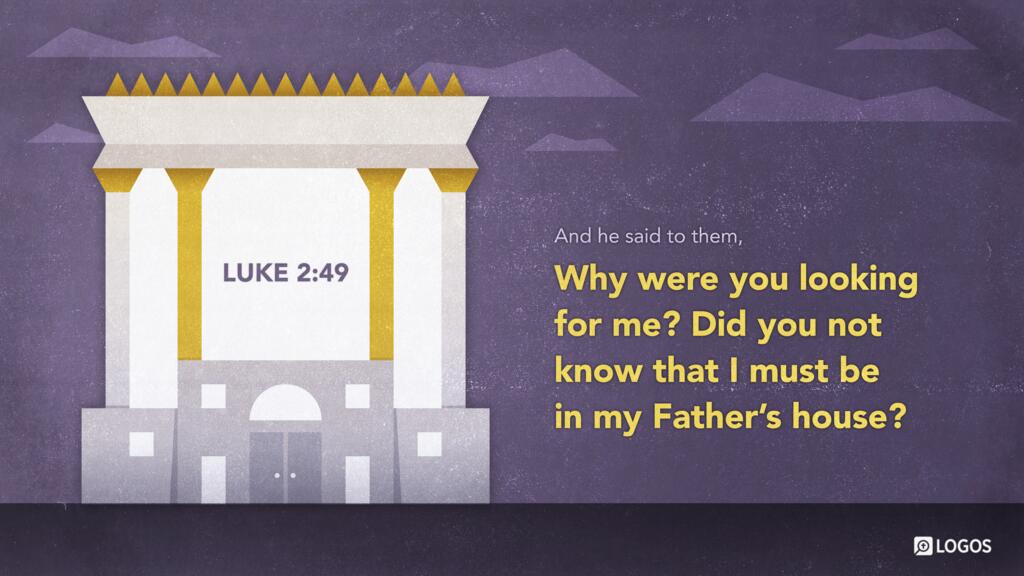
2:41Now125 Jesus’126 parents went to Jerusalem127 every128 year for the feast of the Passover.1292:42When130 he was twelve years old,131 they went up132 according to custom. 2:43But133 when the feast was over,134 as they were returning home,135 the boy Jesus stayed behind in Jerusalem. His136 parents137 did not know it, 2:44but (because they assumed that he was in their group of travelers)138 they went a day’s journey. Then139 they began to look for him among their relatives and acquaintances.1402:45When141 they did not find him, they returned to Jerusalem142 to look for him. 2:46After143 three days144 they found him in the temple courts,145 sitting among the teachers,146 listening to them and asking them questions. 2:47And all who heard Jesus147 were astonished148 at his understanding and his answers. 2:48When149 his parents150 saw him, they were overwhelmed. His151 mother said to him, “Child,152 why have you treated153 us like this? Look, your father and I have been looking for you anxiously.”1542:49But155 he replied,156 “Why were you looking for me?157 Didn’t you know that I must be in my Father’s house?”1582:50Yet159 his parents160 did not understand161 the remark162 he made163 to them. 2:51Then164 he went down with them and came to Nazareth,165 and was obedient166 to them. But167 his mother kept all these things168 in her heart.169
2:52And Jesus increased170 in wisdom and in stature, and in favor with God and with people.
Footnotes
- 125 Here καί (kai) has been translated as “now” to indicate the transition to a new topic.
- 126 Grk “his”; the referent (Jesus) has been specified in the translation for clarity.
- 127 For location see ; ; ; ; ; ; ; ; .
- 128 On the distributive use of the term κατά (kata), see §305.
- 129 The custom of Jesus and his family going to Jerusalem every year for the feast of the Passover shows their piety in obeying the law (Exod 23:14–17).
- 130 Grk “And when.” Here καί (kai) has not been translated because of differences between Greek and English style.
- 131 According to the , the age of twelve years old is one year before a boy becomes responsible for his religious commitments ( Niddah 5.6).
- 132 Most , especially later ones (A Cvid Θ Ψ 0130 f1, 13 33 𝔐 lat) have εἰς Ἱεροσόλυμα (eijs hierosoluma, “to Jerusalem”) here, but the support for the omission is much stronger (א B D L W 579 1241 co); further, the longer reading clarifies what they went up to and thus looks like a motivated reading.
- 133 Here καί (kai) has been translated contrastively in keeping with the context. This outcome is different from what had happened all the times before.
- 134 Grk “when the days ended.”
- 135 The word “home” is not in the Greek text, but has been supplied for clarity.
- 136 Grk “And his.” Here καί (kai) has not been translated because of differences between Greek and English style.
- 137 Most , especially later ones (A C Ψ 0130 f13 𝔐 it), read Ἰωσὴφ καὶ ἡ μήτηρ αὐτοῦ (Iōsēph kai hē mētēr aujtou, “[both] Joseph and his mother”), a reading evidently intended to insulate the doctrine of the virgin conception of our Lord. But א B D L W Θ f1 33 579 1241 lat sa read οἱ γονεῖς αὐτοῦ (hoi goneis autou, “his parents”) as in the translation. Such motivated readings as the former lack credibility, especially since the better witnesses affirm the virgin conception of Christ in Luke 1:34–35.
- 138 An ancient journey like this would have involved a caravan of people who traveled together as a group for protection and fellowship.
- 139 Here καί (kai) has been translated as “then” to indicate the implied sequence of events within the narrative.
- 140 Or “and friends.” See L&N 28.30 and 34.17.
- 141 Grk “And when.” Here καί (kai) has not been translated because of differences between Greek and English style.
- 142 The return to Jerusalem would have taken a second day, since they were already one day’s journey away.
- 143 Grk “And it happened that after.” The introductory phrase ἐγένετο (egeneto, “it happened that”), common in Luke (69 times) and Acts (54 times), is redundant in contemporary English and has not been translated. Here καί (kai) has not been translated because of differences between Greek and English style.
- 144 Three days means there was one day out, another day back, and a third day of looking in Jerusalem.
- 145 Grk “the temple.”
- 146 This is the only place in Luke’s Gospel where the term διδάσκαλος (didaskalos, “teacher”) is applied to Jews.
- 147 Grk “him”; the referent (Jesus) has been specified in the translation for clarity.
- 148 There was wonder (all who heard … were astonished) that Jesus at such a young age could engage in such a discussion. The fact that this story is told of a preteen hints that Jesus was someone special.
- 149 Grk “And when.” Here καί (kai) has not been translated because of differences between Greek and English style.
- 150 Grk “when they”; the referent (his parents) has been supplied in the translation for clarity.
- 151 Grk “And his.” Here καί (kai) has not been translated because of differences between Greek and English style.
- 152 The Greek word here is τέκνον (teknon) rather than υἱός (huios, “son”).
- 153 Or “Child, why did you do this to us?”
- 154 Or “your father and I have been terribly worried looking for you.”
- 155 Here καί (kai) has been translated as “but” to indicate the contrast.
- 156 Grk “he said to them.”
- 157 Grk “Why is it that you were looking for me?”
- 158 Or “I must be about my Father’s business” (so , ); Grk “in the [things] of my Father,” with an ellipsis. This verse involves an idiom that probably refers to the necessity of Jesus being involved in the instruction about God, given what he is doing. The most widely held view today takes this as a reference to the temple as the Father’s house. Jesus is saying that his parents should have known where he was.
- 159 Grk “And they.” Here καί (kai) has been translated as “yet” to indicate the contrast.
- 160 Grk “they”; the referent (his parents) has been specified in the translation for clarity.
- 161 This was the first of many times those around Jesus did not understand what he was saying at the time (9:45; 10:21–24; 18:34).
- 162 Or “the matter.”
- 163 Grk “which he spoke.”
- 164 Here καί (kai) has been translated as “then” to indicate the implied sequence of events within the narrative.
- 165 For location see ; ; ; ; .
- 166 Or “was submitting.”
- 167 Here καί (kai) has been translated as “but” to indicate the contrast.
- 168 Or “all these words.”
- 169 On the phrase his mother kept all these things in her heart compare Luke 2:19.
- 170 Or “kept increasing.” The imperfect tense suggests something of a progressive force to the verb.
The NET Bible First Edition, Copyright 1996-2005 by Biblical Studies Press