Luke 2:41–52
The Lexham English BibleOther versions
English
- LEB The Lexham English Bible
- DARBY 1890 Darby Bible
- ASV American Standard Version
- AV 1873 The Cambridge Paragraph Bible of the Authorized English Version
- CSB Christian Standard Bible
- D-R Douay-Rheims Bible
- ESV English Standard Version
- GW GOD’S WORD Translation
- GNB Good News Translation
- HCSB The Holman Christian Standard Bible
- KJV 1900 King James Version
- LSB Legacy Standard Bible
- MSG The Message: The Bible in Contemporary Language
- NET The NET Bible
- NASB95 New American Standard Bible (1995)
- NCV New Century Version
- NIrV New International Reader’s Version (1998)
- NIV New International Version (2011)
- NKJV The New King James Version
- NLT New Living Translation
- NRSVue New Revised Standard Version: Updated Edition
- RSV The Revised Standard Version
- RSVCE The Revised Standard Version, Catholic Edition
- TNIV Today’s New International Version
- YLT Young’s Literal Translation
Arabic
Czech
French
German
Greek
Hungarian
Italian
Korean
Latin
Portuguese
Russian
Simplified Chinese
Spanish
Traditional Chinese
Jesus in the Temple at Twelve Years Old
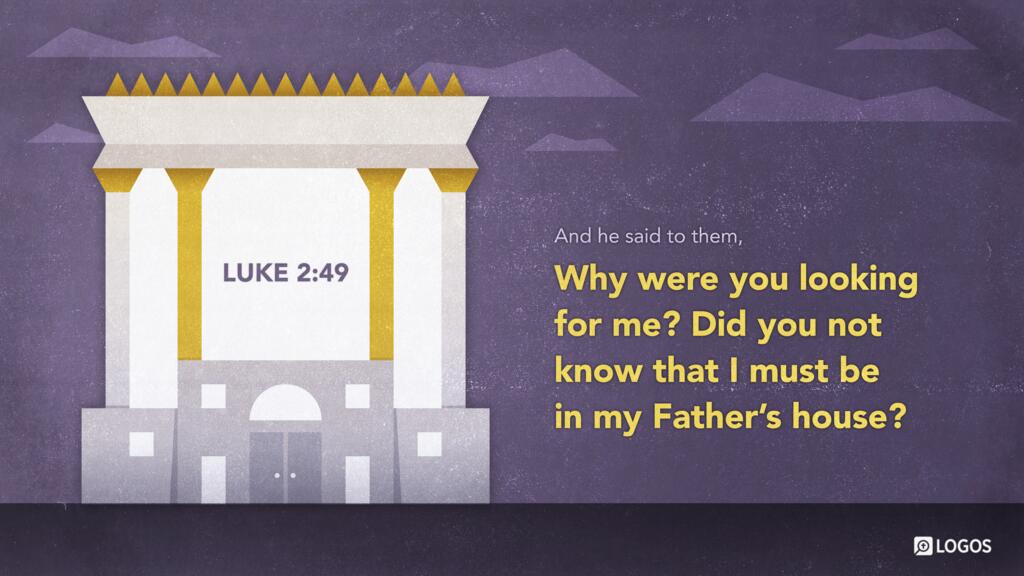
41And his parents went every year to Jerusalem for the feast of the Passover. 42And when he was twelve years old, they went up according to the custom of the feast. 43And after* the days were completed, while they were returning, the boy Jesus stayed behind in Jerusalem. And his parents did not know it,* 44but believing him to be in the group of travelers, they went a day’s journey. And they began searching for* him among theirp relatives and theirq acquaintances, 45and when they* did not find him,* they returned to Jerusalem to search for him. 46And it happened that after three days they found him in the temple courts,* sitting in the midst of the teachers and listening to them and asking them questions. 47And all who heard him were amazed at his insight and his* answers. 48And when they* saw him, they were astounded and his mother said to him, “Child, why have you done this to us? Look, your father and I have been searching for you anxiously!” 49And he said to them, “Whyr were you searching for me? Did you not know that it was necessary for me to be in the houses of my Father?” 50And they did not understand the statement that he spoke to them. 51And he went down with them and came to Nazareth, and was submitting to them. And his mother treasured all these things in her heart.
52And Jesus was advancing in wisdom and stature and in favor with God and with people.
Footnotes
- *Here “after” is supplied as a component of the participle (“were completed”) which is understood as temporal
- *Here the direct object is supplied from context in the English translation
- *The imperfect tense has been translated as ingressive here (“began searching for”)
- pLiterally “the”; the Greek article is used here as a possessive pronoun
- qLiterally “the”; the Greek article is used here as a possessive pronoun
- *Here “when” is supplied as a component of the participle (“find”) which is understood as temporal
- *Here the direct object is supplied from context in the English translation
- *Here “courts” is supplied to distinguish this area from the interior of the temple building itself
- *This is an understood repetition of “his” due to English style
- *Here “when” is supplied as a component of the participle (“saw”) which is understood as temporal
- rLiterally “what is it that”
- sOr “things” (= business)
Copyright 2012 Lexham Press