Luke 2:25–34
The NET BibleOther versions
English
- NET The NET Bible
- DARBY 1890 Darby Bible
- ASV American Standard Version
- AV 1873 The Cambridge Paragraph Bible of the Authorized English Version
- CSB Christian Standard Bible
- D-R Douay-Rheims Bible
- ESV English Standard Version
- GW GOD’S WORD Translation
- GNB Good News Translation
- HCSB The Holman Christian Standard Bible
- KJV 1900 King James Version
- LSB Legacy Standard Bible
- LEB The Lexham English Bible
- MSG The Message: The Bible in Contemporary Language
- NASB95 New American Standard Bible (1995)
- NCV New Century Version
- NIrV New International Reader’s Version (1998)
- NIV New International Version (2011)
- NKJV The New King James Version
- NLT New Living Translation
- NRSVue New Revised Standard Version: Updated Edition
- RSV The Revised Standard Version
- RSVCE The Revised Standard Version, Catholic Edition
- TNIV Today’s New International Version
- YLT Young’s Literal Translation
Arabic
Czech
French
German
Greek
Hungarian
Italian
Korean
Latin
Portuguese
Russian
Simplified Chinese
Spanish
Traditional Chinese
The Prophecy of Simeon
2:25Now68 there was a man in Jerusalem69 named Simeon who was righteous70 and devout, looking for the restoration71 of Israel, and the Holy Spirit72 was upon him. 2:26It73 had been revealed74 to him by the Holy Spirit that he would not die75 before76 he had seen the Lord’s Christ.772:27So78 Simeon,79 directed by the Spirit,80 came into the temple courts,81 and when the parents brought in the child Jesus to do for him what was customary according to the law,822:28Simeon83 took him in his arms and blessed God, saying,84
2:29“Now, according to your word,85 Sovereign Lord,86 permit87 your servant88 to depart89 in peace.
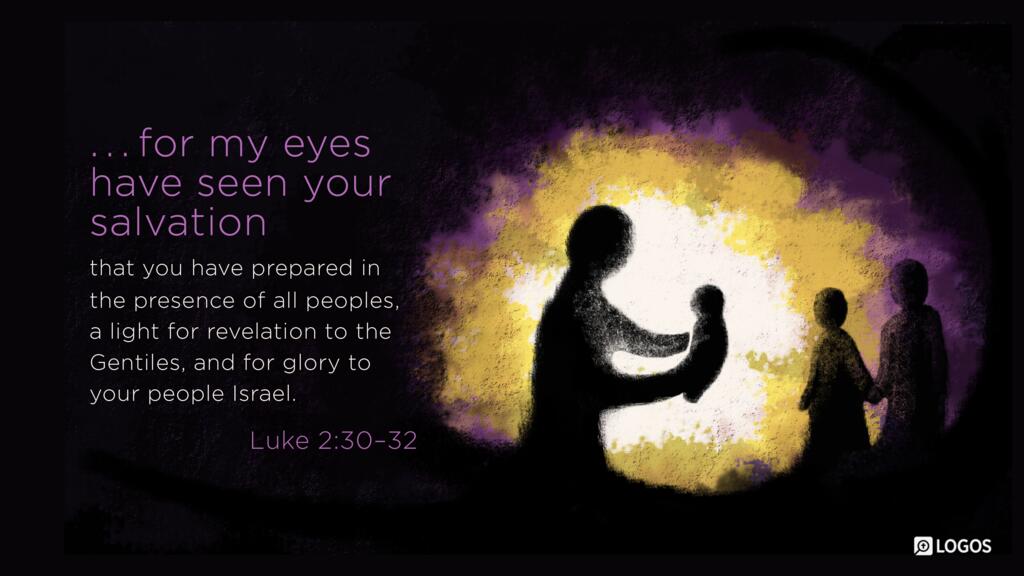
2:30For my eyes have seen your salvation90
2:31that you have prepared in the presence of all peoples:91
2:32a light,92
for revelation to the Gentiles,
and for glory93 to your people Israel.”
2:33So94 the child’s95 father96 and mother were amazed97 at what was said about him. 2:34Then98 Simeon blessed them and said to his mother Mary, “Listen carefully:99 This child100 is destined to be the cause of the falling and rising101 of many in Israel and to be a sign that will be rejected.102
Footnotes
- 68 Grk “And behold.” Here καί (kai) has been translated as “now” to indicate the transition to a new topic. The Greek word ἰδού (idou) at the beginning of this statement has not been translated because it has no exact English equivalent here, but adds interest and emphasis ( 1).
- 69 For location see ; ; ; ; ; ; ; ; .
- 70 Grk “This man was righteous.” The Greek text begins a new sentence here, but this was changed to a relative clause in the translation to avoid redundancy.
- 71 Or “deliverance,” “consolation.” The restoration of Israel refers to Simeon’s hope that the Messiah would come and deliver the nation (Isa 40:1; 49:13; 51:3; 57:18; 61:2; 44:7).
- 72 Once again, by mentioning the Holy Spirit, Luke stresses the prophetic enablement of a speaker. The Spirit has fallen on both men (Zechariah, 1:67) and women (Elizabeth, 1:41) in Luke 1–2 as they share the will of the Lord.
- 73 Grk “And it.” Here καί (kai) has not been translated because of differences between Greek and English style.
- 74 The use of the passive suggests a revelation by God, and in the OT the corresponding Hebrew term represented here by κεχρηματισμένον (kechrēmatismenon) indicated some form of direct revelation from God (Jer 25:30; 33:2; Job 40:8).
- 75 Grk “would not see death” (an idiom for dying).
- 76 On the grammar of this temporal clause, see §§383.3; 395.
- 77 Or “Messiah”; both “Christ” (Greek) and “Messiah” (Hebrew and Aramaic) mean “one who has been anointed.” The revelation to Simeon that he would not die before he had seen the Lord’s Christ is yet another example of a promise fulfilled in Luke 1–2. Also, see the note on Christ in .
- 78 Here καί (kai) has been translated as “so” to indicate the consequential nature of the action.
- 79 Grk “he”; the referent (Simeon) has been specified in the translation for clarity.
- 80 Grk “So in the Spirit” or “So by the Spirit,” but since it refers to the Spirit’s direction the expanded translation “directed by the Spirit” is used here.
- 81 Grk “the temple.” The temple courts is a reference to the larger temple area, not the holy place. Simeon was either in the court of the Gentiles or the court of women, since Mary was present.
- 82 Grk “to do for him according to the custom of the law.” See Luke 2:22–24.
- 83 Grk “he”; the referent (Simeon) has been specified in the translation for clarity.
- 84 Grk “and said.” The finite verb in Greek has been replaced with a participle in English to improve the smoothness of the translation.
- 85 The phrase according to your word again emphasizes that God will perform his promise.
- 86 The Greek word translated here by “Sovereign Lord” is δεσπότης (despotēs).
- 87 This short prophetic declaration is sometimes called the Nunc dimittis, which comes from the opening phrase of the saying in Latin, “now dismiss,” a fairly literal translation of the Greek verb ἀπολύεις (apolueis, “now release”) in this verse.
- 88 Here the Greek word δοῦλος (doulos, “slave”) has been translated “servant” since it acts almost as an honorific term for one specially chosen and appointed to carry out the Lord’s tasks. Undoubtedly the background for the concept of being the Lord’s slave or servant is to be found in the Old Testament scriptures. For a Jew this concept did not connote drudgery, but honor and privilege. It was used of national Israel at times (Isa 43:10), but was especially associated with famous OT personalities, including such great men as Moses (Josh 14:7), David (Ps 89:3; cf. 2 Sam 7:5, 8) and Elijah (2 Kgs 10:10); all these men were “servants (or slaves) of the Lord.”
- 89 Grk “now release your servant.”
- 90 To see Jesus, the Messiah, is to see God’s salvation.
- 91 Is the phrase all peoples a reference to Israel alone, or to both Israel and the Gentiles? The following verse makes it clear that all peoples includes Gentiles, another key Lukan emphasis (Luke 24:47; Acts 10:34–43).
- 92 The syntax of this verse is disputed. Most read “light” and “glory” in parallelism, so Jesus is a light for revelation to the Gentiles and is glory to the people for Israel. Others see “light” (1:78–79) as a summary, while “revelation” and “glory” are parallel, so Jesus is light for all, but is revelation for the Gentiles and glory for Israel. Both readings make good sense and either could be correct, but Luke 1:78–79 and Acts 26:22–23 slightly favor this second option.
- 93 In other words, Jesus is a special cause for praise and honor (“glory”) for the nation.
- 94 Here καί (kai) has been translated as “so” to indicate the consequential nature of the action.
- 95 Grk “his”; the referent (the child) has been specified in the translation for clarity.
- 96 Most ([A] Θ [Ψ] f13 33 𝔐 it) read “Joseph,” but in favor of the reading ὁ πατὴρ αὐτοῦ (ho patēr autou, “his father”) is both external (א B D L W 1 700 1241 sa) and internal evidence. Internally, the fact that Mary is not named at this point and that “Joseph” is an obviously motivated reading, intended to prevent confusion over the virgin conception of Christ, argues strongly for ὁ πατὴρ αὐτοῦ as the authentic reading here. See also the note on “parents” in .
- 97 The term refers to the amazement at what was happening as in other places in Luke 1–2 (1:63; 2:18). The participle is plural, while the finite verb used in the periphrastic construction is singular, perhaps to show a unity in the parents’ response ( §135.1.d: Luke 8:19).
- 98 Here καί (kai) has been translated as “then” to indicate the implied sequence of events within the narrative.
- 99 Grk “behold.”
- 100 Grk “this one”; the referent (the child) is supplied in the translation for clarity.
- 101 The phrase the falling and rising of many emphasizes that Jesus will bring division in the nation, as some will be judged (falling) and others blessed (rising) because of how they respond to him. The language is like Isa 8:14–15 and conceptually like Isa 28:13–16. Here is the first hint that Jesus’ coming will be accompanied with some difficulties.
- 102 Grk “and for a sign of contradiction.”
The NET Bible First Edition, Copyright 1996-2005 by Biblical Studies Press
In other versions
ESVEnglish Standard Version
Now there was a man in Jerusalem, whose name was Simeon, and this man was righteous and devout, waiting for the consolation of Israel, and the Holy Spirit was upon him. And it had been revealed to him by the Holy Spirit that he would not see death before he had seen the Lord’s Christ. And he came in the Spirit into the temple, and when the parents brought in the child Jesus, to do for him according to the custom of the Law, he took him up in his arms and blessed God and said,
“Lord, now you are letting your servant depart in peace,
according to your word;
for my eyes have seen your salvation
that you have prepared in the presence of all peoples,
a light for revelation to the Gentiles,
and for glory to your people Israel.”
And his father and his mother marveled at what was said about him. And Simeon blessed them and said to Mary his mother, “Behold, this child is appointed for the fall and rising of many in Israel, and for a sign that is opposed
Copyright 2001 Crossway Bibles
NIVNew International Version (2011)
Now there was a man in Jerusalem called Simeon, who was righteous and devout. He was waiting for the consolation of Israel, and the Holy Spirit was on him. It had been revealed to him by the Holy Spirit that he would not die before he had seen the Lord’s Messiah. Moved by the Spirit, he went into the temple courts. When the parents brought in the child Jesus to do for him what the custom of the Law required, Simeon took him in his arms and praised God, saying:
“Sovereign Lord, as you have promised,
you may now dismiss your servant in peace.
For my eyes have seen your salvation,
which you have prepared in the sight of all nations:
a light for revelation to the Gentiles,
and the glory of your people Israel.”
The child’s father and mother marveled at what was said about him. Then Simeon blessed them and said to Mary, his mother: “This child is destined to cause the falling and rising of many in Israel, and to be a sign that will be spoken against,
Copyright 1973, 1978, 1984, 2011 Biblica, Inc.
CSBChristian Standard Bible
There was a man in Jerusalem whose name was Simeon. This man was righteous and devout, looking forward to Israel’s consolation, and the Holy Spirit was on him. It had been revealed to him by the Holy Spirit that he would not see death before he saw the Lord’s Messiah. Guided by the Spirit, he entered the temple. When the parents brought in the child Jesus to perform for him what was customary under the law, Simeon took him up in his arms, praised God, and said,
Now, Master,
you can dismiss your servant in peace,
as you promised.
For my eyes have seen your salvation.
You have prepared it
in the presence of all peoples—
a light for revelation to the Gentiles
and glory to your people Israel.
His father and mother were amazed at what was being said about him. Then Simeon blessed them and told his mother Mary, “Indeed, this child is destined to cause the fall and rise of many in Israel and to be a sign that will be opposed—
Copyright 2017 Holman Bible Publishers
NLTNew Living Translation
At that time there was a man in Jerusalem named Simeon. He was righteous and devout and was eagerly waiting for the Messiah to come and rescue Israel. The Holy Spirit was upon him and had revealed to him that he would not die until he had seen the Lord’s Messiah. That day the Spirit led him to the Temple. So when Mary and Joseph came to present the baby Jesus to the Lord as the law required, Simeon was there. He took the child in his arms and praised God, saying,
“Sovereign Lord, now let your servant die in peace,
as you have promised.
I have seen your salvation,
which you have prepared for all people.
He is a light to reveal God to the nations,
and he is the glory of your people Israel!”
Jesus’ parents were amazed at what was being said about him. Then Simeon blessed them, and he said to Mary, the baby’s mother, “This child is destined to cause many in Israel to fall, and many others to rise. He has been sent as a sign from God, but many will oppose him.
Holy Bible, New Living Translation, copyright © 1996, 2004, 2015 by Tyndale House Foundation. Used by permission of Tyndale House Publishers. All rights reserved.
LEBThe Lexham English Bible
And behold, there was a man in Jerusalem whose name was Simeon, and this man was righteous and devout, looking forward to the consolation of Israel, and the Holy Spirit was upon him. And it had been revealed to him by the Holy Spirit that he would not see death before he would see the Lord’s Christ. And he came in the Spirit into the temple, and when the parents brought in the child Jesus so that they could do for him according to what was customary under the law, he took him in his arms and praised God and said,
“Now dismiss your slave in peace, Lord,
according to your word.
For my eyes have seen your salvation
that you have prepared in the presence of all the peoples,
a light for revelation to the Gentiles,
and glory to your people Israel.”
And his father and mother were astonished at what was said about him. And Simeon blessed them and said to his mother Mary, “Behold, this child is appointed for the fall and rise of many in Israel, and for a sign that is opposed—
Copyright 2012 Lexham Press
KJV 1900King James Version
And, behold, there was a man in Jerusalem, whose name was Simeon; and the same man was just and devout, waiting for the consolation of Israel: and the Holy Ghost was upon him. And it was revealed unto him by the Holy Ghost, that he should not see death, before he had seen the Lord’s Christ. And he came by the Spirit into the temple: and when the parents brought in the child Jesus, to do for him after the custom of the law, Then took he him up in his arms, and blessed God, and said,
Lord, now lettest thou thy servant depart
In peace, according to thy word:
For mine eyes have seen thy salvation,
Which thou hast prepared before the face of all people;
A light to lighten the Gentiles, and the glory of thy people Israel.
And Joseph and his mother marvelled at those things which were spoken of him. And Simeon blessed them, and said unto Mary his mother, Behold, this child is set for the fall and rising again of many in Israel; and for a sign which shall be spoken against;
Public Domain