John 7:38
The NET BibleOther versions
English
- NET The NET Bible
- DARBY 1890 Darby Bible
- ASV American Standard Version
- AV 1873 The Cambridge Paragraph Bible of the Authorized English Version
- CSB Christian Standard Bible
- D-R Douay-Rheims Bible
- ESV English Standard Version
- GW GOD’S WORD Translation
- GNB Good News Translation
- HCSB The Holman Christian Standard Bible
- KJV 1900 King James Version
- LSB Legacy Standard Bible
- LEB The Lexham English Bible
- MSG The Message: The Bible in Contemporary Language
- NASB95 New American Standard Bible (1995)
- NCV New Century Version
- NIrV New International Reader’s Version (1998)
- NIV New International Version (2011)
- NKJV The New King James Version
- NLT New Living Translation
- NRSVue New Revised Standard Version: Updated Edition
- RSV The Revised Standard Version
- RSVCE The Revised Standard Version, Catholic Edition
- TNIV Today’s New International Version
- YLT Young’s Literal Translation
Arabic
Czech
French
German
Greek
Hungarian
Italian
Korean
Latin
Portuguese
Russian
Simplified Chinese
Spanish
Traditional Chinese
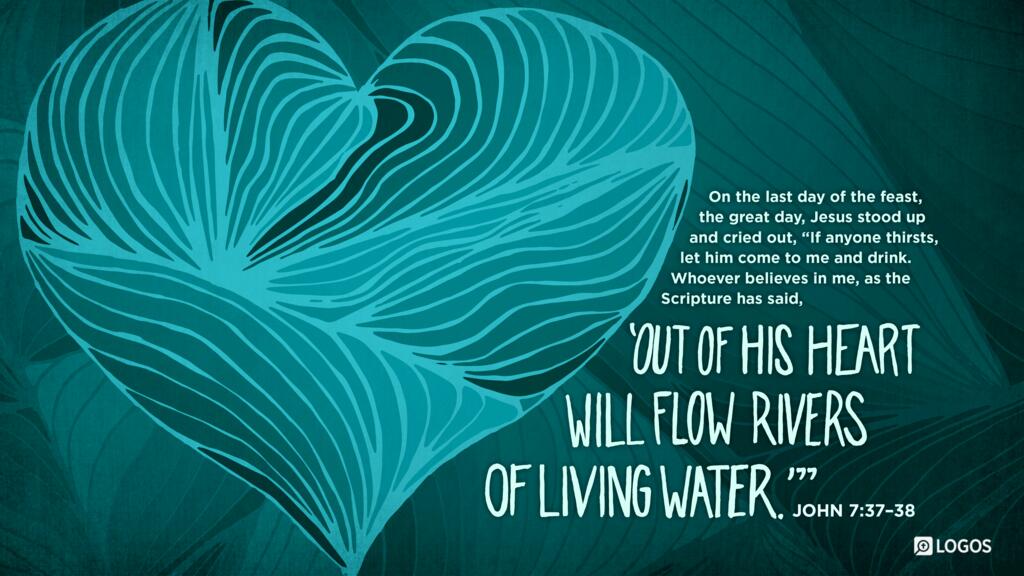
7:38let the one who believes in me drink.103 Just as the scripture says, ‘From within him104 will flow rivers of living water.’ ”105
Footnotes
- 103 An alternate way of punctuating the Greek text of vv. 37–38 results in this translation: “If anyone is thirsty, let him come to me and drink. The one who believes in me, just as the scripture says, ‘From within him will flow rivers of living water.’ ” John 7:37–38 has been the subject of considerable scholarly debate. Certainly Jesus picks up on the literal water used in the ceremony and uses it figuratively. But what does the figure mean? According to popular understanding, it refers to the coming of the Holy Spirit to dwell in the believer. There is some difficulty in locating an OT text which speaks of rivers of water flowing from within such a person, but Isa 58:11 is often suggested: “The Lord will continually lead you, he will feed you even in parched regions. He will give you renewed strength, and you will be like a well-watered garden, like a spring that continually produces water.” Other passages which have been suggested are Prov 4:23 and 5:15; Isa 44:3 and 55:1; Ezek 47:1 ff.; Joel 3:18; and Zech 13:1 and 14:8. The meaning in this case is that when anyone comes to believe in Jesus the scriptures referring to the activity of the Holy Spirit in a person’s life are fulfilled. “When the believer comes to Christ and drinks he not only slakes his thirst but receives such an abundant supply that veritable rivers flow from him” (L. Morris, John [], ). In other words, with this view, the believer himself becomes the source of the living water. This is the traditional understanding of the passage, often called the “Eastern interpretation” following Origen, Athanasius, and the Greek Fathers. It is supported by such modern scholars as Barrett, Behm, Bernard, Cadman, Carson, R. H. Lightfoot, Lindars, Michaelis, Morris, Odeberg, Schlatter, Schweizer, C. H. Turner, M. M. B. Turner, Westcott, and Zahn. In addition it is represented by the following Greek texts and translations: , , , , and . D. A. Carson, John, 322–29, has a thorough discussion of the issues and evidence although he opts for the previous interpretation. There is another interpretation possible, however, called the “Western interpretation” because of patristic support by Justin, Hippolytus, Tertullian, and Irenaeus. Modern scholars who favor this view are Abbott, Beasley-Murray, Bishop, Boismard, Braun, Brown, Bullinger, Bultmann, Burney, Dodd, Dunn, Guilding, R. Harris, Hoskyns, Jeremias, Loisy, D. M. Stanley, Thüsing, N. Turner, and Zerwick. This view is represented by the translation in the margin and by the . It is also sometimes called the “christological interpretation” because it makes Jesus himself the source of the living water in v. 38, by punctuating as follows: (37b) ἐάν τι διψᾷ ἐρχέσθω πρός με, καὶ πινέτω (38) ὁ πιστεύων εἰς ἐμέ. Καθὼς εἶπεν ἡ γραφή, ποταμοὶ ἐκ τῆς κοιλίας αὐτοῦ ῥεύσουσιν ὕδατος ζῶντος. Three crucial questions are involved in the solution of this problem: (1) punctuation; (2) determining the antecedent of αὐτοῦ (autou); and (3) the source of the scripture quotation. With regard to (1) 𝔓66 does place a full stop after πινέτω (pinetō), but this may be theologically motivated and could have been added later. Grammatical and stylistic arguments are inconclusive. More important is (2) the determination of the antecedent of αὐτοῦ. Can any other Johannine parallels be found which make the believer the source of the living water? John 4:14 is often mentioned in this regard, but unlike 4:14 the water here becomes a source for others also. Neither does 14:12 provide a parallel. Furthermore, such an interpretation becomes even more problematic in light of the explanation given in v. 39 that the water refers to the Holy Spirit, since it is extremely difficult to see the individual believer becoming the ‘source’ of the Spirit for others. On the other hand, the Gospel of John repeatedly places Jesus himself in this role as source of the living water: 4:10, of course, for the water itself; but according to 20:22…
- 104 Or “out of the innermost part of his person”; Grk “out of his belly.”
- 105 An OT quotation whose source is difficult to determine; Isa 44:3, 55:1, 58:11, and Zech 14:8 have all been suggested.
The NET Bible First Edition, Copyright 1996-2005 by Biblical Studies Press
In other versions
ESVEnglish Standard Version
Whoever believes in me, as the Scripture has said, ‘Out of his heart will flow rivers of living water.’ ”
Copyright 2001 Crossway Bibles
NIVNew International Version (2011)
Whoever believes in me, as Scripture has said, rivers of living water will flow from within them.”
Copyright 1973, 1978, 1984, 2011 Biblica, Inc.
CSBChristian Standard Bible
The one who believes in me, as the Scripture has said, will have streams of living water flow from deep within him.”
Copyright 2017 Holman Bible Publishers
NLTNew Living Translation
Anyone who believes in me may come and drink! For the Scriptures declare, ‘Rivers of living water will flow from his heart.’ ”
Holy Bible, New Living Translation, copyright © 1996, 2004, 2015 by Tyndale House Foundation. Used by permission of Tyndale House Publishers. All rights reserved.
LEBThe Lexham English Bible
the one who believes in me. Just as the scripture said, ‘Out of his belly will flow rivers of living water.’ ”
Copyright 2012 Lexham Press
KJV 1900King James Version
He that believeth on me, as the scripture hath said, out of his belly shall flow rivers of living water.
Public Domain