John 2:18–22
The NET BibleOther versions
English
- NET The NET Bible
- DARBY 1890 Darby Bible
- ASV American Standard Version
- AV 1873 The Cambridge Paragraph Bible of the Authorized English Version
- CSB Christian Standard Bible
- D-R Douay-Rheims Bible
- ESV English Standard Version
- GW GOD’S WORD Translation
- GNB Good News Translation
- HCSB The Holman Christian Standard Bible
- KJV 1900 King James Version
- LSB Legacy Standard Bible
- LEB The Lexham English Bible
- MSG The Message: The Bible in Contemporary Language
- NASB95 New American Standard Bible (1995)
- NCV New Century Version
- NIrV New International Reader’s Version (1998)
- NIV New International Version (2011)
- NKJV The New King James Version
- NLT New Living Translation
- NRSVue New Revised Standard Version: Updated Edition
- RSV The Revised Standard Version
- RSVCE The Revised Standard Version, Catholic Edition
- TNIV Today’s New International Version
- YLT Young’s Literal Translation
Arabic
Czech
French
German
Greek
Hungarian
Italian
Korean
Latin
Portuguese
Russian
Simplified Chinese
Spanish
Traditional Chinese
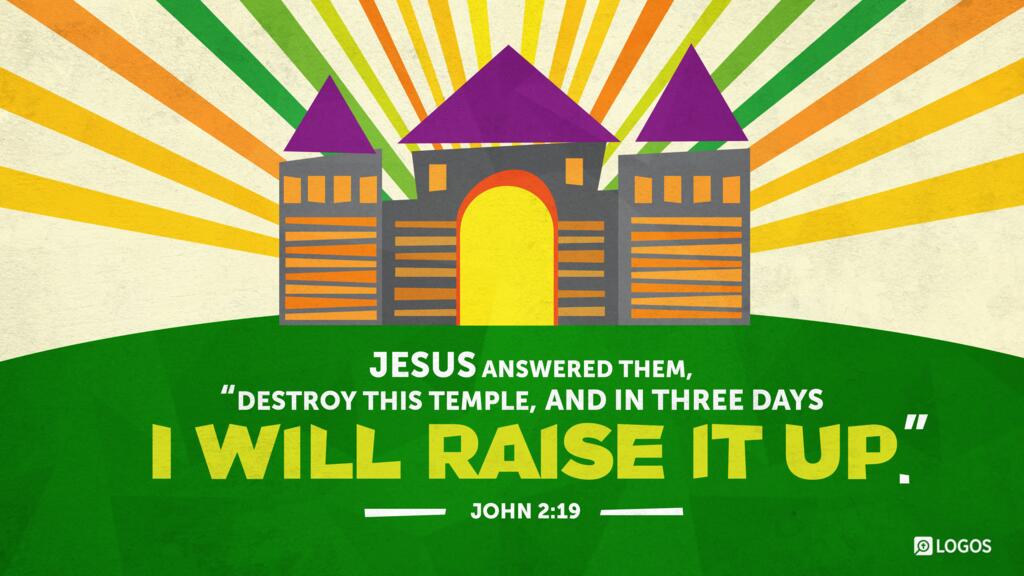
2:18So then the Jewish leaders39 responded,40 “What sign can you show us, since you are doing these things?”412:19Jesus replied,42 “Destroy43 this temple and in three days I will raise it up again.” 2:20Then the Jewish leaders44 said to him, “This temple has been under construction45 for forty-six years,46 and are you going to raise it up in three days?” 2:21But Jesus47 was speaking about the temple of his body.482:22So after he was raised from the dead, his disciples remembered that he had said this, and they believed the scripture49 and the saying50 that Jesus had spoken.
Footnotes
- 39 Or “the Jewish authorities”; Grk “the Jews.” In NT usage the term Ἰουδαῖοι (Ioudaioi) may refer to the entire Jewish people, the residents of Jerusalem and surrounding territory, the authorities in Jerusalem, or merely those who were hostile to Jesus. Here the author refers to the authorities or leaders in Jerusalem. (For further information see R. G. Bratcher, “ ‘The Jews’ in the Gospel of John,” 26 [1975]: 401–9.)
- 40 Grk “answered and said to him.”
- 41 The request “What sign can you show us” by Jesus’ adversaries was a request for a defense of his actions—a mark of divine authentication. Whether this was a request for a miracle is not entirely clear. Jesus never obliged such a request. Yet, ironically, the only sign the Jewish leadership will get is that predicted by Jesus in 2:19—his crucifixion and resurrection. Cf. the “sign of Jonah” in the synoptics (Matt 12:39, 40; Luke 11:29–32).
- 42 Grk “answered and said to them.”
- 43 The imperative here is really more than a simple conditional imperative (= “if you destroy”); its semantic force here is more like the ironical imperative found in the prophets (Amos 4:4, Isa 8:9) = “Go ahead and do this and see what happens.”
- 44 See the note on this phrase in v. .
- 45 A close parallel to the aorist οἰκοδομήθη (oikodomēthē) can be found in Ezra 5:16 (), where it is clear from the following verb that the construction had not yet been completed. Thus the phrase has been translated “This temple has been under construction for forty-six years.” Some, however, see the term ναός (naos) here as referring only to the sanctuary and the aorist verb as consummative, so that the meaning would be “this temple was built forty-six years ago” (so ). Ultimately in context the logic of the authorities’ reply appears to fit more naturally if it compares length of time for original construction with length of time to reconstruct it.
- 46 According to Josephus ( 15.11.1 [15.380]), work on this temple was begun in the 18th year of Herod the Great’s reign, which would have been 19 b.c. (The reference in the is probably more accurate than the date given in 1.21.1 [1.401]). Forty-six years later would be around the Passover of a.d. 27/28.
- 47 Grk “that one”; the referent (Jesus) has been specified in the translation for clarity. This Greek term is frequently used as a way of referring to Jesus in the Johannine letters (cf. 1 John 2:6; 3:3, 5, 7, 16; 4:17).
- 48 The genitive “of his body” (τοῦ σώματος αὐτοῦ, tou sōmatos autou) is a genitive of apposition, clarifying which temple Jesus was referring to. Thus, Jesus not only was referring to his physical resurrection, but also to his participation in the resurrection process. The New Testament thus records the Father, Son, and Holy Spirit as all performing the miracle of Christ’s resurrection. Jesus was speaking about the temple of his body. For the author, the temple is not just the building, it is Jesus’ resurrected body. Compare the nonlocalized worship mentioned in John 4:21–23, and also Rev 21:22 (there is to be no temple in the New Jerusalem; the Lord and the Lamb are its temple). John points to the fact that, as the place where men go in order to meet God, the temple has been supplanted and replaced by Jesus himself, in whose resurrected person people may now encounter God (see John 1:18, 14:6).
- 49 They believed the scripture is probably an anaphoric reference to Ps 69:9 (68:10 ), quoted in above. Presumably the disciples did not remember Ps 69:9 on the spot, but it was a later insight.
- 50 Or “statement”; Grk “word.”
The NET Bible First Edition, Copyright 1996-2005 by Biblical Studies Press
In other versions
ESVEnglish Standard Version
So the Jews said to him, “What sign do you show us for doing these things?” Jesus answered them, “Destroy this temple, and in three days I will raise it up.” The Jews then said, “It has taken forty-six years to build this temple, and will you raise it up in three days?” But he was speaking about the temple of his body. When therefore he was raised from the dead, his disciples remembered that he had said this, and they believed the Scripture and the word that Jesus had spoken.
Copyright 2001 Crossway Bibles
NIVNew International Version (2011)
The Jews then responded to him, “What sign can you show us to prove your authority to do all this?”
Jesus answered them, “Destroy this temple, and I will raise it again in three days.”
They replied, “It has taken forty-six years to build this temple, and you are going to raise it in three days?” But the temple he had spoken of was his body. After he was raised from the dead, his disciples recalled what he had said. Then they believed the scripture and the words that Jesus had spoken.
Copyright 1973, 1978, 1984, 2011 Biblica, Inc.
CSBChristian Standard Bible
So the Jews replied to him, “What sign will you show us for doing these things?”
Jesus answered, “Destroy this temple, and I will raise it up in three days.”
Therefore the Jews said, “This temple took forty-six years to build, and will you raise it up in three days?”
But he was speaking about the temple of his body. So when he was raised from the dead, his disciples remembered that he had said this, and they believed the Scripture and the statement Jesus had made.
Copyright 2017 Holman Bible Publishers
NLTNew Living Translation
But the Jewish leaders demanded, “What are you doing? If God gave you authority to do this, show us a miraculous sign to prove it.”
“All right,” Jesus replied. “Destroy this temple, and in three days I will raise it up.”
“What!” they exclaimed. “It has taken forty-six years to build this Temple, and you can rebuild it in three days?” But when Jesus said “this temple,” he meant his own body. After he was raised from the dead, his disciples remembered he had said this, and they believed both the Scriptures and what Jesus had said.
Holy Bible, New Living Translation, copyright © 1996, 2004, 2015 by Tyndale House Foundation. Used by permission of Tyndale House Publishers. All rights reserved.
LEBThe Lexham English Bible
So the Jews answered and said to him, “What sign do you show to us, because you are doing these things?” Jesus answered and said to them, “Destroy this temple, and in three days I will raise it up!” Then the Jews said, “This temple has been under construction forty-six years, and will you raise it up in three days?” But he was speaking about the temple of his body. So when he was raised from the dead, his disciples remembered that he had said this, and they believed the scripture and the saying that Jesus had spoken.
Copyright 2012 Lexham Press
KJV 1900King James Version
Then answered the Jews and said unto him, What sign shewest thou unto us, seeing that thou doest these things? Jesus answered and said unto them, Destroy this temple, and in three days I will raise it up. Then said the Jews, Forty and six years was this temple in building, and wilt thou rear it up in three days? But he spake of the temple of his body. When therefore he was risen from the dead, his disciples remembered that he had said this unto them; and they believed the scripture, and the word which Jesus had said.
Public Domain