John 11:23–44
The NET BibleOther versions
English
- NET The NET Bible
- DARBY 1890 Darby Bible
- ASV American Standard Version
- AV 1873 The Cambridge Paragraph Bible of the Authorized English Version
- CSB Christian Standard Bible
- D-R Douay-Rheims Bible
- ESV English Standard Version
- GW GOD’S WORD Translation
- GNB Good News Translation
- HCSB The Holman Christian Standard Bible
- KJV 1900 King James Version
- LSB Legacy Standard Bible
- LEB The Lexham English Bible
- MSG The Message: The Bible in Contemporary Language
- NASB95 New American Standard Bible (1995)
- NCV New Century Version
- NIrV New International Reader’s Version (1998)
- NIV New International Version (2011)
- NKJV The New King James Version
- NLT New Living Translation
- NRSVue New Revised Standard Version: Updated Edition
- RSV The Revised Standard Version
- RSVCE The Revised Standard Version, Catholic Edition
- TNIV Today’s New International Version
- YLT Young’s Literal Translation
Arabic
Czech
French
German
Greek
Hungarian
Italian
Korean
Latin
Portuguese
Russian
Simplified Chinese
Spanish
Traditional Chinese
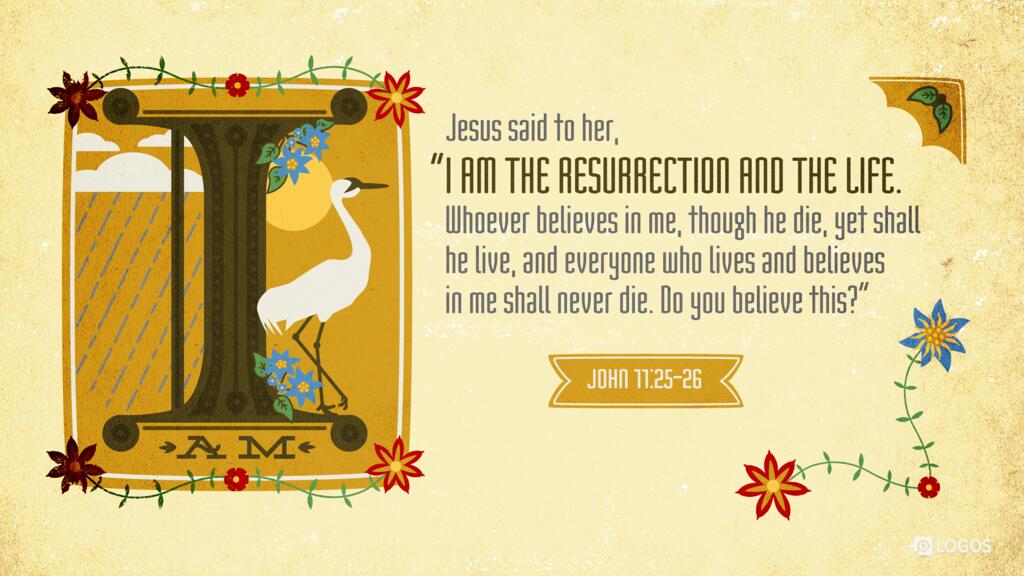
11:23Jesus replied,45 “Your brother will come back to life again.”4611:24Martha said,47 “I know that he will come back to life again48 in the resurrection at the last day.” 11:25Jesus said to her, “I am the resurrection and the life. The one who believes in me will live49 even if he dies, 11:26and the one who lives and believes in me will never die.50 Do you believe this?” 11:27She replied,51 “Yes, Lord, I believe52 that you are the Christ,53 the Son of God who comes into the world.”54
11:28And when she had said this, Martha55 went and called her sister Mary, saying privately,56 “The Teacher is here and is asking for you.”5711:29So when Mary58 heard this, she got up quickly and went to him. 11:30(Now Jesus had not yet entered the village, but was still in the place where Martha had come out to meet him.) 11:31Then the people59 who were with Mary60 in the house consoling her saw her61 get up quickly and go out. They followed her, because they thought she was going to the tomb to weep62 there.
11:32Now when Mary came to the place where Jesus was and saw him, she fell at his feet and said to him, “Lord, if you had been here, my brother would not have died.” 11:33When Jesus saw her weeping, and the people63 who had come with her weeping, he was intensely moved64 in spirit and greatly distressed.6511:34He asked,66 “Where have you laid him?”67 They replied,68 “Lord, come and see.” 11:35Jesus wept.6911:36Thus the people who had come to mourn70 said, “Look how much he loved him!” 11:37But some of them said, “This is the man who caused the blind man to see!71 Couldn’t he have done something to keep Lazarus72 from dying?”
Lazarus Raised from the Dead
11:38Jesus, intensely moved73 again, came to the tomb. (Now it was a cave, and a stone was placed across it.)7411:39Jesus said, “Take away the stone.”75 Martha, the sister of the deceased,76 replied, “Lord, by this time the body will have a bad smell,77 because he has been buried78 four days.”7911:40Jesus responded,80 “Didn’t I tell you that if you believe, you would see the glory of God?” 11:41So they took away81 the stone. Jesus looked upward82 and said, “Father, I thank you that you have listened to me.8311:42I knew that you always listen to me,84 but I said this85 for the sake of the crowd standing around here, that they may believe that you sent me.” 11:43When86 he had said this, he shouted in a loud voice,87 “Lazarus, come out!” 11:44The one who had died came out, his feet and hands tied up with strips of cloth,88 and a cloth wrapped around his face.89 Jesus said to them, “Unwrap him90 and let him go.”
Footnotes
- 45 Grk “Jesus said to her.”
- 46 Or “Your brother will rise again.” Jesus’ remark to Martha that Lazarus would come back to life again is another example of the misunderstood statement. Martha apparently took it as a customary statement of consolation and joined Jesus in professing belief in the general resurrection of the body at the end of the age. However, as Jesus went on to point out in 11:25–26, Martha’s general understanding of the resurrection at the last day was inadequate for the present situation, for the gift of life that conquers death was a present reality to Jesus. This is consistent with the author’s perspective on eternal life in the Fourth Gospel: It is not only a future reality, but something to be experienced in the present as well. It is also consistent with the so-called “realized eschatology” of the Fourth Gospel.
- 47 Grk “Martha said to him.”
- 48 Or “will rise again.”
- 49 That is, will come to life.
- 50 Grk “will never die forever.”
- 51 Grk “She said to him.”
- 52 The perfect tense in Greek is often used to emphasize the results or present state of a past action. Such is the case here. To emphasize this nuance the perfect tense verb πεπίστευκα (pepisteuka) has been translated as a present tense. This is in keeping with the present context, where Jesus asks of her present state of belief in v. 26, and the theology of the Gospel as a whole, which emphasizes the continuing effects and present reality of faith. For discussion on this use of the perfect tense, see and B. M. Fanning, Verbal Aspect, 291–97.
- 53 Or “the Messiah” (Both Greek “Christ” and Hebrew and Aramaic “Messiah” mean “one who has been anointed”). See the note on Christ in .
- 54 Or “the Son of God, the one who comes into the world.”
- 55 Grk “she”; the referent (Martha) has been specified in the translation for clarity.
- 56 Or “in secret” (as opposed to publicly, so that the other mourners did not hear).
- 57 Grk “is calling you.”
- 58 Grk “she”; the referent (Mary) has been specified in the translation for clarity.
- 59 Or “the Judeans”; Grk “the Jews.” Here the phrase refers to the friends, acquaintances, and relatives of Lazarus or his sisters who had come to mourn, since the Jewish religious authorities are specifically mentioned as a separate group in John 11:46–47. See also the notes on the phrase “the Jewish leaders” in v. and “the Jewish people of the region” in v. .
- 60 Grk “her”; the referent (Mary) has been specified in the translation for clarity.
- 61 Grk “Mary”; the proper name (Mary) has been replaced with the pronoun (her) in keeping with conventional English style, to avoid repetition.
- 62 Or “to mourn” (referring to the loud wailing or crying typical of public mourning in that culture).
- 63 Or “the Judeans”; Grk “the Jews.” Here the phrase refers to the friends, acquaintances, and relatives of Lazarus or his sisters who had come to mourn, since the Jewish religious authorities are specifically mentioned as a separate group in John 11:46–47. See also the notes on the phrase “the Jewish leaders” in v. , “the Jewish people of the region” in v. , and the word “people” in v. .
- 64 Or (perhaps) “he was deeply indignant.” The verb ἐνεβριμήσατο (enebrimēsato), which is repeated in John 11:38, indicates a strong display of emotion, somewhat difficult to translate—“shuddered, moved with the deepest emotions.” In the , the verb and its cognates are used to describe a display of indignation (Dan 11:30, for example—see also Mark 14:5). Jesus displayed this reaction to the afflicted in Mark 1:43, Matt 9:30. Was he angry at the afflicted? No, but he was angry because he found himself face-to-face with the manifestations of Satan’s kingdom of evil. Here, the realm of Satan was represented by death.
- 65 Or “greatly troubled.” The verb ταράσσω (tarassō) also occurs in similar contexts to those of ἐνεβριμήσατο (enebrimēsato). John uses it in 14:1 and 27 to describe the reaction of the disciples to the imminent death of Jesus, and in 13:21 the verb describes how Jesus reacted to the thought of being betrayed by Judas, into whose heart Satan had entered.
- 66 Grk “And he said.” Because of the difference between Greek style, which often begins sentences or clauses with “and,” and English style, which generally does not, καί (kai) has not been translated here.
- 67 Or “Where have you placed him?”
- 68 Grk “They said to him.” The indirect object αὐτῷ (autō) has not been translated here for stylistic reasons.
- 69 Jesus wept. The Greek word used here for Jesus’ weeping (ἐδάκρυσεν, edakrusen) is different from the one used to describe the weeping of Mary and the Jews in v. 33 which indicated loud wailing and cries of lament. This word simply means “to shed tears” and has more the idea of quiet grief. But why did Jesus do this? Not out of grief for Lazarus, since he was about to be raised to life again. L. Morris (John [], ) thinks it was grief over the misconception of those round about. But it seems that in the context the weeping is triggered by the thought of Lazarus in the tomb: This was not personal grief over the loss of a friend (since Lazarus was about to be restored to life) but grief over the effects of sin, death, and the realm of Satan. It was a natural complement to the previous emotional expression of anger (11:33). It is also possible that Jesus wept at the tomb of Lazarus because he knew there was also a tomb for himself ahead.
- 70 Or “the Judeans”; Grk “the Jews.” Here the phrase refers to the friends, acquaintances, and relatives of Lazarus or his sisters who had come to mourn, since the Jewish religious authorities are specifically mentioned as a separate group in John 11:46–47. See also the notes on the phrase “the Jewish leaders” in v. and “the Jewish people of the region” in v. , as well as the notes on the word “people” in vv. , .
- 71 Grk “who opened the eyes of the blind man” (“opening the eyes” is an idiom referring to restoration of sight).
- 72 Grk “this one”; the second half of 11:37 reads Grk “Could not this one who opened the eyes of the blind have done something to keep this one from dying?” In the Greek text the repetition of “this one” in 11:37b referring to two different persons (first Jesus, second Lazarus) could confuse a modern reader. Thus the first reference, to Jesus, has been translated as “he” to refer back to the beginning of v. 37, where the reference to “the man who caused the blind man to see” is clearly a reference to Jesus. The second reference, to Lazarus, has been specified (“Lazarus”) in the translation for clarity.
- 73 Or (perhaps) “Jesus was deeply indignant.”
- 74 This is a parenthetical note by the author.
- 75 Or “Remove the stone.”
- 76 Grk “the sister of the one who had died.”
- 77 Grk “already he stinks.”
- 78 Or “been there” (in the tomb—see John 11:17).
- 79 He has been buried four days. Although all the details of the miracle itself are not given, those details which are mentioned are important. The statement made by Martha is extremely significant for understanding what actually took place. There is no doubt that Lazarus had really died, because the decomposition of his body had already begun to take place, since he had been dead for four days.
- 80 Grk “Jesus said to her.”
- 81 Or “they removed.”
- 82 Grk “lifted up his eyes above.”
- 83 Or “that you have heard me.”
- 84 Grk “that you always hear me.”
- 85 The word “this” is not in the Greek text. Direct objects in Greek were often omitted when clear from the context.
- 86 Grk “And when.”
- 87 The purpose of the loud voice was probably to ensure that all in the crowd could hear (compare the purpose of the prayer of thanksgiving in vv. 41–42).
- 88 Many have wondered how Lazarus got out of the tomb if his hands and feet were still tied up with strips of cloth. The author does not tell, and with a miracle of this magnitude, this is not an important fact to know. If Lazarus’ decomposing body was brought back to life by the power of God, then it could certainly have been moved out of the tomb by that same power. Others have suggested that the legs were bound separately, which would remove the difficulty, but the account gives no indication of this. What may be of more significance for the author is the comparison which this picture naturally evokes with the resurrection of Jesus, where the graveclothes stayed in the tomb neatly folded (20:6–7). Jesus, unlike Lazarus, would never need graveclothes again.
- 89 Grk “and his face tied around with cloth.”
- 90 Grk “Loose him.”
The NET Bible First Edition, Copyright 1996-2005 by Biblical Studies Press