Isaiah 58:5–10
The NET BibleOther versions
English
- NET The NET Bible
- DARBY 1890 Darby Bible
- ASV American Standard Version
- AV 1873 The Cambridge Paragraph Bible of the Authorized English Version
- CSB Christian Standard Bible
- D-R Douay-Rheims Bible
- ESV English Standard Version
- GW GOD’S WORD Translation
- GNB Good News Translation
- HCSB The Holman Christian Standard Bible
- KJV 1900 King James Version
- LSB Legacy Standard Bible
- LEB The Lexham English Bible
- MSG The Message: The Bible in Contemporary Language
- NASB95 New American Standard Bible (1995)
- NCV New Century Version
- NIrV New International Reader’s Version (1998)
- NIV New International Version (2011)
- NKJV The New King James Version
- NLT New Living Translation
- NRSVue New Revised Standard Version: Updated Edition
- RSV The Revised Standard Version
- RSVCE The Revised Standard Version, Catholic Edition
- TNIV Today’s New International Version
- YLT Young’s Literal Translation
Arabic
Czech
French
German
Hebrew
Hungarian
Italian
Korean
Latin
Portuguese
Russian
Simplified Chinese
Spanish
Traditional Chinese
58:5Is this really the kind of fasting I want?9
Do I want a day when people merely humble themselves,10
bowing their heads like a reed
and stretching out11 on sackcloth and ashes?
Is this really what you call a fast,
a day that is pleasing to the Lord?
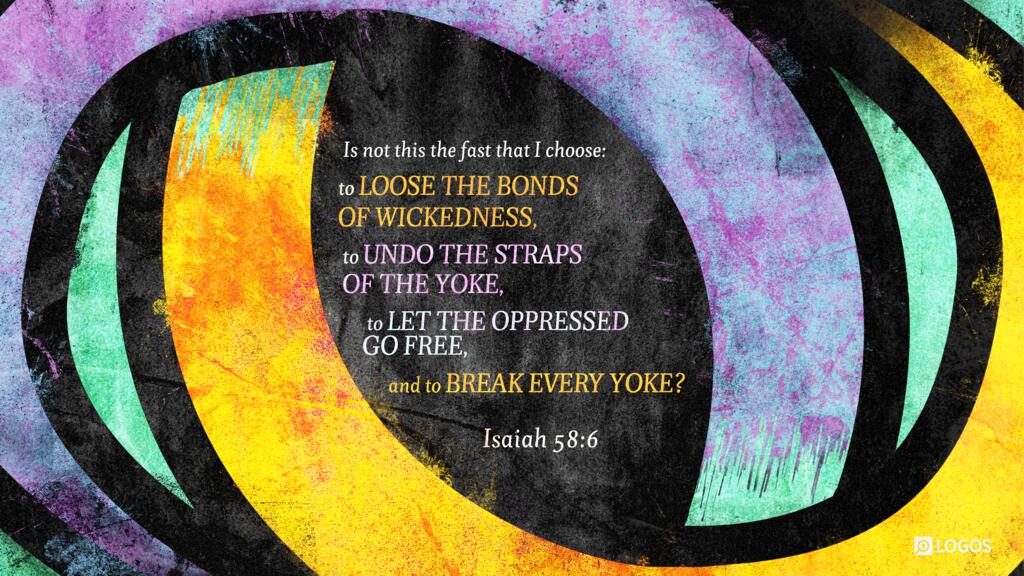
58:6No, this is the kind of fast I want.12
I want you13 to remove the sinful chains,
to tear away the ropes of the burdensome yoke,
to set free the oppressed,14
and to break every burdensome yoke.
58:7I want you15 to share your food with the hungry
and to provide shelter for homeless, oppressed people.16
When you see someone naked, clothe him!
Don’t turn your back on your own flesh and blood!17
58:8Then your light will shine like the sunrise;18
your restoration will quickly arrive;19
your godly behavior20 will go before you,
and the Lord’s splendor will be your rear guard.21
58:9Then you will call out, and the Lord will respond;
you will cry out, and he will reply, ‘Here I am.’
You must22 remove the burdensome yoke from among you
and stop pointing fingers and speaking sinfully.
58:10You must23 actively help the hungry
and feed the oppressed.24
Then your light will dispel the darkness,25
and your darkness will be transformed into noonday.26
Footnotes
- 9 Heb “choose” (so , ); “wish.”
- 10 Heb “a day when man humbles himself.” The words “Do I want” are supplied in the translation for stylistic reasons.
- 11 Or “making [their] bed.”
- 12 Heb “Is this not a fast I choose?” “No” is supplied in the translation for clarification.
- 13 The words “I want you” are supplied in the translation for stylistic reasons.
- 14 Heb “crushed.”
- 15 Heb “Is it not?” The rhetorical question here expects a positive answer, “It is!”
- 16 Heb “and afflicted [ones], homeless [ones] you should bring [into] a house.” On the meaning of מְרוּדִים (mérudim, “homeless”) see *מָרוּד.
- 17 Heb “and from your flesh do not hide yourself.”
- 18 Heb “will burst out like the dawn.” Light here symbolizes God’s favor and restored blessing, as the immediately following context makes clear.
- 19 Heb “prosper”; “spring forth speedily.”
- 20 Or “righteousness.” Their godly behavior will be on display for all to see.
- 21 The nation will experience God’s protective presence.
- 22 Heb “if you.” In the Hebrew text vv. 9b–10 are one long conditional sentence. The protasis (“if” clauses appear in vv. 9b–10a), with the apodosis (“then” clause) appearing in v. 10b.
- 23 Heb “if you.” See the note on “you must” in v. .
- 24 Heb “If you furnish for the hungry [with] your being, and the appetite of the oppressed you satisfy.”
- 25 Heb “will rise in the darkness.”
- 26 Heb “and your darkness [will be] like noonday.”
The NET Bible First Edition, Copyright 1996-2005 by Biblical Studies Press