Hosea 14:1–4
The NET BibleOther versions
English
- NET The NET Bible
- DARBY 1890 Darby Bible
- ASV American Standard Version
- AV 1873 The Cambridge Paragraph Bible of the Authorized English Version
- CSB Christian Standard Bible
- D-R Douay-Rheims Bible
- ESV English Standard Version
- GW GOD’S WORD Translation
- GNB Good News Translation
- HCSB The Holman Christian Standard Bible
- KJV 1900 King James Version
- LSB Legacy Standard Bible
- LEB The Lexham English Bible
- MSG The Message: The Bible in Contemporary Language
- NASB95 New American Standard Bible (1995)
- NCV New Century Version
- NIrV New International Reader’s Version (1998)
- NIV New International Version (2011)
- NKJV The New King James Version
- NLT New Living Translation
- NRSVue New Revised Standard Version: Updated Edition
- RSV The Revised Standard Version
- RSVCE The Revised Standard Version, Catholic Edition
- TNIV Today’s New International Version
- YLT Young’s Literal Translation
Arabic
Czech
French
German
Hebrew
Hungarian
Italian
Korean
Latin
Portuguese
Russian
Simplified Chinese
Spanish
Traditional Chinese
Prophetic Call to Genuine Repentance
14:1Return, O Israel, to the Lord your God,
for your sin has been your downfall!1
14:2Return to the Lord and repent!2
Say to him: “Completely3 forgive our iniquity;
accept4 our penitential prayer,5
that we may offer the praise of our lips as sacrificial bulls.6
14:3Assyria cannot save us;
we will not ride warhorses.
We will never again say, ‘Our gods’
to what our own hands have made.
For only you will show compassion to Orphan Israel!”7
Divine Promise to Relent from Judgment and to Restore Blessings
14:4“I will heal their waywardness8
and love them freely,9
for my anger will turn10 away from them.
Footnotes
- 1 Heb “For you have stumbled in your iniquity”; , “because of your iniquity.”
- 2 Heb “Take words with you and return to the Lord” (so , , ).
- 3 The word order כָּל־תִּשָּׂא עָוֹן (kol-tisa’ ’avon) is syntactically awkward. The editors suggest rearranging the word order: תִּשָּׂא כָּל־עוֹן (“Forgive all [our] iniquity!”). However, Gesenius suggests that כָּל (“all”) does not function as the construct in the genitive phrase כָּל־עוֹן (“all [our] iniquity”); it functions adverbially modifying the verb תִּשָּׂא (“Completely forgive!”; see §128.e).
- 4 The repetition of the root לָקַח (laqakh) creates a striking wordplay in 14:2. If Israel will bring (לָקַח) its confession to God, he will accept (לָקַח) repentant Israel and completely forgive its sin.
- 5 Heb “and accept [our] speech.” The word טוֹב (tov) is often confused with the common homonymic root I טוֹב (tov, “good”; 373 I טוֹב). However, this is probably IV טוֹב (tov, “word, speech”; IV טוֹב), a that is related to the verb טבב (“to speak”; טבב) and the noun טִבָּה (tibbah, “rumor”; טִבָּה). The term טוֹב (“word; speech”) refers to the repentant prayer mentioned in 14:1–3. Most translations relate it to I טוֹב and treat it as (1) accusative direct object: “accept that which is good” (, ), “Accept our good sacrifices” (), or (2) adverbial accusative of manner: “receive [us] graciously” (, , ). Note , however, which follows the suggestion made here: “accept our prayer.”
- 6 The reads פָרִים (farim, “bulls”), but the reflects פְּרִי (péri, “fruit”), a reading followed by , , : “that we may offer the fruit of [our] lips [as sacrifices to you].” Although the Greek expression in Heb 13:15 (καρπὸν χειλέων, karpon xeileōn, “the fruit of lips”) reflects this phrase, the makes good sense as it stands; NT usage of the should not be considered decisive in resolving OT textual problems. The noun פָרִים (parim, “bulls”) functions as an adverbial accusative of state.
- 7 Heb “For the orphan is shown compassion by you.” The present translation takes “orphan” as a figurative reference to Israel, which is specified in the translation for clarity.
- 8 The noun מְשׁוּבָתָה (méshuvatah, “waywardness”; cf. “backsliding”) is from the same root as שׁוּבָה (shuvah, “return!”) in 14:1[2]. This repetition of שׁוּב (shuv) creates a wordplay which emphasizes reciprocity: if Israel will return (שׁוּבָה, shuvah) to the Lord, he will cure her of the tendency to turn away (מְשׁוּבָתָה) from him.
- 9 The noun נְדָבָה (nédavah, “voluntariness; free-will offering”) is an adverbial accusative of manner: “freely, voluntarily” ( 621 נְדָבָה 1). Cf. “without limit”; “with all my heart”; “my love will know no bounds.”
- 10 The verb שָׁב, shav, “will turn” (Qal perfect 3rd person masculine singular from שׁוּב, shuv, “to turn”) continues the wordplay on שׁוּב in 14:1–4[2–5]. If Israel will “return” (שׁוּב) to the Lord, he will heal Israel’s tendency to “turn away” (מְשׁוּבָתָה, méshuvatah) and “turn” (שָׁב) from his anger.
The NET Bible First Edition, Copyright 1996-2005 by Biblical Studies Press
In other versions
ESVEnglish Standard Version
Return, O Israel, to the Lord your God,
for you have stumbled because of your iniquity.
Take with you words
and return to the Lord;
say to him,
“Take away all iniquity;
accept what is good,
and we will pay with bulls
the vows of our lips.
Assyria shall not save us;
we will not ride on horses;
and we will say no more, ‘Our God,’
to the work of our hands.
In you the orphan finds mercy.”
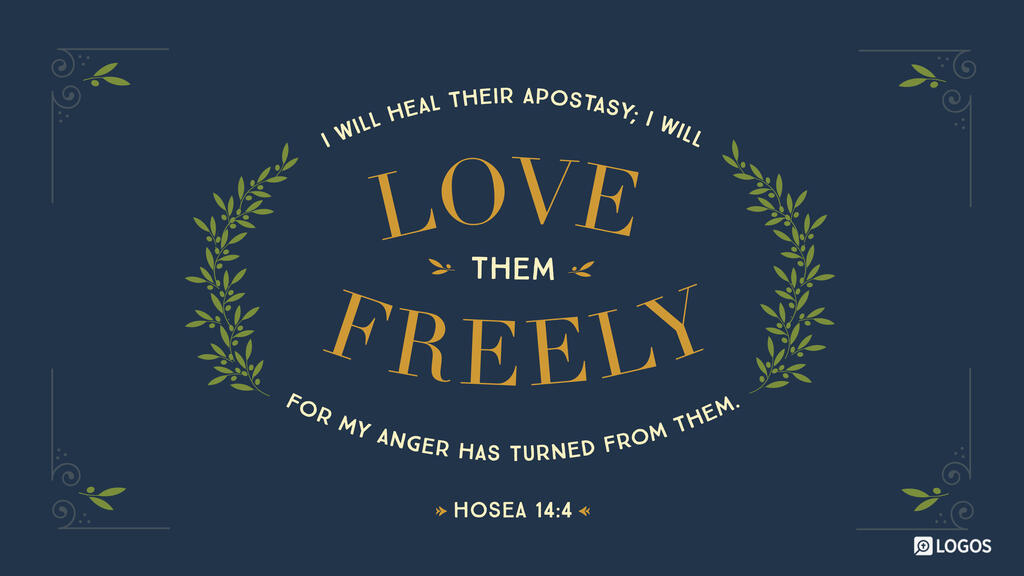
I will heal their apostasy;
I will love them freely,
for my anger has turned from them.
Copyright 2001 Crossway Bibles
NIVNew International Version (2011)
Return, Israel, to the Lord your God.
Your sins have been your downfall!
Take words with you
and return to the Lord.
Say to him:
“Forgive all our sins
and receive us graciously,
that we may offer the fruit of our lips.
Assyria cannot save us;
we will not mount warhorses.
We will never again say ‘Our gods’
to what our own hands have made,
for in you the fatherless find compassion.”
“I will heal their waywardness
and love them freely,
for my anger has turned away from them.
Copyright 1973, 1978, 1984, 2011 Biblica, Inc.
CSBChristian Standard Bible
Israel, return to the Lord your God,
for you have stumbled in your iniquity.
Take words of repentance with you
and return to the Lord.
Say to him, “Forgive all our iniquity
and accept what is good,
so that we may repay you
with praise from our lips.
Assyria will not save us,
we will not ride on horses,
and we will no longer proclaim, ‘Our gods!’
to the work of our hands.
For the fatherless receives compassion in you.”
I will heal their apostasy;
I will freely love them,
for my anger will have turned from him.
Copyright 2017 Holman Bible Publishers
NLTNew Living Translation
Return, O Israel, to the Lord your God,
for your sins have brought you down.
Bring your confessions, and return to the Lord.
Say to him,
“Forgive all our sins and graciously receive us,
so that we may offer you our praises.
Assyria cannot save us,
nor can our warhorses.
Never again will we say to the idols we have made,
‘You are our gods.’
No, in you alone
do the orphans find mercy.”
The Lord says,
“Then I will heal you of your faithlessness;
my love will know no bounds,
for my anger will be gone forever.
Holy Bible, New Living Translation, copyright © 1996, 2004, 2015 by Tyndale House Foundation. Used by permission of Tyndale House Publishers. All rights reserved.
LEBThe Lexham English Bible
Return to Yahweh your God, O Israel,
for you have stumbled because of your sin.
Take words with you,
and return to Yahweh.
Say to him,
“Take away all guilt;
accept good, and we will offer
the fruit of our lips.
Assyria will not save us;
we will not ride on horses,
and we will say no more, “Our God,”
to the work of our hands
because in you the fatherless child finds mercy.
I will heal their disloyalty;
I will love them freely
because my anger has turned back
from them.
Copyright 2012 Lexham Press
KJV 1900King James Version
O Israel, return unto the Lord thy God;
For thou hast fallen by thine iniquity.
Take with you words, and turn to the Lord:
Say unto him, Take away all iniquity, and receive us graciously:
So will we render the calves of our lips.
Asshur shall not save us; we will not ride upon horses:
Neither will we say any more to the work of our hands, Ye are our gods:
For in thee the fatherless findeth mercy.
I will heal their backsliding, I will love them freely:
For mine anger is turned away from him.
Public Domain