Genesis 4:3–10
The NET BibleOther versions
English
- NET The NET Bible
- DARBY 1890 Darby Bible
- ASV American Standard Version
- AV 1873 The Cambridge Paragraph Bible of the Authorized English Version
- CSB Christian Standard Bible
- D-R Douay-Rheims Bible
- ESV English Standard Version
- GW GOD’S WORD Translation
- GNB Good News Translation
- HCSB The Holman Christian Standard Bible
- KJV 1900 King James Version
- LSB Legacy Standard Bible
- LEB The Lexham English Bible
- MSG The Message: The Bible in Contemporary Language
- NASB95 New American Standard Bible (1995)
- NCV New Century Version
- NIrV New International Reader’s Version (1998)
- NIV New International Version (2011)
- NKJV The New King James Version
- NLT New Living Translation
- NRSVue New Revised Standard Version: Updated Edition
- RSV The Revised Standard Version
- RSVCE The Revised Standard Version, Catholic Edition
- TNIV Today’s New International Version
- YLT Young’s Literal Translation
Arabic
Czech
French
German
Hebrew
Hungarian
Italian
Korean
Latin
Portuguese
Russian
Simplified Chinese
Spanish
Traditional Chinese
4:3At the designated time9 Cain brought some of the fruit of the ground for an offering10 to the Lord. 4:4But Abel brought11 some of the firstborn of his flock—even the fattest12 of them. And the Lord was pleased with13 Abel and his offering, 4:5but with Cain and his offering he was not pleased.14 So Cain became very angry,15 and his expression was downcast.16
4:6Then the Lord said to Cain, “Why are you angry, and why is your expression downcast? 4:7Is it not true17 that if you do what is right, you will be fine?18 But if you do not do what is right, sin is crouching19 at the door. It desires to dominate you, but you must subdue it.”20
4:8Cain said to his brother Abel, “Let’s go out to the field.”21 While they were in the field, Cain attacked22 his brother23 Abel and killed him.
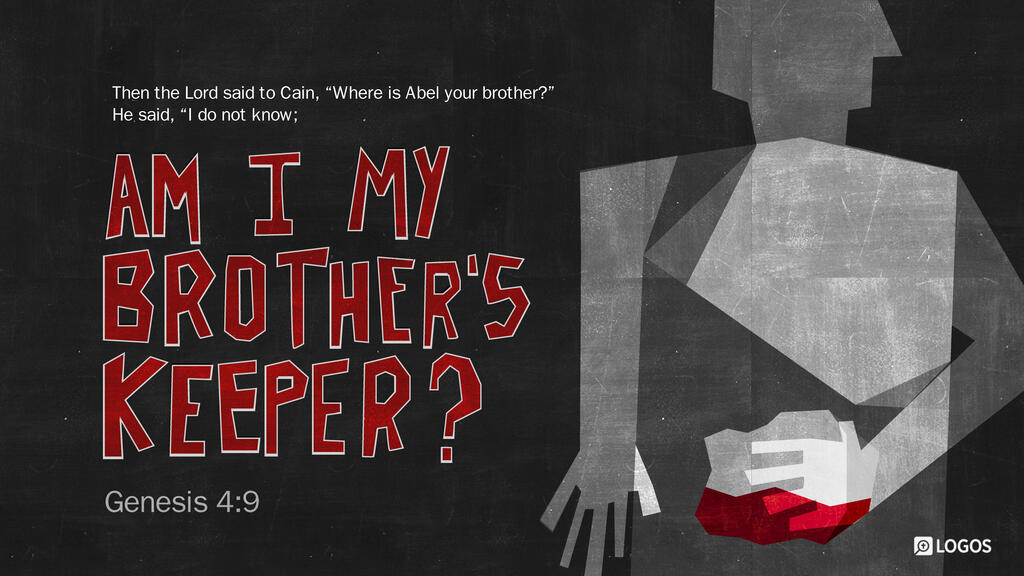
4:9Then the Lord said to Cain, “Where is your brother Abel?”24 And he replied, “I don’t know! Am I my brother’s guardian?”25 4:10But the Lord said, “What have you done?26 The voice27 of your brother’s blood is crying out to me from the ground!
Footnotes
- 9 Heb “And it happened at the end of days.” The clause indicates the passing of a set period of time leading up to offering sacrifices.
- 10 The Hebrew term מִנְחָה (minkhah, “offering”) is a general word for tribute, a gift, or an offering. It is the main word used in Lev 2 for the dedication offering. This type of offering could be comprised of vegetables. The content of the offering (vegetables, as opposed to animals) was not the critical issue, but rather the attitude of the offerer.
- 11 Heb “But Abel brought, also he.…” The disjunctive clause (conjunction + subject + verb) stresses the contrast between Cain’s offering and Abel’s.
- 12 Two prepositional phrases are used to qualify the kind of sacrifice that Abel brought: “from the firstborn” and “from the fattest of them.” These also could be interpreted as a hendiadys: “from the fattest of the firstborn of the flock.” Another option is to understand the second prepositional phrase as referring to the fat portions of the sacrificial sheep. In this case one may translate, “some of the firstborn of his flock, even some of their fat portions” (cf. , , ). Here are two types of worshipers—one (Cain) merely discharges a duty at the proper time, while the other (Abel) goes out of his way to please God with the first and the best.
- 13 The Hebrew verb שָׁעָה (sha’ah) simply means “to gaze at, to have regard for, to look on with favor [or “with devotion”].” The text does not indicate how this was communicated, but it indicates that Cain and Abel knew immediately. Either there was some manifestation of divine pleasure given to Abel and withheld from Cain (fire consuming the sacrifice?), or there was an inner awareness of divine response.
- 14 The Letter to the Hebrews explains the difference between the brothers as one of faith—Abel by faith offered a better sacrifice. Cain’s offering as well as his reaction to God’s displeasure did not reflect faith. See further B. K. Waltke, “Cain and His Offering,” 48 (1986): .
- 15 Heb “and it was hot to Cain.” This Hebrew idiom means that Cain “burned” with anger.
- 16 Heb “And his face fell.” The idiom means that the inner anger is reflected in Cain’s facial expression. The fallen or downcast face expresses anger, dejection, or depression. Conversely, in Num 6 the high priestly blessing speaks of the Lord lifting up his face and giving peace.
- 17 The introduction of the conditional clause with an interrogative particle prods the answer from Cain, as if he should have known this. It is not a condemnation, but an encouragement to do what is right.
- 18 The Hebrew text is difficult, because only one word occurs, שְׂאֵת (sé’et), which appears to be the infinitive construct from the verb “to lift up” (נָאָשׂ, na’as). The sentence reads: “If you do well, uplifting.” On the surface it seems to be the opposite of the fallen face. Everything will be changed if he does well. God will show him favor, he will not be angry, and his face will reflect that. But more may be intended since the second half of the verse forms the contrast: “If you do not do well, sin is crouching.…” Not doing well leads to sinful attack; doing well leads to victory and God’s blessing.
- 19 The Hebrew term translated “crouching” (רֹבֵץ, rovets) is an active participle. Sin is portrayed with animal imagery here as a beast crouching and ready to pounce (a figure of speech known as zoomorphism). An Akkadian cognate refers to a type of demon; in this case perhaps one could translate, “Sin is the demon at the door” (see E. A. Speiser, Genesis [], , ).
- 20 Heb “and toward you [is] its desire, but you must rule over it.” As in Gen 3:16, the Hebrew noun “desire” refers to an urge to control or dominate. Here the desire is that which sin has for Cain, a desire to control for the sake of evil, but Cain must have mastery over it. The imperfect is understood as having an obligatory sense. Another option is to understand it as expressing potential (“you can have [or “are capable of having”] mastery over it.”). It will be a struggle, but sin can be defeated by righteousness. In addition to this connection to Gen 3, other linguistic and thematic links between chaps. 3 and 4 are discussed by A. J. Hauser, “Linguistic and Thematic Links Between Genesis 4:1–6 and Genesis 2–3,” 23 (1980): .
- 21 The has simply “and Cain said to Abel his brother,” omitting Cain’s words to Abel. It is possible that the elliptical text is original. Perhaps the author uses the technique of aposiopesis, “a sudden silence” to create tension. In the midst of the story the narrator suddenly rushes ahead to what happened in the field. It is more likely that the ancient versions (Samaritan Pentateuch, , , and ), which include Cain’s words, “Let’s go out to the field,” preserve the original reading here. After writing אָחִיו (’akhiyv, “his brother”), a scribe’s eye may have jumped to the end of the form בַּשָּׂדֶה (basadeh, “to the field”) and accidentally omitted the quotation. This would be an error of virtual homoioteleuton. In older phases of the Hebrew script the sequence יו (yod-vav) on אָחִיו is graphically similar to the final ה (he) on בַּשָּׂדֶה.
- 22 Heb “arose against” (in a hostile sense).
- 23 The word “brother” appears six times in vv. 8–11, stressing the shocking nature of Cain’s fratricide (see 1 John 3:12).
- 24 Where is Abel your brother? Again the Lord confronts a guilty sinner with a rhetorical question (see Gen 3:9–13), asking for an explanation of what has happened.
- 25 Heb “The one guarding my brother [am] I?” Am I my brother’s guardian? Cain lies and then responds with a defiant rhetorical question of his own in which he repudiates any responsibility for his brother. But his question is ironic, for he is responsible for his brother’s fate, especially if he wanted to kill him. See P. A. Riemann, “Am I My Brother’s Keeper?” 24 (1970): 482–91.
- 26 What have you done? Again the Lord’s question is rhetorical (see Gen 3:13), condemning Cain for his sin.
- 27 The word “voice” is a personification; the evidence of Abel’s shed blood condemns Cain, just as a human eyewitness would testify in court. For helpful insights, see G. von Rad, Biblical Interpretations in Preaching; and L. Morris, “The Biblical Use of the Term ‘Blood,’ ” 6 (1955/56): 77–82.
The NET Bible First Edition, Copyright 1996-2005 by Biblical Studies Press
In other versions
ESVEnglish Standard Version
In the course of time Cain brought to the Lord an offering of the fruit of the ground, and Abel also brought of the firstborn of his flock and of their fat portions. And the Lord had regard for Abel and his offering, but for Cain and his offering he had no regard. So Cain was very angry, and his face fell. The Lord said to Cain, “Why are you angry, and why has your face fallen? If you do well, will you not be accepted? And if you do not do well, sin is crouching at the door. Its desire is for you, and you must rule over it.”
Cain spoke to Abel his brother. And when they were in the field, Cain rose up against his brother Abel and killed him. Then the Lord said to Cain, “Where is Abel your brother?” He said, “I do not know; am I my brother’s keeper?” And the Lord said, “What have you done? The voice of your brother’s blood is crying to me from the ground.
Copyright 2001 Crossway Bibles
NIVNew International Version (2011)
In the course of time Cain brought some of the fruits of the soil as an offering to the Lord. And Abel also brought an offering—fat portions from some of the firstborn of his flock. The Lord looked with favor on Abel and his offering, but on Cain and his offering he did not look with favor. So Cain was very angry, and his face was downcast.
Then the Lord said to Cain, “Why are you angry? Why is your face downcast? If you do what is right, will you not be accepted? But if you do not do what is right, sin is crouching at your door; it desires to have you, but you must rule over it.”
Now Cain said to his brother Abel, “Let’s go out to the field.” While they were in the field, Cain attacked his brother Abel and killed him.
Then the Lord said to Cain, “Where is your brother Abel?”
“I don’t know,” he replied. “Am I my brother’s keeper?”
The Lord said, “What have you done? Listen! Your brother’s blood cries out to me from the ground.
Copyright 1973, 1978, 1984, 2011 Biblica, Inc.
CSBChristian Standard Bible
In the course of time Cain presented some of the land’s produce as an offering to the Lord. And Abel also presented an offering—some of the firstborn of his flock and their fat portions. The Lord had regard for Abel and his offering, but he did not have regard for Cain and his offering. Cain was furious, and he looked despondent.
Then the Lord said to Cain, “Why are you furious? And why do you look despondent? If you do what is right, won’t you be accepted? But if you do not do what is right, sin is crouching at the door. Its desire is for you, but you must rule over it.”
Cain said to his brother Abel, “Let’s go out to the field.” And while they were in the field, Cain attacked his brother Abel and killed him.
Then the Lord said to Cain, “Where is your brother Abel?”
“I don’t know,” he replied. “Am I my brother’s guardian?”
Then he said, “What have you done? Your brother’s blood cries out to me from the ground!
Copyright 2017 Holman Bible Publishers
NLTNew Living Translation
When it was time for the harvest, Cain presented some of his crops as a gift to the Lord. Abel also brought a gift—the best portions of the firstborn lambs from his flock. The Lord accepted Abel and his gift, but he did not accept Cain and his gift. This made Cain very angry, and he looked dejected.
“Why are you so angry?” the Lord asked Cain. “Why do you look so dejected? You will be accepted if you do what is right. But if you refuse to do what is right, then watch out! Sin is crouching at the door, eager to control you. But you must subdue it and be its master.”
One day Cain suggested to his brother, “Let’s go out into the fields.” And while they were in the field, Cain attacked his brother, Abel, and killed him.
Afterward the Lord asked Cain, “Where is your brother? Where is Abel?”
“I don’t know,” Cain responded. “Am I my brother’s guardian?”
But the Lord said, “What have you done? Listen! Your brother’s blood cries out to me from the ground!
Holy Bible, New Living Translation, copyright © 1996, 2004, 2015 by Tyndale House Foundation. Used by permission of Tyndale House Publishers. All rights reserved.
LEBThe Lexham English Bible
And in the course of time Cain brought an offering from the fruit of the ground to Yahweh, and Abel also brought an offering from the choicest firstlings of his flock. And Yahweh looked with favor to Abel and to his offering, but to Cain and to his offering he did not look with favor. And Cain became very angry, and his face fell. And Yahweh said to Cain, “Why are you angry, and why is your face fallen? If you do well will I not accept you? But if you do not do well, sin is crouching at the door. And its desire is for you, but you must rule over it.”
Then Cain said to his brother Abel, “Let us go out into the field.” And when they were in the field, Cain rose up against his brother Abel and killed him. Then Yahweh said to Cain, “Where is Abel your brother?” And he said, “I do not know; am I my brother’s keeper?” And he said, “What have you done? The voice of your brother’s blood is crying out to me from the ground.
Copyright 2012 Lexham Press
KJV 1900King James Version
And in process of time it came to pass, that Cain brought of the fruit of the ground an offering unto the Lord. And Abel, he also brought of the firstlings of his flock and of the fat thereof. And the Lord had respect unto Abel and to his offering: But unto Cain and to his offering he had not respect. And Cain was very wroth, and his countenance fell. And the Lord said unto Cain, Why art thou wroth? and why is thy countenance fallen? If thou doest well, shalt thou not be accepted? and if thou doest not well, sin lieth at the door. And unto thee shall be his desire, and thou shalt rule over him. And Cain talked with Abel his brother: and it came to pass, when they were in the field, that Cain rose up against Abel his brother, and slew him. And the Lord said unto Cain, Where is Abel thy brother? And he said, I know not: Am I my brother’s keeper? And he said, What hast thou done? the voice of thy brother’s blood crieth unto me from the ground.
Public Domain