Genesis 17:1–8
The NET BibleOther versions
English
- NET The NET Bible
- DARBY 1890 Darby Bible
- ASV American Standard Version
- AV 1873 The Cambridge Paragraph Bible of the Authorized English Version
- CSB Christian Standard Bible
- D-R Douay-Rheims Bible
- ESV English Standard Version
- GW GOD’S WORD Translation
- GNB Good News Translation
- HCSB The Holman Christian Standard Bible
- KJV 1900 King James Version
- LSB Legacy Standard Bible
- LEB The Lexham English Bible
- MSG The Message: The Bible in Contemporary Language
- NASB95 New American Standard Bible (1995)
- NCV New Century Version
- NIrV New International Reader’s Version (1998)
- NIV New International Version (2011)
- NKJV The New King James Version
- NLT New Living Translation
- NRSVue New Revised Standard Version: Updated Edition
- RSV The Revised Standard Version
- RSVCE The Revised Standard Version, Catholic Edition
- TNIV Today’s New International Version
- YLT Young’s Literal Translation
Arabic
Czech
French
German
Hebrew
Hungarian
Italian
Korean
Latin
Portuguese
Russian
Simplified Chinese
Spanish
Traditional Chinese
The Sign of the Covenant
17:1When Abram was 99 years old,1 the Lord appeared to him and said,2 “I am the sovereign God.3 Walk4 before me5 and be blameless.617:2Then I will confirm my covenant7 between me and you, and I will give you a multitude of descendants.”8
17:3Abram bowed down with his face to the ground,9 and God said to him,1017:4“As for me,11 this12 is my covenant with you: You will be the father of a multitude of nations. 17:5No longer will your name be13 Abram. Instead, your name will be Abraham14 because I will make you15 the father of a multitude of nations. 17:6I will make you16 extremely17 fruitful. I will make nations of you, and kings will descend from you.1817:7I will confirm19 my covenant as a perpetual20 covenant between me and you. It will extend to your descendants after you throughout their generations. I will be your God and the God of your descendants after you.2117:8I will give the whole land of Canaan—the land where you are now residing22—to you and your descendants after you as a permanent23 possession. I will be their God.”
Footnotes
- 1 Heb “the son of ninety-nine years.”
- 2 Heb “appeared to Abram and said to him.” The proper name has been replaced by the pronoun (“him”) and the final phrase “to him” has been left untranslated for stylistic reasons.
- 3 The name אֵל שַׁדַּי (’el shadday, “El Shaddai”) has often been translated “God Almighty,” primarily because Jerome translated it omnipotens (“all powerful”) in the Latin . There has been much debate over the meaning of the name. For discussion see W. F. Albright, “The Names Shaddai and Abram,” 54 (1935): 173–210; R. Gordis, “The Biblical Root sdy-sd,” 41 (1940): 34–43; and especially T. N. D. Mettinger, In Search of God, 69–72. Shaddai/El Shaddai is the sovereign king of the world who grants, blesses, and judges. In the Book of Genesis he blesses the patriarchs with fertility and promises numerous descendants. Outside Genesis he both blesses/protects and takes away life/happiness. The patriarchs knew God primarily as El Shaddai (Exod 6:3). While the origin and meaning of this name are uncertain (see discussion below) its significance is clear. The name is used in contexts where God appears as the source of fertility and life. In Gen 17:1–8 he appeared to Abram, introduced himself as El Shaddai, and announced his intention to make the patriarch fruitful. In the role of El Shaddai God repeated these words (now elevated to the status of a decree) to Jacob (35:11). Earlier Isaac had pronounced a blessing on Jacob in which he asked El Shaddai to make Jacob fruitful (28:3). Jacob later prayed that his sons would be treated with mercy when they returned to Egypt with Benjamin (43:14). The fertility theme is not as apparent here, though one must remember that Jacob viewed Benjamin as the sole remaining son of the favored and once-barren Rachel (see 29:31; 30:22–24; 35:16–18). It is quite natural that he would appeal to El Shaddai to preserve Benjamin’s life, for it was El Shaddai’s miraculous power which made it possible for Rachel to give him sons in the first place. In 48:3 Jacob, prior to blessing Joseph’s sons, told him how El Shaddai appeared to him at Bethel (see Gen 28) and promised to make him fruitful. When blessing Joseph on his deathbed Jacob referred to Shaddai (we should probably read “El Shaddai,” along with a few Hebrew , the Samaritan Pentateuch, the , and ) as the one who provides abundant blessings, including “blessings of the breast and womb” (49:25). (The direct association of the name with “breasts” suggests the name might mean “the one of the breast” [i.e., the one who gives fertility], but the juxtaposition is probably better explained as wordplay. Note the wordplay involving the name and the root שָׁדַד, shadad, “destroy”] in Isa 13:6 and in Joel 1:15.) Outside Genesis the name Shaddai (minus the element “El” [“God”]) is normally used when God is viewed as the sovereign king who blesses/protects or curses/brings judgment. The name appears in the introduction to two of Balaam’s oracles (Num 24:4, 16) of blessing upon Israel. Naomi employs the name when accusing the Lord of treating her bitterly by taking the lives of her husband and sons (Ruth 1:20–21). In Ps 68:14; Isa 13:6; and Joel 1:15 Shaddai judges his enemies through warfare, while Ps 91:1 depicts him as the protector of his people. (In Ezek 1:24 and 10:5 the sound of the cherubs’ wings is compared to Shaddai’s powerful voice. The reference may be to the mighty divine warrior’s battle cry which accompanies his angry judgment.) Finally, the name occurs 31 times in the Book of Job. Job and his “friends” assume that Shaddai is the sovereign king of the world (11:7; 37:23a) who is the source of life (33:4b) and is responsible for maintaining justice (8:3; 34:10–12; 37:23b). He provides abundant blessings, including children (22:17–18; 29:4–6), but he can also discipline, punish, and destroy (5:17; 6:4; 21:20; 23:16). It is not surprising to see the name so often in this book, where the theme of God’s justice is primary and even called into question (24:1; 27:2). The most likely proposal is that the name means “God, the one of the mountain” (an Akkadian cognate means “mountain,” to which the Hebrew שַׁד, shad, “breast”] is…
- 4 Or “Live out your life.” The Hebrew verb translated “walk” is the Hitpael; it means “to walk back and forth; to walk about; to live out one’s life.”
- 5 Or “in my presence.”
- 6 There are two imperatives here: “walk … and be blameless [or “perfect”].” The second imperative may be purely sequential (see the translation) or consequential: “walk before me and then you will be blameless.” How one interprets the sequence depends on the meaning of “walk before”: (1) If it simply refers in a neutral way to serving the Lord, then the second imperative is likely sequential. (2) But if it has a positive moral connotation (“serve me faithfully”), then the second imperative probably indicates purpose (or result). For other uses of the idiom see 1 Sam 2:30, 35 and 12:2 (where it occurs twice).
- 7 Following the imperative, the cohortative indicates consequence. If Abram is blameless, then the Lord will ratify the covenant. Earlier the Lord ratified part of his promise to Abram (see Gen 15:18–21), guaranteeing him that his descendants would live in the land. But the expanded form of the promise, which includes numerous descendants and eternal possession of the land, remains to be ratified. This expanded form of the promise is in view here (see vv. 2b, 4–8). See the note at and R. B. Chisholm, “Evidence from Genesis,” A Case for Premillennialism, 35–54.
- 8 Heb “I will multiply you exceedingly, exceedingly.” The repetition is emphatic.
- 9 Heb “And Abram fell on his face.” This expression probably means that Abram sank to his knees and put his forehead to the ground, although it is possible that he completely prostrated himself. In either case the posture indicates humility and reverence.
- 10 Heb “God spoke to him, saying.” This is redundant in contemporary English and has been simplified in the translation for stylistic reasons.
- 11 Heb “I.”
- 12 Heb “is” (הִנֵּה, hinneh).
- 13 Heb “will your name be called.”
- 14 Your name will be Abraham. The renaming of Abram was a sign of confirmation to the patriarch. Every time the name was used it would be a reminder of God’s promise. “Abram” means “exalted father,” probably referring to Abram’s father Terah. The name looks to the past; Abram came from noble lineage. The name “Abraham” is a dialectical variant of the name Abram. But its significance is in the wordplay with אַב־הֲמוֹן (’av-hamon, “the father of a multitude,” which sounds like אַבְרָהָם, ’avraham, “Abraham”). The new name would be a reminder of God’s intention to make Abraham the father of a multitude. For a general discussion of renaming, see O. Eissfeldt, “Renaming in the Old Testament,” Words and Meanings, 70–83.
- 15 The perfect verbal form is used here in a rhetorical manner to emphasize God’s intention.
- 16 This verb starts a series of perfect verbal forms with vav (ו) consecutive to express God’s intentions.
- 17 Heb “exceedingly, exceedingly.” The repetition is emphatic.
- 18 Heb “and I will make you into nations, and kings will come out from you.”
- 19 The verb קוּם (qum, “to arise, to stand up”) in the Hiphil verbal stem means “to confirm, to give effect to, to carry out” (i.e., a covenant or oath; see 878–79 קוּם).
- 20 Or “as an eternal.”
- 21 Heb “to be to you for God and to your descendants after you.”
- 22 The verbal root is גּוּר (gur, “to sojourn, to reside temporarily,” i.e., as a resident alien). It is the land in which Abram resides, but does not yet possess as his very own.
- 23 Or “as an eternal.”
The NET Bible First Edition, Copyright 1996-2005 by Biblical Studies Press
In other versions
ESVEnglish Standard Version
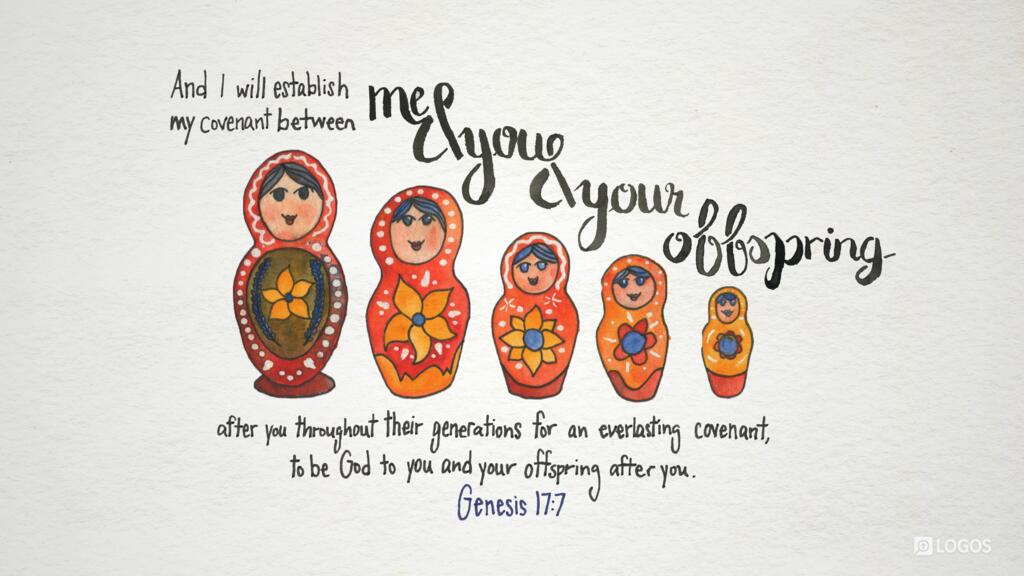
When Abram was ninety-nine years old the Lord appeared to Abram and said to him, “I am God Almighty; walk before me, and be blameless, that I may make my covenant between me and you, and may multiply you greatly.” Then Abram fell on his face. And God said to him, “Behold, my covenant is with you, and you shall be the father of a multitude of nations. No longer shall your name be called Abram, but your name shall be Abraham, for I have made you the father of a multitude of nations. I will make you exceedingly fruitful, and I will make you into nations, and kings shall come from you. And I will establish my covenant between me and you and your offspring after you throughout their generations for an everlasting covenant, to be God to you and to your offspring after you. And I will give to you and to your offspring after you the land of your sojournings, all the land of Canaan, for an everlasting possession, and I will be their God.”
Copyright 2001 Crossway Bibles
NIVNew International Version (2011)
When Abram was ninety-nine years old, the Lord appeared to him and said, “I am God Almighty; walk before me faithfully and be blameless. Then I will make my covenant between me and you and will greatly increase your numbers.”
Abram fell facedown, and God said to him, “As for me, this is my covenant with you: You will be the father of many nations. No longer will you be called Abram; your name will be Abraham, for I have made you a father of many nations. I will make you very fruitful; I will make nations of you, and kings will come from you. I will establish my covenant as an everlasting covenant between me and you and your descendants after you for the generations to come, to be your God and the God of your descendants after you. The whole land of Canaan, where you now reside as a foreigner, I will give as an everlasting possession to you and your descendants after you; and I will be their God.”
Copyright 1973, 1978, 1984, 2011 Biblica, Inc.
CSBChristian Standard Bible
When Abram was ninety-nine years old, the Lord appeared to him, saying, “I am God Almighty. Live in my presence and be blameless. I will set up my covenant between me and you, and I will multiply you greatly.”
Then Abram fell facedown and God spoke with him: “As for me, here is my covenant with you: You will become the father of many nations. Your name will no longer be Abram; your name will be Abraham, for I will make you the father of many nations. I will make you extremely fruitful and will make nations and kings come from you. I will confirm my covenant that is between me and you and your future offspring throughout their generations. It is a permanent covenant to be your God and the God of your offspring after you. And to you and your future offspring I will give the land where you are residing—all the land of Canaan—as a permanent possession, and I will be their God.”
Copyright 2017 Holman Bible Publishers
NLTNew Living Translation
When Abram was ninety-nine years old, the Lord appeared to him and said, “I am El-Shaddai—‘God Almighty.’ Serve me faithfully and live a blameless life. I will make a covenant with you, by which I will guarantee to give you countless descendants.”
At this, Abram fell face down on the ground. Then God said to him, “This is my covenant with you: I will make you the father of a multitude of nations! What’s more, I am changing your name. It will no longer be Abram. Instead, you will be called Abraham, for you will be the father of many nations. I will make you extremely fruitful. Your descendants will become many nations, and kings will be among them!
“I will confirm my covenant with you and your descendants after you, from generation to generation. This is the everlasting covenant: I will always be your God and the God of your descendants after you. And I will give the entire land of Canaan, where you now live as a foreigner, to you and your descendants. It will be their possession forever, and I will be their God.”
Holy Bible, New Living Translation, copyright © 1996, 2004, 2015 by Tyndale House Foundation. Used by permission of Tyndale House Publishers. All rights reserved.
LEBThe Lexham English Bible
When Abram was ninety-nine years old Yahweh appeared to Abram. And he said to him, “I am El-Shaddai; walk before me and be blameless so that I may make my covenant between me and you, and may multiply you exceedingly.” Then Abram fell upon his face and God spoke with him, saying, “As for me, behold, my covenant shall be with you, and you shall be the father of a multitude of nations. Your name shall no longer be called Abram, but your name shall be Abraham, for I will make you the father of a multitude of nations. And I will make you exceedingly fruitful. I will make you a nation, and kings shall go out from you. And I will establish my covenant between me and you, and between your offspring after you, throughout their generations as an everlasting covenant to be as God for you and to your offspring after you. And I will give to you and to your offspring after you the land in which you are living as an alien, all the land of Canaan, as an everlasting property. And I will be to them as God.”
Copyright 2012 Lexham Press
KJV 1900King James Version
And when Abram was ninety years old and nine, the Lord appeared to Abram, and said unto him, I am the Almighty God; walk before me, and be thou perfect. And I will make my covenant between me and thee, and will multiply thee exceedingly. And Abram fell on his face: and God talked with him, saying, As for me, behold, my covenant is with thee, and thou shalt be a father of many nations. Neither shall thy name any more be called Abram, but thy name shall be Abraham; for a father of many nations have I made thee. And I will make thee exceeding fruitful, and I will make nations of thee, and kings shall come out of thee. And I will establish my covenant between me and thee and thy seed after thee in their generations for an everlasting covenant, to be a God unto thee, and to thy seed after thee. And I will give unto thee, and to thy seed after thee, the land wherein thou art a stranger, all the land of Canaan, for an everlasting possession; and I will be their God.
Public Domain