Genesis 3:15b
The NET BibleOther versions
English
- NET The NET Bible
- DARBY 1890 Darby Bible
- ASV American Standard Version
- AV 1873 The Cambridge Paragraph Bible of the Authorized English Version
- CSB Christian Standard Bible
- D-R Douay-Rheims Bible
- ESV English Standard Version
- GW GOD’S WORD Translation
- GNB Good News Translation
- HCSB The Holman Christian Standard Bible
- KJV 1900 King James Version
- LSB Legacy Standard Bible
- LEB The Lexham English Bible
- MSG The Message: The Bible in Contemporary Language
- NASB95 New American Standard Bible (1995)
- NCV New Century Version
- NIrV New International Reader’s Version (1998)
- NIV New International Version (2011)
- NKJV The New King James Version
- NLT New Living Translation
- NRSVue New Revised Standard Version: Updated Edition
- RSV The Revised Standard Version
- RSVCE The Revised Standard Version, Catholic Edition
- TNIV Today’s New International Version
- YLT Young’s Literal Translation
Arabic
Czech
French
German
Hebrew
Hungarian
Italian
Korean
Latin
Portuguese
Russian
Simplified Chinese
Spanish
Traditional Chinese
3:15And I will put hostility40 between you and the woman
and between your offspring and her offspring;41
her offspring will attack42 your head,
Footnotes
- 40 The Hebrew word translated “hostility” is derived from the root אֵיב (’ev, “to be hostile, to be an adversary [or enemy]”). The curse announces that there will be continuing hostility between the serpent and the woman. The serpent will now live in a “battle zone,” as it were.
- 41 The Hebrew word translated “offspring” is a collective singular. The text anticipates the ongoing struggle between human beings (the woman’s offspring) and deadly poisonous snakes (the serpent’s offspring). An ancient Jewish interpretation of the passage states: “He made the serpent, cause of the deceit, press the earth with belly and flank, having bitterly driven him out. He aroused a dire enmity between them. The one guards his head to save it, the other his heel, for death is at hand in the proximity of men and malignant poisonous snakes.” See 1:59–64. For a similar interpretation see Josephus, 1.1.4 (1.50–51).
- 42 Heb “he will attack [or “bruise”] you [on] the head.” The singular pronoun and verb agree grammatically with the collective singular noun “offspring.” For other examples of singular verb and pronominal forms being used with the collective singular “offspring,” see Gen 16:10; 22:17; 24:60. The word “head” is an adverbial accusative, locating the blow. A crushing blow to the head would be potentially fatal.
- 43 Or “but you will …”; or “as they attack your head, you will attack their heel.” The disjunctive clause (conjunction + subject + verb) is understood as contrastive. Both clauses place the subject before the verb, a construction that is sometimes used to indicate synchronic action (see Judg 15:14).
- 44 You will attack her offspring’s heel. Though the conflict will actually involve the serpent’s offspring (snakes) and the woman’s offspring (human beings), v. 15b for rhetorical effect depicts the conflict as being between the serpent and the woman’s offspring, as if the serpent will outlive the woman. The statement is personalized for the sake of the addressee (the serpent) and reflects the ancient Semitic concept of corporate solidarity, which emphasizes the close relationship between a progenitor and his offspring. Note Gen 28:14, where the Lord says to Jacob, “Your offspring will be like the dust of the earth, and you [second masculine singular] will spread out in all directions.” Jacob will “spread out” in all directions through his offspring, but the text states the matter as if this will happen to him personally.
- 45 Heb “you will attack him [on] the heel.” The verb (translated “attack”) is repeated here, a fact that is obscured by some translations (e.g., “crush … strike”). The singular pronoun agrees grammatically with the collective singular noun “offspring.” For other examples of singular verb and pronominal forms being used with the collective singular “offspring,” see Gen 16:10; 22:17; 24:60. The word “heel” is an adverbial accusative, locating the blow. A bite on the heel from a poisonous serpent is potentially fatal. The etiological nature of v. 15 is apparent, though its relevance for modern western man is perhaps lost because we rarely come face to face with poisonous snakes. Ancient Israelites, who often encountered snakes in their daily activities (see, for example, Eccl 10:8; Amos 5:19), would find the statement quite meaningful as an explanation for the hostility between snakes and humans. (In the broader ancient Near Eastern context, compare the Mesopotamian serpent omens. See H. W. F. Saggs, The Greatness That Was Babylon, 309.) This ongoing struggle, when interpreted in light of v. 15, is a tangible reminder of the conflict introduced into the world by the first humans’ rebellion against God. Many Christian theologians (going back to Irenaeus) understand v. 15 as the so-called protevangelium, supposedly prophesying Christ’s victory over Satan (see W. Witfall, “Genesis 3:15—a Protevangelium?” 36 [1974]: 361–65; and R. A. Martin, “The Earliest Messianic Interpretation of Genesis 3:15,” 84 [1965]: 425–27). In this allegorical approach, the woman’s offspring is initially Cain, then the whole human race, and ultimately Jesus Christ, the offspring (Heb “seed”) of the woman (see Gal 4:4). The offspring of the serpent includes the evil powers and demons of the spirit world, as well as those humans who are in the kingdom of darkness (see John 8:44). According to this view, the passage gives the first hint of the gospel. Satan delivers a crippling blow to the Seed of the woman (Jesus), who in turn delivers a fatal blow to the Serpent (first defeating him through the death and resurrection [1 Cor 15:55–57] and then destroying him in the judgment [Rev 12:7–9; 20:7–10]). However, the grammatical structure of Gen 3:15b does not suggest this view. The repetition of the verb “attack,” as well as the word order, suggests mutual hostility is being depicted, not the defeat of the serpent. If the serpent’s defeat were being portrayed, it is odd that the alleged description of his death comes first in the sentence. If he has already been crushed by the woman’s “Seed,” how can he bruise his heel? To sustain the allegorical view, v. 15b must be translated in one of the following ways: “he will crush your head, even though you attack his heel” (in which case the second clause is concessive) or “he will crush your head as you attack his heel” (the clauses, both of which place the subject before the verb, may indicate synchronic action).
The NET Bible First Edition, Copyright 1996-2005 by Biblical Studies Press
In other versions
ESVEnglish Standard Version
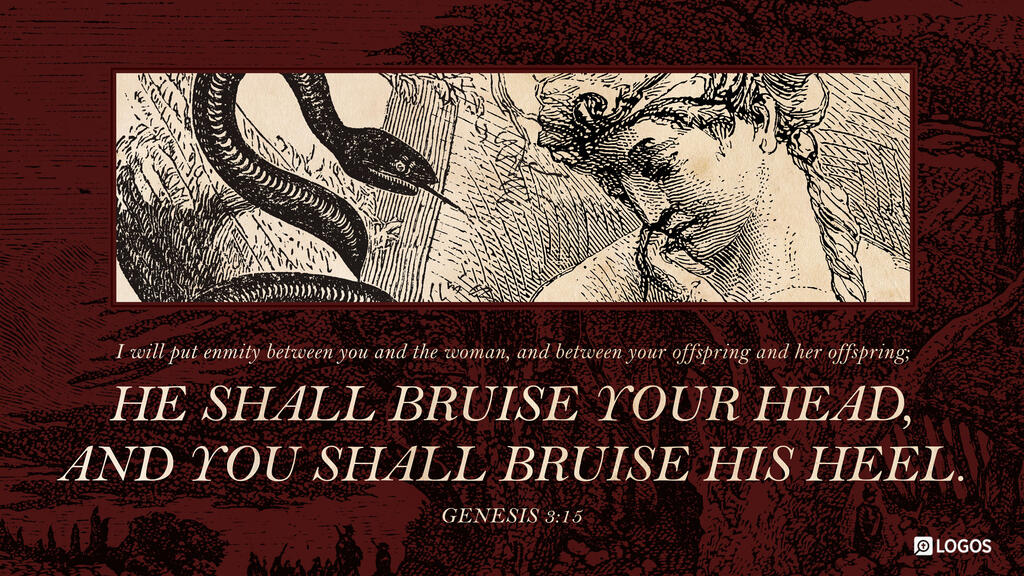
I will put enmity between you and the woman,
and between your offspring and her offspring;
he shall bruise your head,
and you shall bruise his heel.”
Copyright 2001 Crossway Bibles
NIVNew International Version (2011)
And I will put enmity
between you and the woman,
and between your offspring and hers;
he will crush your head,
and you will strike his heel.”
Copyright 1973, 1978, 1984, 2011 Biblica, Inc.
CSBChristian Standard Bible
I will put hostility between you and the woman,
and between your offspring and her offspring.
He will strike your head,
and you will strike his heel.
Copyright 2017 Holman Bible Publishers
NLTNew Living Translation
And I will cause hostility between you and the woman,
and between your offspring and her offspring.
He will strike your head,
and you will strike his heel.”
Holy Bible, New Living Translation, copyright © 1996, 2004, 2015 by Tyndale House Foundation. Used by permission of Tyndale House Publishers. All rights reserved.
LEBThe Lexham English Bible
And I will put hostility
between you and between the woman,
and between your offspring and between her offspring;
he will strike you on the head,
and you will strike him on the heel.”
Copyright 2012 Lexham Press
KJV 1900King James Version
And I will put enmity between thee and the woman, and between thy seed and her seed; it shall bruise thy head, and thou shalt bruise his heel.
Public Domain