Exodus 1:15–21
The NET BibleOther versions
English
- NET The NET Bible
- DARBY 1890 Darby Bible
- ASV American Standard Version
- AV 1873 The Cambridge Paragraph Bible of the Authorized English Version
- CSB Christian Standard Bible
- D-R Douay-Rheims Bible
- ESV English Standard Version
- GW GOD’S WORD Translation
- GNB Good News Translation
- HCSB The Holman Christian Standard Bible
- KJV 1900 King James Version
- LSB Legacy Standard Bible
- LEB The Lexham English Bible
- MSG The Message: The Bible in Contemporary Language
- NASB95 New American Standard Bible (1995)
- NCV New Century Version
- NIrV New International Reader’s Version (1998)
- NIV New International Version (2011)
- NKJV The New King James Version
- NLT New Living Translation
- NRSVue New Revised Standard Version: Updated Edition
- RSV The Revised Standard Version
- RSVCE The Revised Standard Version, Catholic Edition
- TNIV Today’s New International Version
- YLT Young’s Literal Translation
Arabic
Czech
French
German
Hebrew
Hungarian
Italian
Korean
Latin
Portuguese
Russian
Simplified Chinese
Spanish
Traditional Chinese
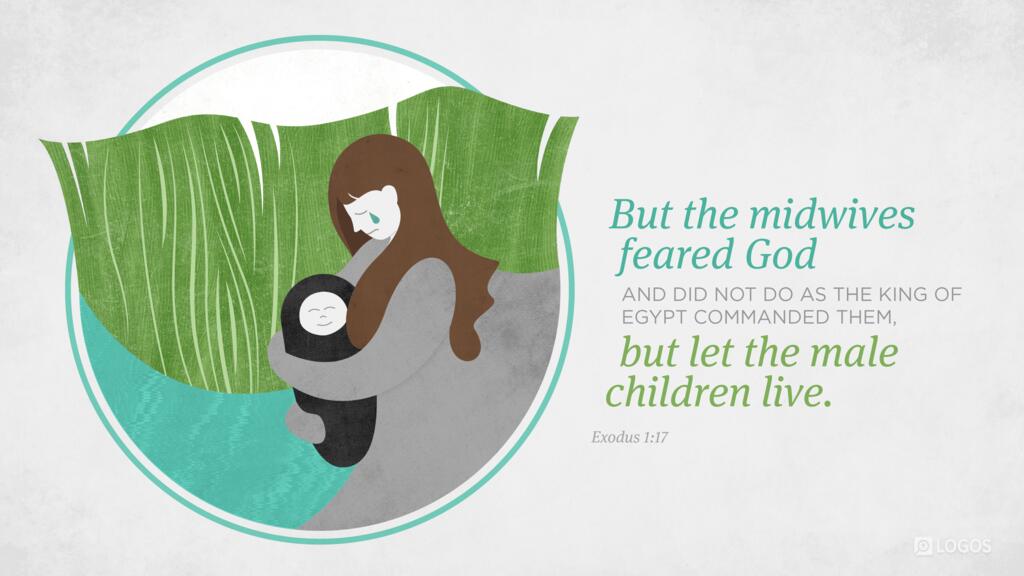
1:15The king of Egypt said40 to the Hebrew midwives,41 one of whom was named Shiphrah and the other Puah,421:1643 “When you assist44 the Hebrew women in childbirth, observe at the delivery:45 If it is a son, kill him,46 but if it is a daughter, she may live.”471:17But48 the midwives feared God and did not do what the king of Egypt had told them; they let the boys live.49
1:18Then the king of Egypt summoned50 the midwives and said to them, “Why have you done this and let the boys live?”511:19The midwives said to Pharaoh, “Because the Hebrew52 women are not like the Egyptian women—for the Hebrew women53 are vigorous; they give birth before the midwife gets to them!”541:20So God treated the midwives well,55 and the people multiplied and became very strong. 1:21And because the midwives feared God, he made56 households57 for them.
Footnotes
- 40 Heb “and the king of Egypt said.”
- 41 The word for “midwife” is simply the Piel participle of the verb יָלַד (yalad, “to give birth”). So these were women who assisted in the childbirth process. It seems probable that given the number of the Israelites in the passage, these two women could not have been the only Hebrew midwives, but they may have been over the midwives (Rashi). Moreover, the and do not take “Hebrew” as an adjective, but as a genitive after the construct, yielding “midwives of/over the Hebrews.” This leaves open the possibility that these women were not Hebrews. This would solve the question of how the king ever expected Hebrew midwives to kill Hebrew children. And yet, the two women have Hebrew names.
- 42 Heb “who the name of the first [was] Shiphrah, and the name of the second [was] Puah.”
- 43 The verse starts with the verb that began the last verse; to read it again seems redundant. Some versions render it “spoke” in v. 15 and “said” in v. 16. In effect, Pharaoh has been delayed from speaking while the midwives are named.
- 44 The form is the Piel infinitive construct serving in an adverbial clause of time. This clause lays the foundation for the next verb, the Qal perfect with a vav consecutive: “when you assist … then you will observe.” The latter carries an instructional nuance (= the imperfect of instruction), “you are to observe.”
- 45 Heb “at the birthstool” (cf. , , ), but since this particular item is not especially well known today, the present translation simply states “at the delivery.” Cf. “delivery stool.”
- 46 The instructions must have been temporary or selective, otherwise the decree from the king would have ended the slave population of Hebrews. It is also possible that the king did not think through this, but simply took steps to limit the population growth. The narrative is not interested in supplying details, only in portraying the king as a wicked fool bent on destroying Israel.
- 47 The last form וָחָיָה (vakhaya) in the verse is unusual; rather than behaving as a III-Hey form, it is written as a geminate but without the daghesh forte in pause ( §76.i). In the conditional clause, following the parallel instruction (“kill him”), this form should be rendered “she may live” or “let her live.”
- 48 Heb “and they [fem. ] feared”; the referent (the midwives) has been specified in the translation for clarity.
- 49 The verb is the Piel preterite of חָיָה (khaya, “to live”). The Piel often indicates a factitive nuance with stative verbs, showing the cause of the action. Here it means “let live, cause to live.” The verb is the exact opposite of Pharaoh’s command for them to kill the boys.
- 50 The verb קָרָא (qara’) followed by the lamed (ל) preposition has here the nuance of “summon.” The same construction is used later when Pharaoh summons Moses.
- 51 The second verb in Pharaoh’s speech is a preterite with a vav (ו) consecutive. It may indicate a simple sequence: “Why have you done … and (so that you) let live?” It could also indicate that this is a second question, “Why have you done … [why] have you let live?”
- 52 See further N. Lemche, “ ‘Hebrew’ as a National Name for Israel,” 33 (1979): 1–23.
- 53 Heb “they”; the referent (the Hebrew women) has been specified in the translation for clarity.
- 54 Heb “before the midwife comes to them (and) they give birth.” The perfect tense with the vav consecutive serves as the apodosis to the preceding temporal clause; it has the frequentative nuance (see §112.oo). The point of this brief section is that the midwives respected God above the king. They simply followed a higher authority that prohibited killing. Fearing God is a basic part of the true faith that leads to an obedient course of action and is not terrified by worldly threats. There probably was enough truth in what they were saying to be believable, but they clearly had no intention of honoring the king by participating in murder, and they saw no reason to give him a straightforward answer. God honored their actions.
- 55 The verb וַיֵּיטֶב (vayyetev) is the Hiphil preterite of יָטַב (yatav). In this stem the word means “to cause good, treat well, treat favorably.” The vav (ו) consecutive shows that this favor from God was a result of their fearing and obeying him.
- 56 The temporal indicator וַיְהִי (vayéhi) focuses attention on the causal clause and lays the foundation for the main clause, namely, “God made households for them.” This is the second time the text affirms the reason for their defiance, their fear of God.
- 57 Or “families”; Heb “houses.”
The NET Bible First Edition, Copyright 1996-2005 by Biblical Studies Press
In other versions
ESVEnglish Standard Version
Then the king of Egypt said to the Hebrew midwives, one of whom was named Shiphrah and the other Puah, “When you serve as midwife to the Hebrew women and see them on the birthstool, if it is a son, you shall kill him, but if it is a daughter, she shall live.” But the midwives feared God and did not do as the king of Egypt commanded them, but let the male children live. So the king of Egypt called the midwives and said to them, “Why have you done this, and let the male children live?” The midwives said to Pharaoh, “Because the Hebrew women are not like the Egyptian women, for they are vigorous and give birth before the midwife comes to them.” So God dealt well with the midwives. And the people multiplied and grew very strong. And because the midwives feared God, he gave them families.
Copyright 2001 Crossway Bibles
NIVNew International Version (2011)
The king of Egypt said to the Hebrew midwives, whose names were Shiphrah and Puah, “When you are helping the Hebrew women during childbirth on the delivery stool, if you see that the baby is a boy, kill him; but if it is a girl, let her live.” The midwives, however, feared God and did not do what the king of Egypt had told them to do; they let the boys live. Then the king of Egypt summoned the midwives and asked them, “Why have you done this? Why have you let the boys live?”
The midwives answered Pharaoh, “Hebrew women are not like Egyptian women; they are vigorous and give birth before the midwives arrive.”
So God was kind to the midwives and the people increased and became even more numerous. And because the midwives feared God, he gave them families of their own.
Copyright 1973, 1978, 1984, 2011 Biblica, Inc.
CSBChristian Standard Bible
The king of Egypt said to the Hebrew midwives—the first, whose name was Shiphrah, and the second, whose name was Puah—“When you help the Hebrew women give birth, observe them as they deliver. If the child is a son, kill him, but if it’s a daughter, she may live.” The midwives, however, feared God and did not do as the king of Egypt had told them; they let the boys live. So the king of Egypt summoned the midwives and asked them, “Why have you done this and let the boys live?”
The midwives said to Pharaoh, “The Hebrew women are not like the Egyptian women, for they are vigorous and give birth before the midwife can get to them.”
So God was good to the midwives, and the people multiplied and became very numerous. Since the midwives feared God, he gave them families.
Copyright 2017 Holman Bible Publishers
NLTNew Living Translation
Then Pharaoh, the king of Egypt, gave this order to the Hebrew midwives, Shiphrah and Puah: “When you help the Hebrew women as they give birth, watch as they deliver. If the baby is a boy, kill him; if it is a girl, let her live.” But because the midwives feared God, they refused to obey the king’s orders. They allowed the boys to live, too.
So the king of Egypt called for the midwives. “Why have you done this?” he demanded. “Why have you allowed the boys to live?”
“The Hebrew women are not like the Egyptian women,” the midwives replied. “They are more vigorous and have their babies so quickly that we cannot get there in time.”
So God was good to the midwives, and the Israelites continued to multiply, growing more and more powerful. And because the midwives feared God, he gave them families of their own.
Holy Bible, New Living Translation, copyright © 1996, 2004, 2015 by Tyndale House Foundation. Used by permission of Tyndale House Publishers. All rights reserved.
LEBThe Lexham English Bible
And the king of Egypt said to the Hebrew midwives—of whom the name of the one was Shiphrah and the name of the second was Puah—and he said, “When you help the Hebrews give birth, you will look upon the pairs of testicles; if he is a son, you will put him to death, and if she is a daughter, she will live.” But the midwives feared God, and they did not do as the king of Egypt had said to them. They let the boys live. And the king of Egypt summoned the midwives, and he said to them, “Why have you done this thing and let the boys live?” And the midwives said to Pharaoh, “Because the Hebrew women are not like the Egyptian women, because they are vigorous; before the midwife comes to them, they have given birth.” And God did the midwives good, and the Israelite people became many and were very numerous. And so because the midwives feared God, he gave them families.
Copyright 2012 Lexham Press
KJV 1900King James Version
And the king of Egypt spake to the Hebrew midwives, of which the name of the one was Shiphrah, and the name of the other Puah: And he said, When ye do the office of a midwife to the Hebrew women, and see them upon the stools; if it be a son, then ye shall kill him: but if it be a daughter, then she shall live. But the midwives feared God, and did not as the king of Egypt commanded them, but saved the men children alive. And the king of Egypt called for the midwives, and said unto them, Why have ye done this thing, and have saved the men children alive? And the midwives said unto Pharaoh, Because the Hebrew women are not as the Egyptian women; for they are lively, and are delivered ere the midwives come in unto them. Therefore God dealt well with the midwives: and the people multiplied, and waxed very mighty. And it came to pass, because the midwives feared God, that he made them houses.
Public Domain